

Album Review: 5786 AM: Easy Listen by Mach-Hommy
Some of the densest, funniest writing of Mach-Hommy’s career is locked on a physical-only record built to keep most people out.
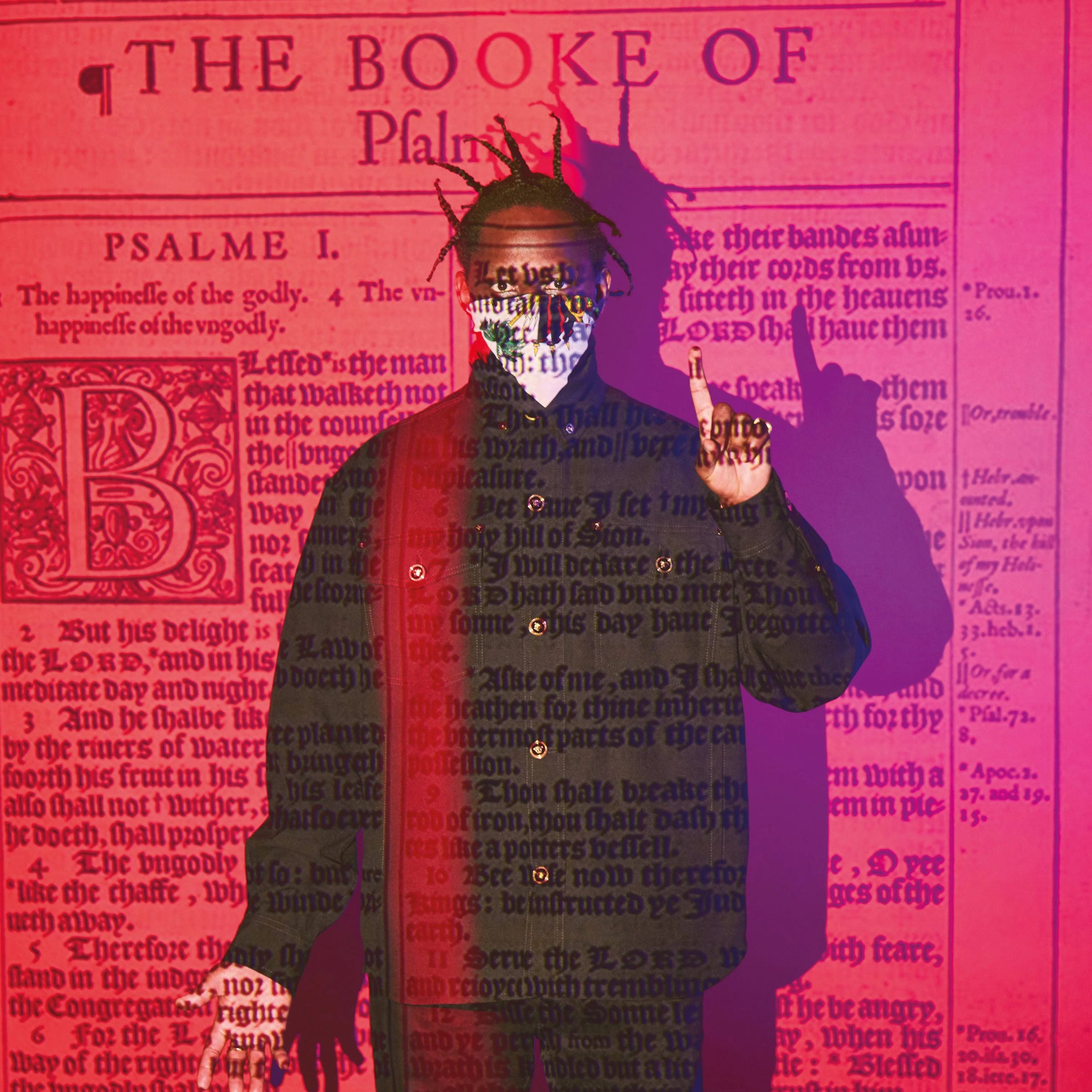
The rapper who sells his LPs like fine art and rarely has his catalog streaming isn’t chasing the algorithm, and this new record directly names the joke stone-faced. 5786 AM: Easy Listen comes out on a limited LP and cassette run with no standard rollout; its title juxtaposes the Hebrew calendar year against the Latin phrase for the age of the world. Easy listening isn’t at all what’s offered. Mach-Hommy, who claims Newark and Haiti as his own, has spent the last ten years dropping verses so dense and so many of them are referential that at least a casual listen barely gets at them, and throughout these thirteen Playa Haze-produced front-to-back tracks, he elevates the challenge further and laughs while doing so.
That challenge is clear in “Name, Image, Likeness,” where he piles the boasts on so thickly that they continue to fold over onto each other, Mach moving from a hickey to a plus-sized suit to “Hot shit coming quicker than a ride or die on the jitney” before anything settles. He runs an entire Eddie Murphy routine in the verse and tells a woman to refer to him as Prince Akeem before swinging the globe around, “and land on we’s like Eddie.” Then, the hook evolves into near-scripture: “I am the coin where the light of God shines through/‘Cause God and I are one and not two.” He traverses the gamut from a Coming to America bit to divinity in the span of less than one breath and doesn’t pause to flag the shift.
Violence isn’t ever explicit but always implicitly folded into punchlines and household debris, no more evident than on “The Fifth Hammer,” where the word “hammer” is used in reference to the lap, jeans, armrests, underneath the seat, the mother of his children and his peeps, the neighbors’, every possible setting he can conjure, with a firearm stowed away in every nook and relationship he lists. “I used to go bananas, now I’m ceramic on Tropicana,” he says, weaponizing a firearm as a punchline, again, and again, and again; Doley Bernays responds, with something colder and more meticulous: a gun by the bedside, a rat by the other one, the last guy who tried to grab it has “turned his ass to ash” and the gun tossed “in the sky like LeBron at the pre-game,” his most incisive boast comes when the gun is buried within the silverware drawer: “Deuce five under the napkin right next to the rigatoni/’Cause what happened to Tony?” He then steps out of the song to ask in a deadpan: “(Is that fucking part of the hook?)” The threat has been defused without losing any power; he revisits the toaster on “When Putsch Comes to Shove,” aimed at “approachable heat makers,” industry leeches that he has always avoided.
A rapper so protective of his own territory gives his guest verses ample room, and a couple of them make the best moments of the night out of it. Spook closes out “The Twelfth Pound” with a verse that morphs the rap game into a tech swindle, then into a history lesson, beginning with a gross SEO and an insult to the algorithm and landing in a dead, stark finish: “White people do capitalism like that/They cut a check with clockwork, I met my newest cousin/It’s Black people do capitalism like this.” Mavi slides onto “Pre Dawn Chong” midway through myth, Prometheus falling and an eagle ripping out a liver, then “You can see my divine Fibonacci curve in your spine,” ending by skittering out of the way with “Solve your puzzle for the day like Lauren London on the skates,” a verse too frenetic to summarize. Even Blu’s “Jolly Good” turns a period of financial struggle into tongue-twisting comedy: “Finance fiance left me cause my finances was fishy/But now my fists be extra fit when they fit me.” Mach holds his own throughout them and is relaxed enough to allow his guests to win the round repeatedly.
Three songs have no rapping at all, just a Playa Haze beat and someone speaking over it. They don’t feel like fillers. “Price of a Kilo” opens a man at a table piled with African foods that colonial officers referred to as filthy and primitive, the same voice noting that teff, an ingredient in injera, now costs ten pounds per kilogram in London and is touted as a gluten-free panacea. “Memento Vivere” is shorter and more direct, a sample to not expect life to be on its own. “Smarty Pants” takes us on a tour of the Arawak genocide as the sample describes it; a few million people on the island in 1492 became fewer than 100,000 ten years later, before the sample returns “cannibals” to those who first used it as an insult.
Two verses get lost in their own wordplay. “Like Fork” chants “Cutting, everything cutting” above a verse so associative that it falls apart when handled, and parts of “Convex to the Origin” load paradox on paradox to the point of meaninglessness. When Mach travels this far into sonic exploration that leaves sense behind, his songs become beautiful and elusive.
Despite all the wordplay, the swagger keeps showing. Over the chorus of JAŸ-Z’s “Where I’m From,” he swaps “I’m from where niggas pull your card” for a barbershop debate “about who’s the best MCs: billy, Z, or mine?” billy woods, JAŸ-Z, and Mach; three names rolled off without a pause. He weaves Creole into the same bragging, “Where I’m from they don’t say ‘Sak Pase’ back,” and then, sitting underneath all of that, his simplest sentence: “We spent about five summers straight with the lights off/I fetched my mom a purse.” Similar, on “Convex to the Origin,” the contradictions begin to split at ‘Shot my dog like O yellin now pray for him,’ and he circles back to that line like a reopened wound.
Great (★★★★☆)
Favorite Track(s): “The Fifth Hammer,” “The Twelfth Pound,” “Moxy Priest”