

Album Review: According To... by RJD2 & Supastition
On their collaborative effort, Supastition spends an entire album saying the things most rappers are too proud or too young to admit, and RJD2 builds every beat around that honesty.
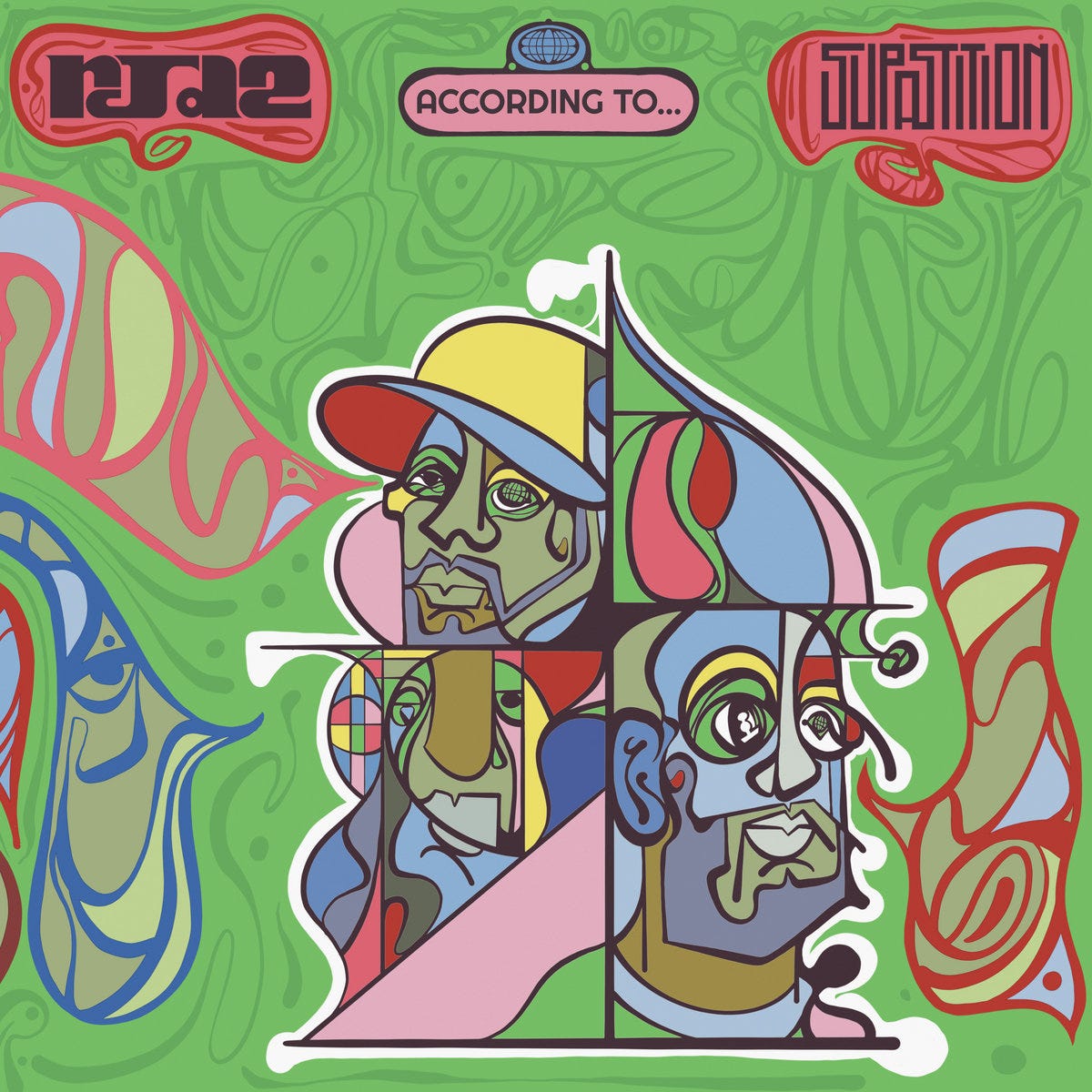
Most rap collaborations between a veteran producer and a veteran MC get announced with years of buildup, social media teases, tracklist reveals. According To... showed up the way Kam Moye and Ramble Jon Krohn have spent most of their careers showing up. Without much fanfare, distributed through their own channels, released on a Thursday in February while the rest of hip-hop chased algorithmic real estate. Moye, who records as Supastition, has been rapping since the late ‘90s out of North Carolina and then Charlotte and then Atlanta, collecting XXL write-ups and Source features and tour dates across a dozen countries, and somehow remaining the kind of artist people describe by listing all the famous rappers who respect him. Krohn, better known as RJD2, built his name through Deadringer on El-P’s Definitive Jux in 2002, produced for everyone from Aesop Rock to Mos Def, composed a theme song for Mad Men, formed Soul Position with Blueprint, released eight solo records, and at some point started soldering his own hardware. They’d been circling each other for years. RJD2 made the STS record in 2015. Supastition worked with every backpack-era producer who ever mattered. It took until now for the two of them to fill an entire album together, and the finished product suggests they should have done it a decade ago.
Late-career underground rap records tend to spend their first half relitigating an artist’s place in hip-hop history. Supastition does some of that here, and he’s good at it, but the bulk of these twelve songs are about the daily, tedious, infuriating grind of being a Black man in his forties with children and bills and friends who drain him and an ex-girlfriend who just got engaged to somebody else. “Six figures feels like ditch digging,” he raps on “Machines Like Us.” Cubicles aren’t beautiful. Your salary is what they pay you to forget your dreams. The only thing that gets a raise around here is your blood pressure. You’re a measurable metric on a spreadsheet, and if you die tomorrow, they’ll sign a couple of sympathy cards and post your position by the following week. He’s rapping about the plain, stomach-turning math of corporate employment, the kind of detail you get from somebody who has actually sat in that chair and watched the clock.
Then he pivots from the office to the kitchen on “Wins and Losses.” He wants to turn W’s into a W-2. His cousin sold drugs, went to prison, came home, started a business. Supastition just wants a scratch-off. Life comes at you like a Jordan Hicks fastball. His pockets don’t have to be JAY-Z, at least Black Thought. And then the line that splits the song open: “Maybe God don’t want me to be a millionaire.” He goes back and forth, says he doesn’t need to be rich, just comfortable. Then admits he’s watched the way his kids eat lately, and comfortable won’t cut it. That admission sits in the song like a stone in your shoe. He’s doing the math out loud, in real time, and the numbers aren’t adding up.
The album’s most purely entertaining moment comes on “Bittersweet,” when his ex gets engaged. He’s furious at both of them. She told him he couldn’t fix a broken man, and he knew she had a point. He borrowed money from her and didn’t have a reliable car. But when he finally got himself together, it was supposed to be them. So he hopes the world ends on her wedding day. He prays for thunderstorms on her honeymoon. He hopes the pastor gets stuck in traffic, hopes her mama and daddy object, hopes her heel breaks. No physical harm, he says that himself, he’s just pissed. And it keeps going. The girl, his ex hates from work, the one she calls toxic, he saw her shopping last week, thinks she’s trying to get with him. He hopes they apply for a home loan together, and the bank turns them down. He hopes the DJ plays nothing but boom bap at the reception. Even he can’t help himself: “That’s super petty, right?” Every rapper alive has made a breakup song. Almost none of them have the nerve to be this small about it, this detailed in their spite, this willing to let themselves look ridiculous. The pettiness is so precise it circles back around to something painfully real.
Deeper in, on “The Mourning After,” Supastition talks for a long time about his father. The intro is spoken and unsteady. Rough year, holding things inside, hasn’t talked to people about it. He says he carried trauma without being taught how to process it, just taught to move on. Depression said goodbye and anxiety showed up. Depression had been emptiness, nothing left, his whole world gone flat. Anxiety was the opposite, everything mattering at once, everybody needing him, stress like a slow suffocation. Every week, every month, somebody he loves dying. He’s growing numb to it all. The second verse goes further. His real father never raised him, left his son, then resurfaced two weeks before dying from a massive stroke. The one person Supastition had spent years wanting to meet had no ability to speak. He stared into the face of a stranger on his deathbed and felt nothing, because all he’d ever known about the man was his name. Then he found out he had a sister he never knew existed, and his father had been telling the sister for years that they were keeping in touch. The lie within the abandonment.
“I forgive you for your trash ways, I pray that you repented in your last days.”
And then, just when he thinks he’s found some closure: “Now I gotta add another chapter to a closed book.” Most albums would bury a confession like this in a single verse or a bonus track. Supastition gives it the longest emotional real estate on the record, and every second of it justifies its space by refusing to package grief into anything digestible.
Outside of the heavy material, Supastition takes stock of his friendships on “Reset (Better Friends)” and finds almost all of them lacking. One friend is a pessimist who drags every room’s energy through the floor. Another has a rotating collection of pyramid schemes. One’s a narcissist. One’s a conspiracy theorist wearing a tinfoil hat. One is such a picky eater they can’t even grab dinner together. He runs through these people with the weary affection of somebody who has tried, for years, to hold on to bonds that no longer fit his life, and finally has to say it out loud. His marriage changed him, his free time vanished, and BBL models are all his friends seem to care about. He doesn’t resent them, but he’s tired.
Through all of this, he keeps returning to his place in hip-hop, and these passages carry a different charge because they’re surrounded by so much domestic and professional reality. “One Last Time” has him saying he might not be the top three artists you hear, but his kids call him father of the year, and that’s a Lex Luthor flex. Who the best MC is isn’t his fight. He just writes the lines that felt the best. “Expiration Date” goes harder on the bitterness. Producers he used to work with told him he was a waste of beats, and critics treated him and J-Live like stray cats. And then “Carte Blanche” flips the mood entirely. He tells the story of running into his favorite rapper, telling the guy he’s a legend, and the rapper responding, “You a legend yourself.” Ever since that moment, he bet on himself.
There’s a quiet satisfaction in those bars, the kind that belongs to somebody who stopped measuring himself against an industry that never intended to pay him back. He’d already said it on “Back Talk,” the album’s opener, asking whether the artists you’re listening to are cowards or martyrs, noting that rap went from inventing new styles to bending the truth. J-Live shows up on “Expiration Date” and matches the energy with a verse about getting better as an old pro by saying things he didn’t even know years ago. Both of them deliver with conviction, and neither one carries a whiff of trying to collect credit.
RJD2 built every track here at Dustbowl Studios in Columbus and kept the production warm, spacious, and consistently out of Supastition’s way. The beats borrow from the boom-bap tradition without turning into museum pieces; they bump and move and leave wide lanes for the vocals to breathe. When the songs get heavy, the instrumentation pulls back. The more aggressive cuts hit harder, drums punching through. “Beasts Per Minute” gets the blood moving the way a good DJ set does, Supastition half Human Torch, half tortured soul, hoping his mama gets to see her son get there. Krohn has spent thirty years learning how to match a rapper’s energy without smothering it, and the record benefits enormously from that restraint. He just needs the pocket to be right, and it almost always is.
STS drops in on “Rent Money” for a guest verse about blowing bill money on Gucci, admitting he’s clinically diagnosed as an onomaniac, choosing new shoes over fresh food and hitting the drive-thru incognito. Supastition matches him. Scientific studies say the best way to cope with a terrible day is buying retro Jordans. They might be broke, but they aren’t poor. His mama keeps asking about the sneakers. Grocery bills are doubling the increase in sneaker prices.
“Judge me not, my budget’s shot, this my coping mechanism.”
There’s a whole generation of men in their thirties and forties who will hear that song and feel personally called out, and that’s not an accident.
The album closes on “A Beautiful Ending,” a long, careful goodbye. Supastition addresses his children, asks their forgiveness for the times he pushed too hard and came up short. He talks about a friend who died—thirty years of brotherhood, gone on a Tuesday morning. He says he can’t name one person more qualified to be an angel, and then admits he’s been struggling since the death, caught somewhere between motivated and depressed, questioning how much time he has left. The song is dedicated to Eric Hood and Eric Powell, by name, both gone. His father went two weeks before death without the ability to speak. The one closed book in his life already has a new chapter growing out of it, uninvited.
Great (★★★★☆)
Favorite Track(s): “Wins and Losses,” “The Mourning After,” “Bittersweet”