

Album Review: Blood of the Lamb by Mickey Diamond & Big Ghost Ltd
Mickey Diamond spends the record questioning free will and who painted Jesus white. The doubt, not the scripture-as-flex, gives these twelve tracks their weight.
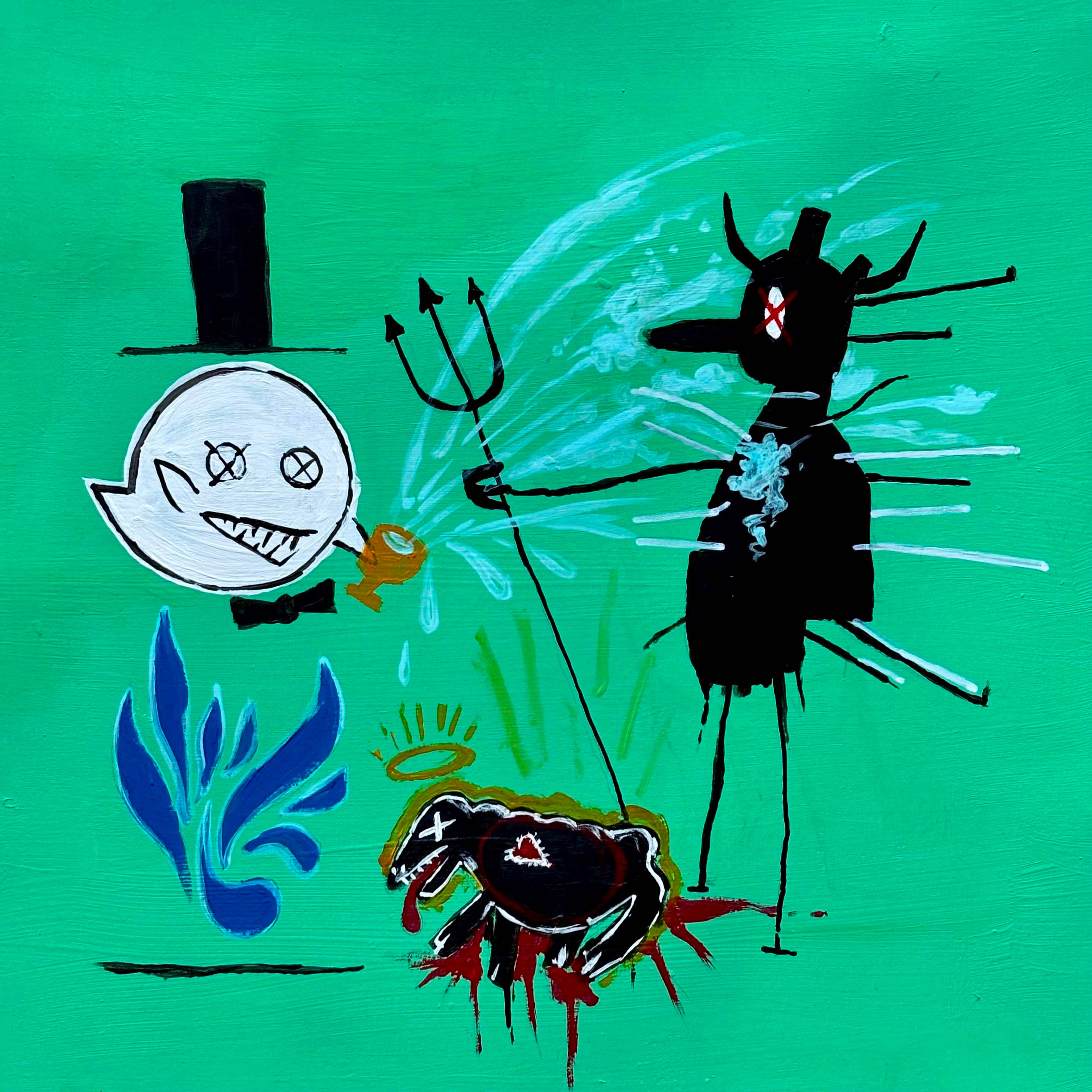
After only just over a year, having three albums in a year under the same producer can surely strain any partnership to breaking point. The three-album run that Big Ghost have just completed sticks to the same one soul-and-gospel lane and one raw voice for the whole duration, without ever venturing into any form of melody. That voice is that of Mickey Diamond, one of the most fertile underground rappers that Detroit has produced this decade, and one thing he does on this last chapter, which he mostly sidesteps elsewhere, is to argue. Scripture permeates the vernacular throughout; communion, stigmata, holy water, the lamb’s blood all refer to money, loyalty, paranoia, grief, Mickey mid-flex is always questioning aloud the veracity of anything, and everything said.
The question marks arise loudest on “Communion,” where Mickey states a commandment and immediately questions the integrity of it. “Thou shall not take another man’s life,” Mickey states before immediately throwing out the part missing from the catechism: “What if he had it coming? Can I ask for forgiveness?” Mickey isn’t sure that you can promise something without meaning it, and that it can count as repentance. “Promise, but I don’t mean it, does that pass for repentance?” The verse continued until he reached a question to which there is no easy response: “They painted Jesus white, so how are we the chosen people?” This arises out of the honest bewilderment of one brought up within a faith attempting to square it with the reality of a world that dictated it to him.
It becomes a full argument over the people making money in the name of God on “Lamb’s Blood,” when his argument is redirected from The Almighty to the people who are gathered under His name. Mickey opens the track with, “I’m not one of those guys that know the Bible by heart.” He then goes on to present Sunday School teachers with questions they may struggle with: Who created hell if God created heaven? Why were we handed free will, then why are we surrounded by sin? Why were we made to suffer four hundred years of slavery? And then gets down to the more tangible questions: “He can drive any car, why the pastor need a Benz?/Why the pastor never broke? Why the pastor house so big?/Eight bedrooms, they don’t even got no kids.”
For all the questioning, Mickey never escapes the street concerns that necessitated those questions. “Cold Sweats” begins on a guy waking “cold sweating and screaming” to find a devil sitting on his back; it cuts to a street shooting that caught the wrong man on the wire; it continues with the witnesses who take ten grand and still testify; it’s followed by a verse about a buddy who’s doing life; the hook delivers the gospel, plain and simple: “In the end karma catches up to all.” “Break Bread” transmutes the familial notion into a warning; “Keep the wolves fed/Hunger lead to bloodshed,” the hook cautions before a full prison sentence enters the story, a kid who’s still young when he goes in, who gets out old, whose girl’s gone and the visits stop; the lesson his mother imparted on the way in is recalled. He delivers a final word that’s arguably the simplest here, “Do something different with your life.” He just says it, flat out; that one point in the album where the writing stops pretending to do something and just speaks.
By the back stretch of the record, the armor comes off completely. “Erick’s Sermon” is a direct ode to his father, centered on a recorded phone conversation where Mickey tells his half-asleep dad that he’s written a song about him in the form of his naming it after the EPMD rapper/producer; in the verses Mickey unpacks every defense he’s raised up throughout the record: “My father walked a crooked path so I could fly straight;” “So as your only son I vow to never let him down.” He explicitly names him at the close, Erick Robinson, lest there be confusion about who this all means to him. And “Holy Water,” several cuts prior, contains the moment it’s most difficult to shrug off. What begins as a prayer of thanks ends on Mickey’s recounting of his infant son finding his gun under the sofa and firing it off, of the shot grazing his own head before bouncing harmlessly off the wall, of his kid who should have died. He relays it as fact, matter-of-factly, without Bible verses or sermons to buffer the story, as a father still processing the narrow margin by which he escaped killing his own child.
Great (★★★★☆)
Favorite Track(s): “Communion,” “Lamb’s Blood,” “Erick’s Sermon”