

Album Review: Blue Island by Ravyn Lenae
On her second album with Dahi executive producing, the Chicago singer moves from character studies into first-person accounts of leaving that put a calendar on every romance.
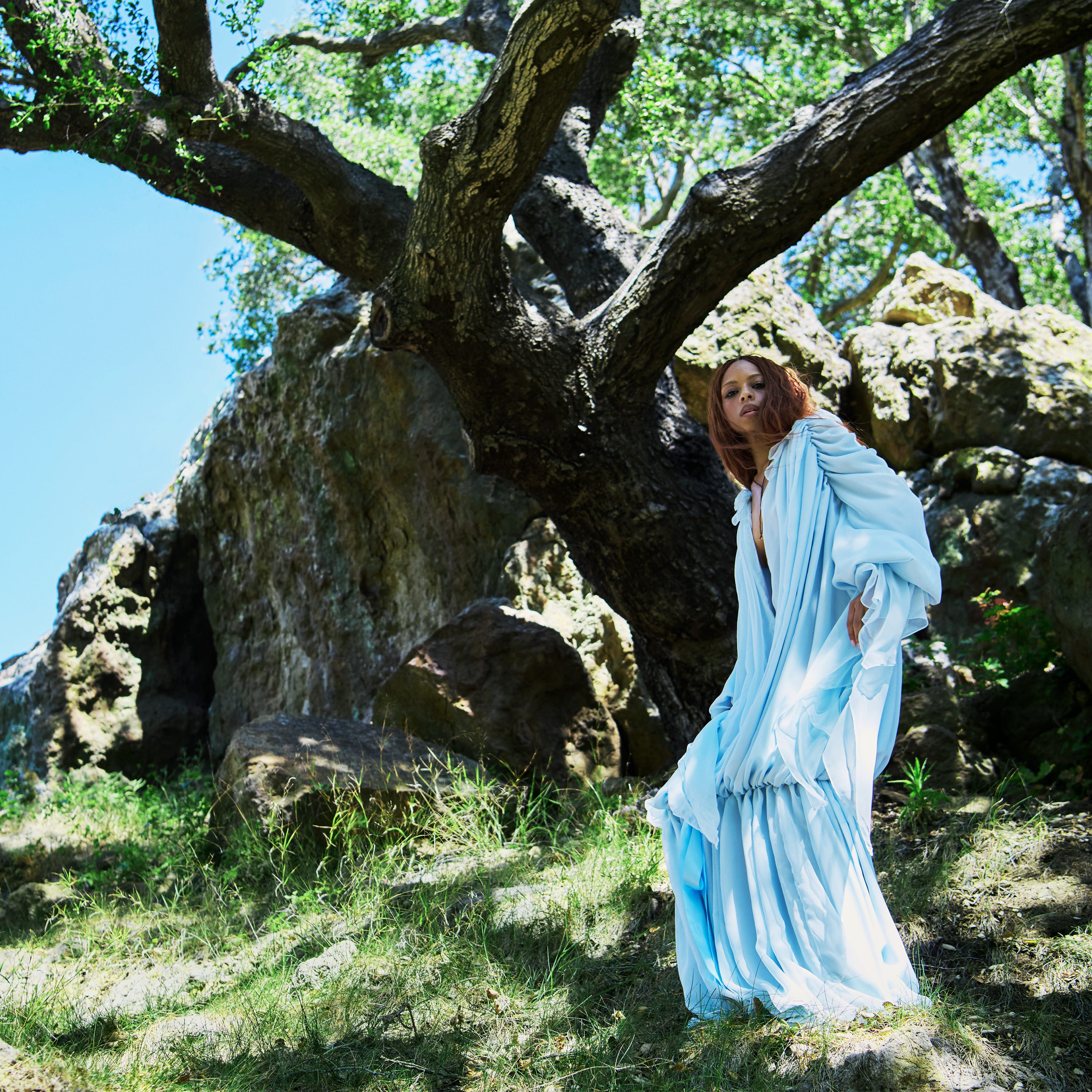
Smino and Monte Booker were at work in Chris Classick’s Humboldt Park studio before they had much to their name. It was there in 2015 that Ravyn Lenae (a then-sophomore from the Chicago High School for the Arts) put down her own money for a session. She left with Moon Shoes, made it available as a free download, and an Atlantic deal came of it. For the most part, Booker would produce what followed. Steve Lacy was on hand for Crush in 2018; she was yet to complete high school when she opened for Noname and SZA. When Hypnos was out, she had made her way to Los Angeles to put in time with Lacy and KAYTRANADA. There is Bird’s Eye and Dahi (a year later, “Love Me Not” would go viral on TikTok), who has a stockpile of beats and will, as she puts it, something at odds with a singer to whatever melody he is handed. He also produced and executive-produced Blue Island in its entirety. The material she has put over him is not the same approach one would expect after what she told Complex in 2018: “None of my songs are actually me, they’re characters I’ve created.” These days she writes as herself.
“Familiar Dreams” is introduced by Lenae with a count, “It’s been a year and two weeks,” and she will have none of that figure for the remainder of the track. It has not ceased to feel as it once did even though he is nearly a stranger, so she lists off where they might come together, be it on a runner’s course or at the liquor store he does not frequent any more. On “Saturday Night,” the number is a self-imposed curfew, “I’ll take my chances, make it home by 3,” and true to her word she leaves without the man across the room who has been watching her look like the time of his life. She counts into the funky “Handle,” “Two, three, four,” and wants to know if anyone can hold on in the undertow with her.
Some men need to be told by her what they are waiting for. A glance would have done it, but they shy away. Others will have her running and show up when he sees fit, well aware she cannot pin him down. And when one holds on too hard as if to keep some unspoken thing in check, she is the one asking him twice to put a name to it.
The only other voices you are likely to hear are Dominic Fike and Doechii. Fike is given the lion’s share of space and makes use of it to put himself in a corner. On “Reputation,” he has the refrain and vows to be loyal to a fault, “Like a dog, just like a dog,” putting her first. Later he is in a room as dark as can be with a stereo and a drink, conceding that she and he gave up on each other with equal ease. He says let them polygraph him, calls it typical to go around saying he is a polygamist, and eventually has to make amends with Ms. Jackson. But the chorus has already seen to him: “You look so good, boy, when you lie.” First she says to him that his reputation is not one for her to alter, that he is the one who put it there and can be the one to put it right.
The melody is what Dahi puts his disruption to, so the words are left in her hands. With “Sew Me Back Together,” she wonders if he is capable of mending her before coming to rest on “Maybe love ain’t hard to measure,” a line as unremarkable as any. “Barriers” has her saying “This tension, I can’t take it anymore,” and indeed there is no place to go with it. One could call the writing on “Let Us In” surface-level. Four lines on the subject of knocking, rent due on a Friday and jumping about with friends is pretty much the sum of it.
Lenae was laughing when she discussed with The FADER at Governors Ball last June that anyone expecting the same song from her twice, “I’m not the artist for you.” She has no patience for him on “Bobby.” Staring up at the ceiling, she lets him know his stories are tedious and she is done putting on a show of climax for him, and then tells him to open his eyes and make haste. She is half out of there already. “In & Out” is where she applies that bluntness to herself, absolving herself of allowing some sad boy to get under her skin. She is a hazard only to herself, buckling her belt and walking a tightrope while the man on her mind is all over downtown. Doechii is in the same vein on “Babygirl,” proffering advice on how to put a flower in the pavement and have the courage to say you want to be saved, before inquiring in the next breath if she is in denial over being a boss.
When she was nine or ten, her grandmother gave her a guitar, but Lenae has been forthright in saying the practice required of it was no appeal to her then. A grandmother reappears in the closing of “Never Let Me Go” in a recorded call to a man she is calling Papa; she makes mention of needing Grandma to help with a line in a song and is told by her people they are proud. “Find It One Day” begins with pen and paper. The two of them live in the space between the lines, she says. What she couldn’t put to words is in a book and put away. She would like for him to come across it unawares. From an airplane she is looking for his house. As for “Wish You Well,” the work is done. She has taken him at his worst as a friend should, and money has a way of being revealing; soon enough the cracks let the water in.
On “Potential,” she wants to know if it happened at all without proof of it. He still comes around, and she is happy, but neither is being honest. Then she ceases to circle the issue. She had them in her mind growing old. Now she sees she was holding onto potential and at seventeen would have made of it what she could. The image is of a car in park that never moved, and she leaves it there at the start.
Great (★★★★☆)
Favorite Track(s): “Potential,” “Saturday Night,” “Bobby”