

Album Review: Born$aviiior by BlackMugen
BlackMugen spends fourteen tracks as a shinobi messiah at war with Satan, and he commits to the cosmology so completely.
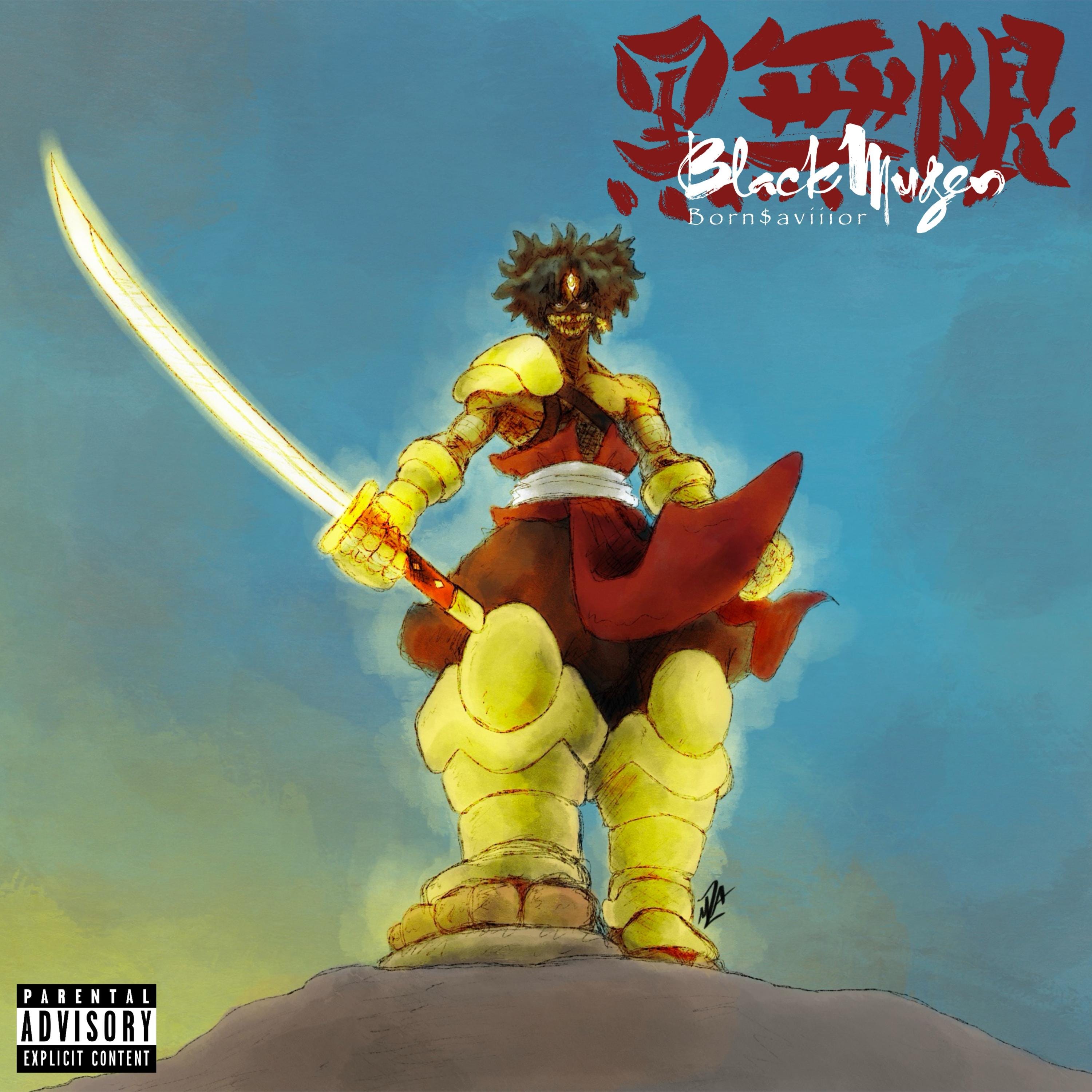
The Black$hinobi Clan operates on a platform that plays the role of a comic book logline and a Sunday sermon. A band of Asiatic warriors trained in ninjutsu and ancestral power; they’ve been sent to rescue the original people and to destroy the empire of the Devil. Through the album, the one warrior (BlackMugen) trains to be the savior of Satan and crowns himself with the prophecy. Black$aviiior is “the final chapter” to the battle with Satan, one warrior training to be the savior and possible fulfillment of the prophecy. Five Percent doctrine and Nation of Islam run this one; the legacy runs through Rakim, Brand Nubian, and Poor Righteous Teachers, where the Black man is God, and the devil is literal. Anime and martial arts films are the mythos; dragon masks, hypertime chambers, and “Mugen” glossed within the songs as being infinite. It’s weird that the two seem to merge seamlessly; the crack between sermon and anime never shows.
With a shinobi blade upon his back and a dragon mask upon his face, hands and feet wrapped in bandages, Mugen begins “Art of War” fresh from several months of jungle training against lions, tigers, and bears with no weapons. He states everything he’s saying as fact; there’s no hedging anywhere within these lines. His best line is a boast about being able to find flaws, “from as far as ninety-three million miles away; the same distance between the Earth and the sun.” He twists the statement into science and then back into a boast in two breaths. He’s always returning to a part of the thesis from the title song: “It’s been a hell of a journey to get to heaven/Learning that now is the greatest gift/That’s why it’s called the present.” The conclusion of that journey, however, rarely changes. On the war tracks, he’s still murdering Satan, unchaining the gods from their chains, tearing apart the slave master piece by piece, and naming himself the savior once again. It gets boring to hear the same sermon time after time, even for those who’ve bought into it.
On “Da2ndComiiing,” Mugen cycles through rhyme cyphers around the sun, then arrives at, “Indigo child become son of man;” followed by, “Hair like wool, skin the color of brass.” It uses the description of Christ found in Revelation to state that the original man was Black. These samples perform the same job as the rapping. “Born$aviiior” kicks off with a voice that declares that a Black man condemned by a white man is someone to get closer to, and ends with an exchange of the loving every man Jesus for the one who returns with a sword. The strongest passage of spoken word closes “Da2ndComiiing” where the new gangster is born not from the Italian blueprints, but as a new model of community protection and wealth building, the old gangster dying. Satan has an address, and Mugen doesn’t step out of the music to remind you it’s symbolic.
Mugen passes “Diiiv(eye)neFlow” to SHERM STX and AREX and gets two of the liveliest here in return, SHERM trading diamonds for the twelve jewels of life and reminds us that “No weapon formed against the God ever prospers,” AREX diving into a cosmic battle verse so dense it nearly leaves the planet, picturing himself in a hyperbolic time chamber while everybody is copying and pasting. Arkatype and Mugen exchange a round of fighting-game and martial arts wordplay over “$upreme Massacre”—blades in tissue, a roundhouse to gristle, a straightfaced “What’s Sun Tzu to a Shih Tzu?” Over “Magiiic,” the deity V uses an entire verse to describe space, suck stones from Orion’s belt, and gravitate toward fact more easily than anyone else in the room. The pointed one is Erick Purpose on “M(eye)nd of a Warriiior,” whose dropped mystique for street rage (”Fuck police immunity; every cop is a cancer cell”) and who goes after the gospel of good vibes: “All this talk about positive vibes rooted in money/If you don’t see the problem with that, I ain’t money.” The bench is deep, and it’s the guests’ variety of approaches that keeps a long set of war raps moving.
A true test of stamina, “Hieroglyphics,” at six minutes long, is dense with guest verses. What they share is a diversity of approaches. Mugen opens, stating that his words are “like hieroglyphics inscribed on the walls of the pyramids; Built by the ancestors still living within myself.” TYMAY delivers a racing, alliterative chant of internal rhyme that snaps shut: “Creating a history, solving a mystery/Stopping the gossip, changing the topic.” Lord Karu Villain gives an elegiac street verse about chasing waterfalls “on the side where lonely Negroes reside,” finding a dead pile of birds on the ground after a prayer, dropping religious wisdom to kids in the ghetto and questioning whether he is dropping a fable or fact. The sample does not move throughout any of the verses, as it fits a cipher, and at six minutes, it begins to wear thin.
The palette remains steady, purposefully so. Much of this beats feel like heavy, dark space, stripped of light, hard drums over low end thick enough to feel in the chest, KiiiNG MZA handling writing, mixing and mastering and hiding every seam between tracks, even as five other producers contributed. The shading exists on the fringes. Still Do makes “Art of War” hard-wired; eno-obong offers the album’s clearest light on “Da$ource,” and again on “DaChosenOne.” These are islands of brightness on a familiar, shadowed plain.
The armor actually makes the few delicate love songs stick. On “Da10thJewel,” he has a murmured conversation evolve into a love song that retains its celestial vernacular and directs it towards a singular entity-the one who counts only in terms of energy and time, the woman he addresses as the queen of his cosmos, the person reminding him, “True love starts with self/Without that, you can’t love nobody else.” He calls himself a lover of lovers, like Pac. Vows to stick with her to “infinity times ten to the seventy-six trillion power,” and addresses it to a wife not yet arrived. After the slaying of so many demons, his desire for something soft is the only time he puts his sword down.
What the armor was keeping from the world: Grief. The blood is present all throughout the entire record, as kinfolk unable to stomach his ascension, and on “M(eye)nd of a Warriiior” he states simply: “Received more real love from strangers than my own kin.” The cosmic map narrows by the end of the record, towards a family tree. On “DaChosenOne” he lays out Fred Hampton, Tupac, Nipsey Hussle, and Huey Newton as his guides before setting them aside for Susie, his great grandmother, an angel he thanks for saving him during his lowest lows, stating himself as Susie’s grandbaby for life, and ending the track with her voicemail; an old woman asking about him, reminding him to call back, and saying ‘all this love and stuff’. All of the dragon masks and the ninja blades, the record is strewn with, were built to protect the boy who saved that voicemail.
Great (★★★★☆)
Favorite Track(s): “Art of War,” “Diiiv(eye)neFlow,” “DaChosenOne”