

Album Review: BROWN by Chris Brown
On his 12th album, the R&B star buries five or six worthwhile songs under twenty-one that all want the same thing.
Twenty-seven tracks on a phone screen, and the scroll takes a minute. The first half runs on a loop. Bassline drops, a verse about getting someone undressed, a chorus that splits the difference between demanding and tender, then the next song does it again with slightly different drums. Within the album’s middle stretch the bedroom has become a setting so constant it stops registering, the way a smell disappears after you’ve been in the room long enough. Somewhere past the sixteenth track, Chris Brown, on his twelfth studio album, sings over a ‘90s-flavored hip-hop beat that he doesn’t know what love is. Then track eighteen starts, and the bedroom’s back.
The career math tells its own story. Brown debuted in 2005, when his first single made him the first male solo artist to enter the Hot 100 at number one since Montell Jordan a decade earlier; he was sixteen. Twenty-one years and twelve studio albums later, the selection lengths have moved in one direction. F.A.M.E. had 18 songs in 2011; Heartbreak on a Full Moon had 45 in 2017; Indigo had 32 in 2019. 11:11 arrived in 2023 at 22 tracks, then ballooned to 35 with a deluxe that won Best R&B Album at the 2025 Grammys. His Breezy Bowl XX Stadium Tour grossed nearly $300 million across 52 dates. He promised, before 11:11, that the era of bloated albums was finished. BROWN has 27 tracks.
The handful of songs worth returning to are the ones where Brown stops performing confidence. On “Hate Me,” he offers himself up as a punching bag with enough conviction that the self-destruction registers. A fog-driving metaphor on “Won’t Let Me Leave” holds for an entire verse without collapsing into a moral. “Colours” just asks for safety. But every one of them is buried past track 16, back-loaded behind a wall of bedroom propositions. The disposable material was put up front. Surviving it requires faith.
Metro Boomin opens the album on a different frequency entirely. The beat on “Leave Me Alone” runs on heavy 808s and a somber synth line mixed for a locked room at 2 a.m., claustrophobic trap closer to a Young Nudy opener than anything on an R&B album, production that suggests Brown might spend the next hour somewhere dark and complicated. He doesn’t. Not even close. The middle of BROWN is stocked with Hitmaka’s competent club pop, bright drums and dramatic piano snaps engineered for playlist placement, none of it bad enough to skip and none of it memorable enough to return to. The exception, buried at track 26, is “Holy Blindfold,” where Jon Bellion and The Monsters & Strangerz layer dream-pop textures over gospel-tinged harmonies and build extended wordless post-choruses where the arrangement finally has room to stretch—something close to patience, or at least the shape of it. The rest of the tracklist could have used a producer willing to wait.
Sex is the default setting, and most of BROWN‘s midsection was written on autopilot. “Honey Pack” and “#BODYGOALS” land on the same proposition from different angles (Hennessy and stamina on one track, Tank and a minimal bassline on another), with Brown arriving at “Penetratin’ slowly/Lovin’ your performance/So put that shit up on me,” words that could have been generated by a comment card. (Who is this for?) The sharpest case, and the most frustrating, is “Cry for Me.” It opens by asking a partner to shed real tears as proof the relationship mattered. That’s a sharp emotional premise, the idea that someone’s pain is the only evidence of love worth trusting. By the second verse it has collapsed into “You fuck me like a demon/One minute you moanin’/Next minute you screamin’,” and whatever the song was reaching for in its first thirty seconds is gone. Brown can write sex songs; he proved that years ago. Ten on one album, and the tenth is indistinguishable from the first.
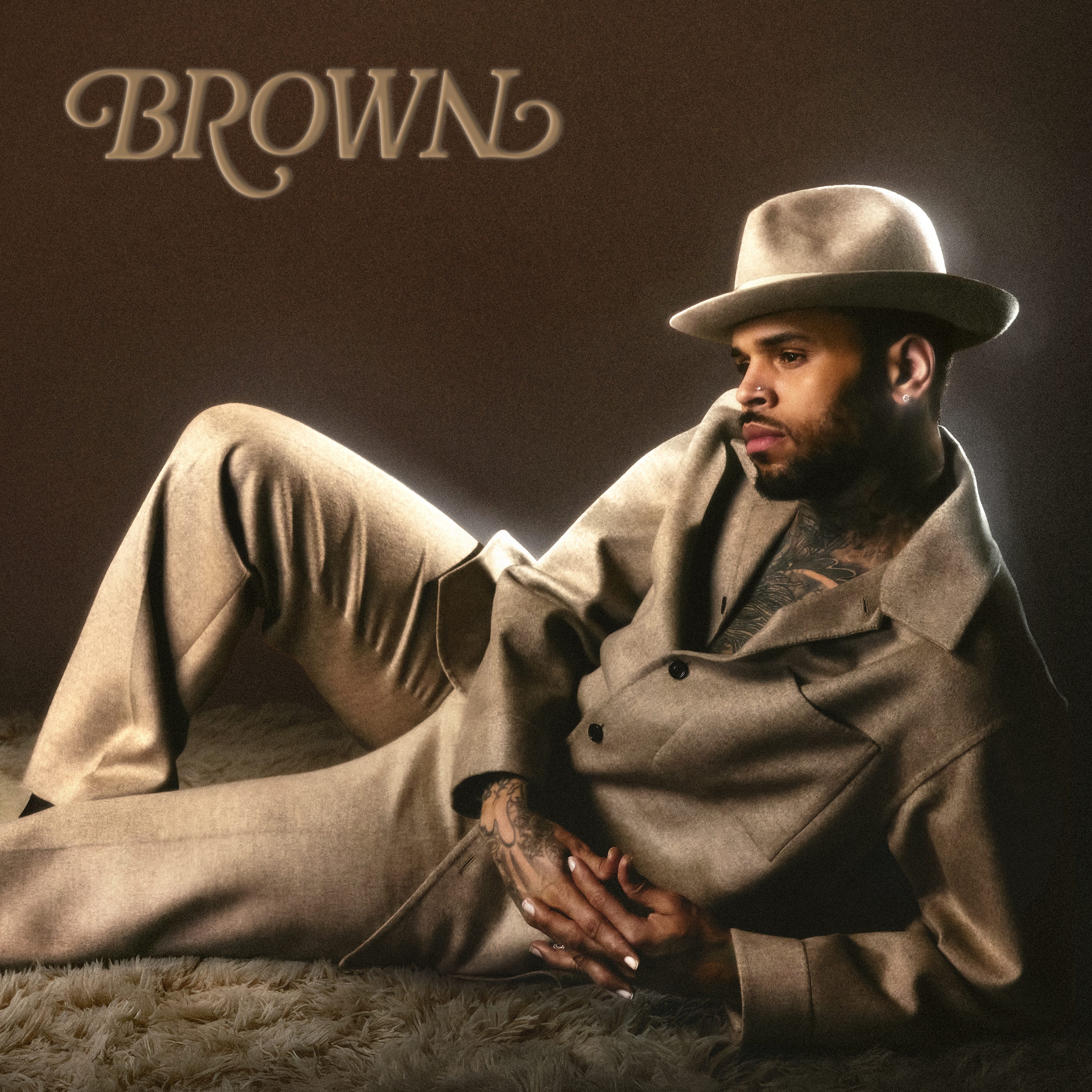
Thirty-seven years old, and this is the cover Brown chose. Reclining in a tan suit and fedora, a pose that mirrors Michael Jackson on Thriller and the R&B portraiture of Teddy Pendergrass and Luther Vandross, men who got the suit right on the first try. Inside the album, a different picture. Across the back half, Brown describes himself as a mess on one song, admits he’s scared of what he feels on another, sings about needing safety on a third, and compares his own devotion to poison he can’t quit on a fourth. At sixteen he was on top of the Hot 100. Now he’s on the cover dressed as a legend. Track 17 asks if he knows what love is.
Past track 16, the mood shifts. Beats slow down. The lyrics stop wailing to the bedroom, and Brown starts saying things that sound like they cost him to admit. Four or five songs in a row play as if someone edited the tracklist in half and kept the right ones. Then track 23 reverts to club music, and the closing stretch scatters between gratitude and resentment without choosing either. A shorter record was buried in here.
Too many songs. Everybody will say that about BROWN, and they’ll be right. But underneath the bloat is a stranger problem. What opens as a demand to be left alone becomes, over twenty-six more songs, an album made almost entirely of invitations to stay the night, with the one genuine confession wedged at track 17 between a honey pack and a drowning metaphor. By the time “What’s Love” arrives, the answer has already been given a dozen ways over. Brown writes songs that admit he doesn’t know what love is, but he still buries them under twenty that pretend he does.
Slightly Below Average (★★½☆☆)
Favorite Track(s): “What’s Love,” “Holy Blindfold”
Hitmaka Had nothing to do with "Leave Me Alone" so stop the cap! Ken Will is the writer and only producer for the record. Metro Boomin, and Peter Lee Johnson are both co- producers to the Intro, but Ken Will did it all.
U say it just about right this new brown album is gonna be one of worst ever came out in 2026 he don't need to make any more albums Everytime throughout the whole entire Year
I pass
Prefer Old Chris Brown albums and songs are better than new ones