

Album Review: Confessions II by Madonna
Reunited with Stuart Price two decades on, Madonna runs the nonstop mix through grief, exes, and pre-fame New York. Her best album since the original.
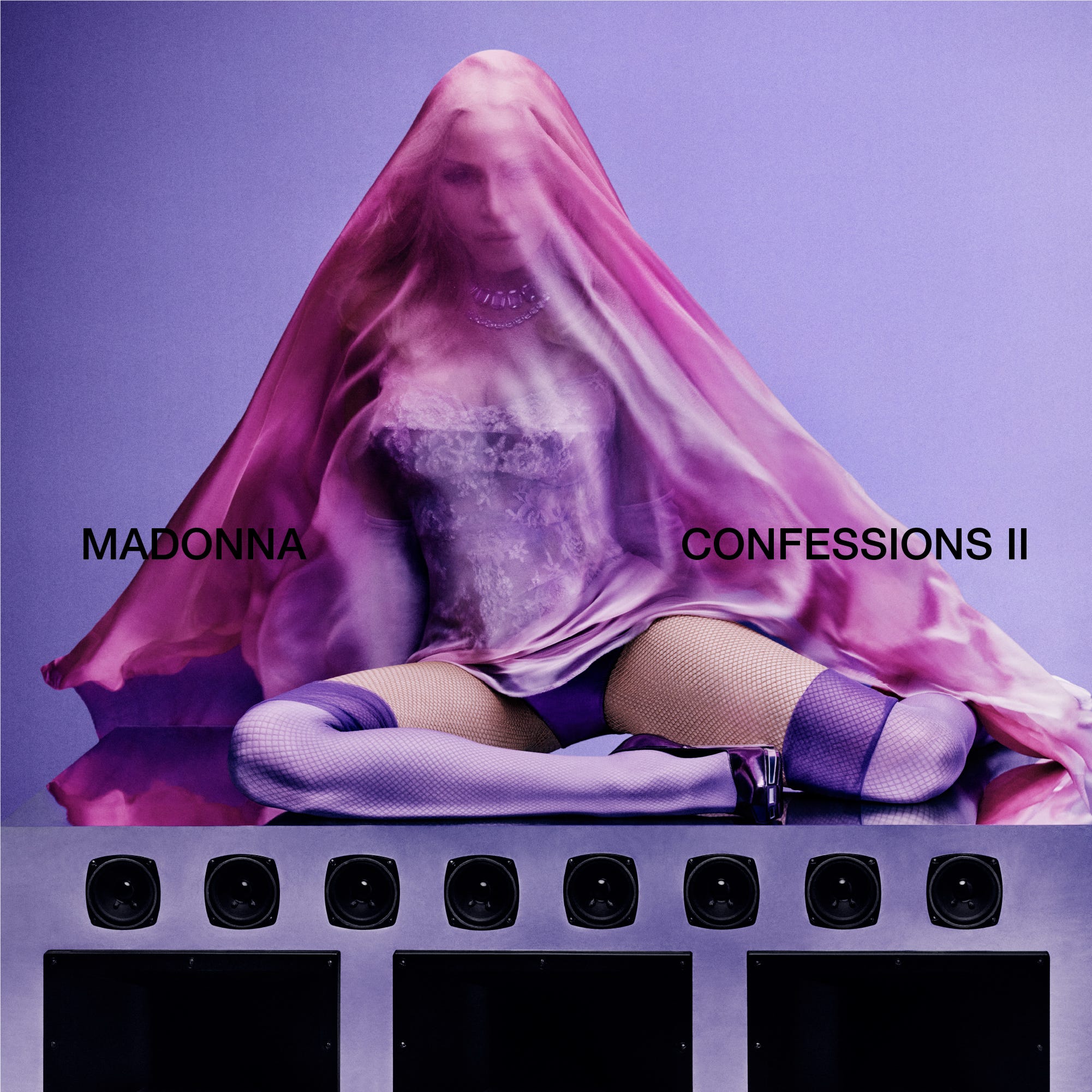
Madonna, the 46-year-old dance-pop lifer with the worst reviews of her life, secluded herself in Stuart Price’s London home studio and spun a continuous mix on shedding sweat beneath a mirror ball in 2005. Confessions on a Dance Floor was her last unquestionable hit, and she spent the next 20 years chasing its tail with EDM collaborators, releasing multiple forgettable albums, a side trip to Lisbon, and a greatest-hits tour. Price has returned for Confessions II, picking up the original’s thread, but tweaking one detail: the woman dancing on the floor is 67 now, and her deceased partners, exes, and her daughter have joined her.
Her returned dance floor is initially less a party space than a refuge. Amid the pressure of Price’s deep house under “I Feel So Free” (a loop of Lil Louis’s “French Kiss”), Madonna workarounds the space as a half-whispered, club-host hostess who prefers to create “a new persona” than be recognized, seeking “safety in numbers,” ordering champagne just to get herself onto the floor. Her request is amplified to a churchly incantation on “Love Without Words,” where the club becomes “a temple of sweat and surrender” and every stranger is a brother or sister. Trust finally arrives, unexpectedly, on “Love Sensation,” and Madonna almost sounds surprised by the discovery as she sings, “It’s more than love, yeah/Knowing that I can feel trust.”
The claim is delivered directly on “One Step Away”: “People think that dance music is superficial/But they’ve got it all wrong.” Instead, she asserts during a fully spoken keynote: the floor “is a threshold.” It is a rite room where dance takes precedence over talk, and Madonna puts a sharp spike in the heart of this message of joy: “Nobody’s free until they’re broken.” She smooths this sermon across “Good for the Soul,” noting the Virgo moon, aligning Venus and Taurus, releasing a thousand birds into the sky, and advising a rain-dance, with no need to specify the method, her guidance light as a yoga studio chalkboard. The mysticism sells itself only if the pain is still visible in the anatomy.
Sabrina Carpenter drops by on “Bring Your Love” to play the younger half of a two-woman team battling the forces of opinion and spreadsheets, and Madonna delivers her own warning: “Don’t try to distract me with numbers/I did it all for love,” before adding, as if raising a toast, “I know where the bodies are buried.” On “Read My Lips” she has a specific liar in mind, addressed in a repeated entreaty to just shut his mouth, while she details the damage: “You hurt me with your kiss, and I realize/You’re just broken,” and Feid responds in Spanish, picking at her from inside the fray. Even on “Everything,” a series of crystal-clear visions and commands to venture into the sunlight, she smuggles a chip on her shoulder into the bridge, wondering why this other person is always making her feel bad about herself and wishing she could be somebody else.
For seduction, she creates a curriculum. On “School,” she plays teacher to a man who was apparently never given a textbook, noting: “Maybe you’re Picasso/But you’re also a liar,” before insisting on a blank canvas for her longing and specifying the terms: “Really I’m not your mother, I’d rather be your lover.” The painter motif could last, the images surrounding it leaping from a burned masterpiece to a dealer’s cut to an observation about colorblindness before any of them solidify. She tightens up on “Bizarre,” compressing an old romance into a four-line, tabloid-friendly refrain—“Movie star, deep blue eyes/In Hollywood, we’re a perfect prize,” along with a Shelby Cobra speeding along—and already it’s being attached to a real-life celeb in the British tabloids.
Her recently departed brother is given the most vulnerable material. Madonna has said “Fragile” began after a last conversation with her brother Christopher Ciccone, who had been estranged from the family for years before his 2024 death. The words are stark: “We shared a name, a home/We shared a fragile bond/Now you’re gone.” She invites him into her dreams to carry out specific tasks, “Don’t forget about me” and “Don’t forget to be happy,” the grief organized into a to-do list. She goes ice-cold on “Betrayal,” writing a verse like an excerpt from a deposition: “When the book of love is written, I am the writer/And by the last page, you will not be mentioned.” She tells an off-stage addressee, “You’ll never take my mother’s place” and then melts mid-dance into something stranger, admitting she hated him once, then loved, “forever ‘til the end.” On “My Sins Are My Savior,” she leaves part of the burden of redemption to the French-language artist Stromae and reserves a moment of disarming plainness for herself near the end: “I was not lost, I was just broken,” the crown, she insists, firmly on her head.
On “Danceteria” she comes off the 4, 5, 6 trains and unspools a film credit list of who’s in the house: her best friend Martin Burgoyne is holding the door, Haoui Montaug waves people past the velvet rope, Debi Mazar’s in the elevator, Mark Kamins is spinning her “Everybody” demo from the DJ booth, and her voice is singing that everybody in here is a piece of art. And she picks up the same girl in “L.E.S. Girl,” only this time she’s out in the rain on Avenue B, cherry red lipstick smeared on a cracked mirror in a boy’s leather jacket, staring at a guitarist on St. Mark’s Place who has a Marlon Brando face with dirty bleach-blond roots. The landlord wants money, and her Polaroids are stapled to the wall and the whole neighborhood sings to her like an address.
She gets into deepest on “The Test.” Madonna is calling Lourdes Leon “Little star,” is perched on the stool she’s put under the strobes and announces “I wish I knew/The pain I caused.” Lola, as Lola Leon, is in the other verse: “I trace the line of what you have sewn/Keep my own design.” The two of them end on “You made me whole when I was broken too,” two careful singers around an unavoidable apology. After forty years of framing herself, Madonna gives the microphone to the only person in the room she can’t chassis, and it is all better for it.
Great (★★★★☆)
Favorite Track(s): “Danceteria,” “Fragile,” “L.E.S. Girl”