

Album Review: Crayola Circles by Fatboi Sharif & Child Actor
The New Jersey rapper’s first record with Child Actor is all broken sentences and American wreckage, and it refuses to slow down or explain itself.
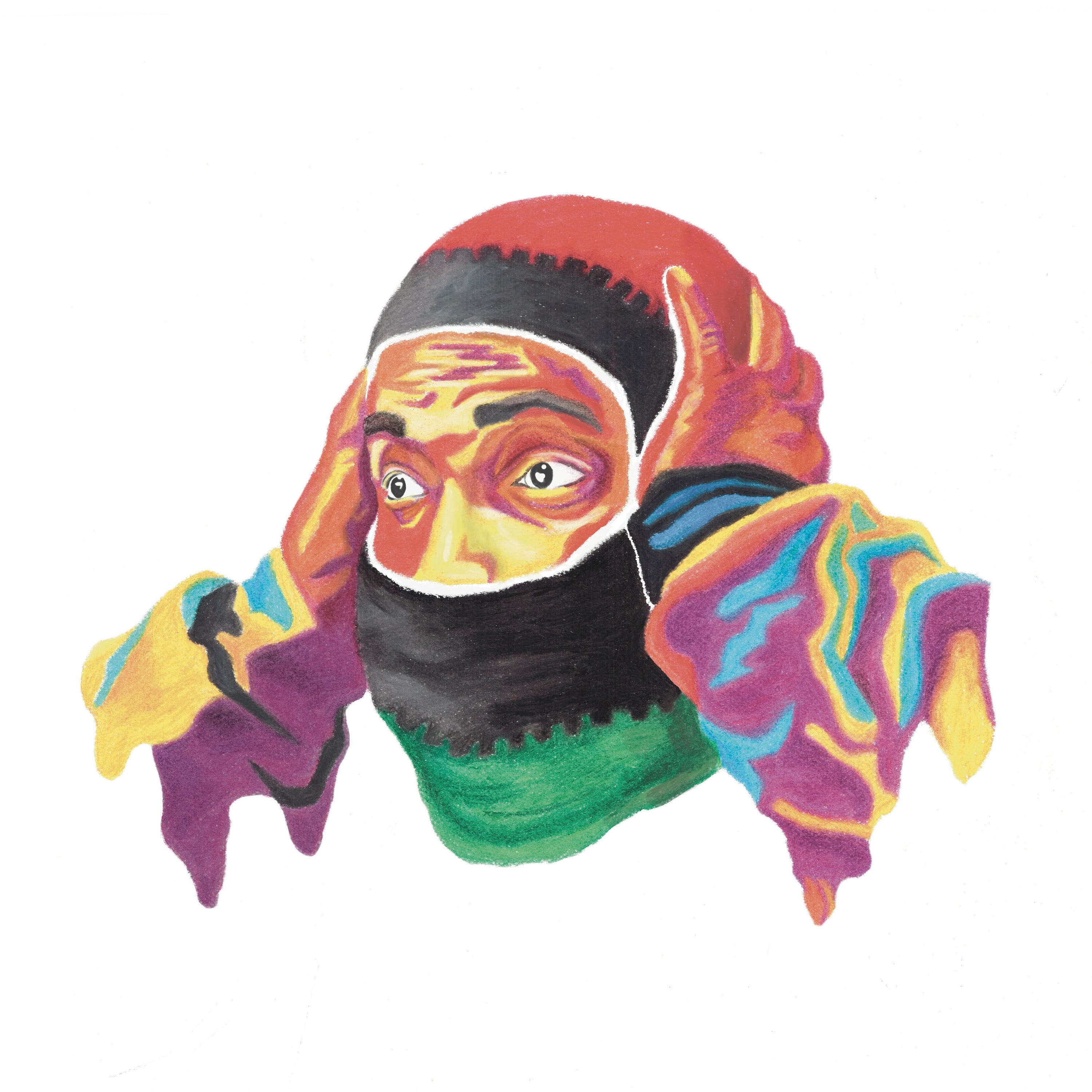
A rapper who has been releasing an insane amount of music at a very fast rate for an independent artist since 2016 has been creating a discography that is absurd in quantity in relation to the average independent artist since the year 2016. Age of Extinction, Ape Twin, Gandhi Loves Children, Cyber City Society, Preaching In Havana, Decay, Insomniac Missile Launcher, Something About Shirley, Brain Candy, Psychedelics Wrote the Bible, Goth Girl On the Enterprise, and many others that have yet to be released, each track produced by a different producer like people cycling through roommates. In an interview on Bandcamp with Phillip Mlynar, Fatboi Sharif (who calls himself “The Garden State Gargoyle”) says he sleeps on beats for weeks at a time, has dreams that are in color and temperature, and assigns each song to a specific degree and color palette. Crayola Circles is the first of any sort of collaboration between Sharif and Child Actor, who is the producer behind the record.
He has been associated with the Backwoodz Studioz for many years and this is the first time that the two of them have worked together. Child Actor has produced for artists such as Navy Blue, Earl Sweatshirt, ELUCID, Cavalier, Open Mike Eagle, and Ghais Guevara—all of whom have been part of the same roster and have been within a short distance of one another at various times. All tracks are either less than three minutes long or do not have any longer tracks. The first track is “Six Figurines” and it is an instrumental track from a 21-second sample. The music is based on samples, and it creates a sound that is like a mixed-up radio. It sounds like you are listening to a radio station that is out of tune, and you are tuning into a college station late at night, and you hear pieces of melodies blended in with static. The drumming can either be the last thing to be played (and sometimes there is no drumming at all).
Crayola Circles employs very small amounts of percussion and sound effects to accompany his voice, which functions mainly as background music or to create an ambient atmosphere. Similar but with a more ambient feel, the song “Assassination Tapes” is characterized by electronically sounding percussion and drum samples that act more like furniture sliding across the floor above than they do percussion instruments representing various forms of music. Likewise, the vocal samples of the song “Chemo Crystal Ball” sound as if they were placed through a synthesizer effect, providing little but a low-frequency thump. Conversely, “Recognition” uses only the sound of Sharif’s vocals as he does not use an actual rhythm, only an implied heartbeat in an open-air atmosphere. The wide open production allows Sharif’s voice to fill up most of the available space; depending on how you feel about a man saying “Live grenade incoming” over a dusty soul beat may determine whether you think what he is doing is generous or brutal.
Sharif’s lyrics in Crayola Circles are not arguments, stories, or confessions, but rather visual images that are fired in a series (almost:sound-wise) one after the other with only a small amount of legally required punctuation and/or grammatical structure. Each line of “How to Disinfect a Live Grenade” contains at least one proper noun and one proper verb; however, the manner in which these words relate to one another is more related to a half-remembered dream than they are to an actual shared experience. In this example, the hotdog truck (postponed) and the syringe (fell) both happened to be in the same area, but they did not meet or speak to each other. Another example is seen in the lyrics of “Diagnosis,” where Sharif seems to pack as much individual meaning into one verse as he does into an entire song.
Although the individual words of Sharif’s lyrics are clear and concise, and could probably be paraphrased easily, there does not appear to be a way in which to paraphrase the entire song. Essentially, Sharif’s lyrics must either be experienced as an electric current (not the energy part) or you must stand still on the bank trying to diagram the complete thought, which was not the original purpose of creating them in the first place. Sharif populates these super-compressed tracks with a variety of proper names, which drop like flash bulbs. For example, in “Assassination Tapes,” the chorus alone juxtaposes Ancient Jack’s mixing of cocaine with sour, an informant yelling “Black power” at Times Square, and Tupac working at McDonald’s for twelve bucks an hour in a breath.
In addition, at the end of the third verse, he raps, “I shot Regan/Injected relief”—again placing those two lines in the same moral space as the McDonald’s detail. The references are neither allusions nor name-drops in the traditional hip-hop sense. The former assumes you will follow the thread through to discover a second meaning, the latter assumes you will be impressed by the name. Sharif does neither of those things. The names JFK, Mizell, Betty Shabazz, Baldwin, Lynch, Lynch Hung, Dr. Octagon, Basquiat, Michael Myers, and Ironheart appear mid-line, frequently grammatically separated from the clause around them—more like shards of a broken window than citations. In “Cold Day in Hell,” Sharif raps, “Betty Shabazz and James Baldwin won a fortune at the DJ School Memorial as purple rain was falling.” This line is so full of American mythology that if you pulled on any one of these names, all the other names would go with it.
The lyrics on this album’s “Chemo Crystal Ball” come the closest to being something you could sing back as a chorus:
“My Momma told me I was crazy
The system told me I was crazy
Religion told me I was crazy
But no crazier than you.”
This simple statement stands out in stark contrast to the surrounding chaotic material. The relationship between momma, the system and religion is similar; they all inhabit the same grammatical space as each other and have the same verdict applied to them. The “you” that closes out this section destroys the three aforementioned spaces. Police, hospitals, churches, cartels, family—they all contribute to the same type of violence on this record. “Policy bringing false prophets to the people” and “The firing squad chanted, ‘Death to the less fortunate’” are on this track list along with “Dear Mama, I’m Sorry.” There is no categorization of the three forces on the album, they leak into one another as they leak into one another in the neighborhoods where Sharif raps about.
Familial lines are consistent throughout the album; “My parents asked if suicide is the solution” is found in “How to Disinfect a Live Grenade” (the placement is arbitrary, the line was sandwiched between a ghost ship and a fast track to heaven). “My father who carved out my heart at arm's length from a distance,” which closes out “The Destitute Stashspot” (a line so simple that it can sound bureaucratic). “Seeing the family tree break down branches, emotional rollercoaster, someone tantrums,” sits beside “Especially scared because time is running short. Fall.
Sharif’s baritone has a thick, echoing quality and he has processed the vocals to make them sound as if you are listening to a recording of someone speaking through the wall of a concrete stairwell. When he is relating his paranoia and how it affects his family, he does not change how he delivers the line. He delivers the images associated with domestic violence on “Night Terrors,” and images associated with a monster film on “The werewolf had ate his soul through his armpit”; these lines share similar pitches, “Seen it all from the bleeding knife/Loud screams when I dream at night” also arrive at reference point for temperature.
Sharif delivers all his lines vocally the same regardless of if the content of the lyric is about him or it is a content that has a warning not only against or for him. For example, on the track, “ANGER,” there is a sample at the start of the song indicating that the following song has content that is unsuitable for those that have heart conditions, then when Sharif delivers the first line of the song “Financially forged, forgotten family entertained,” his tone of voice does not differ. There are no songs on this record that build; they all begin, discontinue and then cease. “Leon Ichaso,” is the product of a single spoken line (“Enter a world of perpetual dreams”), who is named after a Cuban-American director of Piñero and El Cantante and the majority of the original sound of the track, and pushes through the sound of each song having the same center by transitioning the bass line to each beat after the previous beat of the next song.
Great (★★★★☆)
Favorite Track(s): “Chemo Crystal Ball,” “Cold Day in Hell,” “The Destitute Stashspot”
 | A guest post by
|