

Album Review: Cry Baby by Vince Staples
Staples aims his Long Beach dread at the whole country over live guitars, the most direct work of his career. He never lets go of his own body.
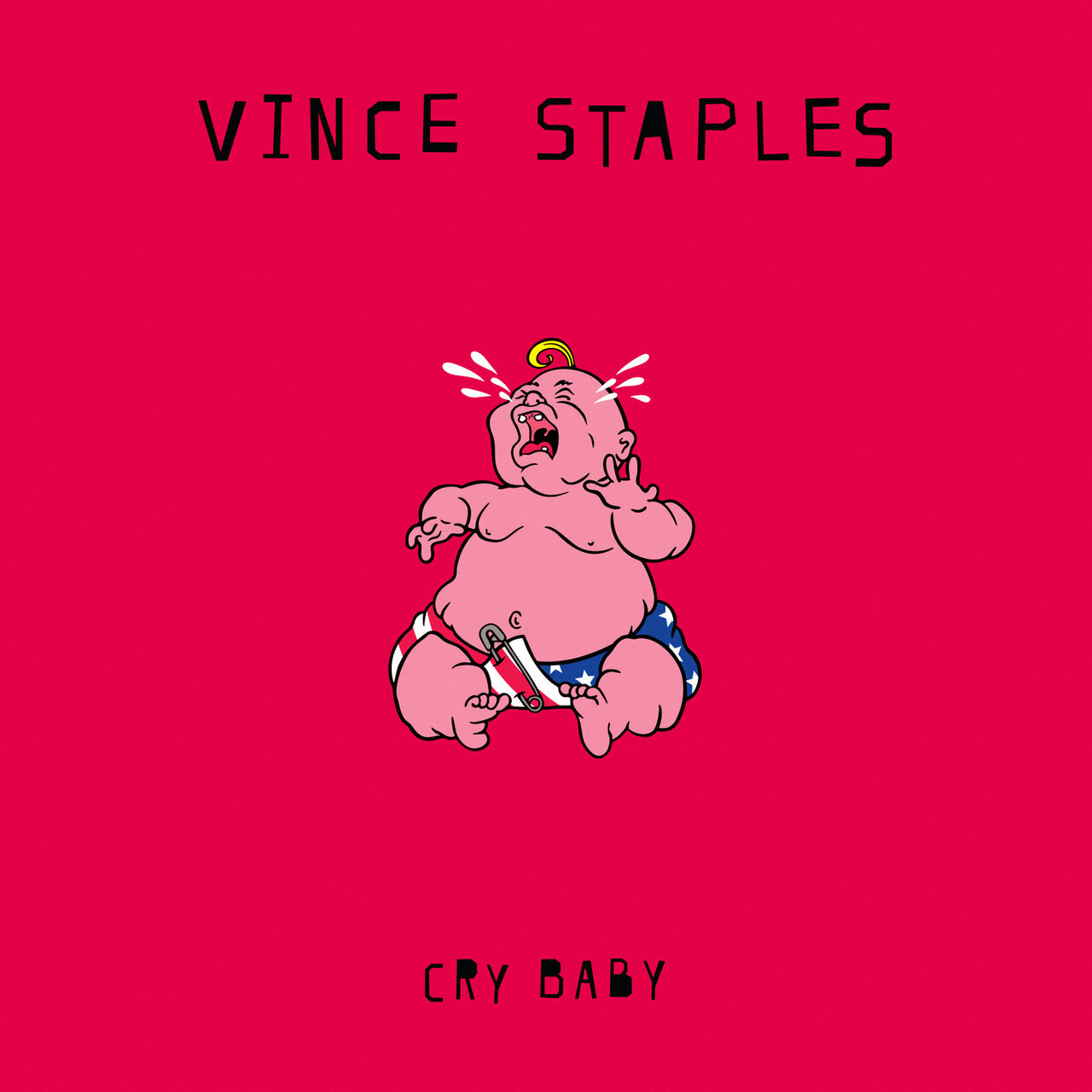
For the past two times the camera was pointing inward, the previous two instances detailing Ramona Park and the original block; and years of disappointment and the toll of a decade of constant focus, the next time. Both small and tightly packed, Vince Staples had taken his own measure of both Long Beach and himself. Cry Baby flips the camera around to the country where it was made and runs through his songs live with guitars, no longer programmed drums, and though it moved, outward it keeps the camera still on his body, though his subjects were not his own.
On “Blackberry Marmalade,” a single guitar hook carries the melody and features lines with a litany of tiny joys and domestic bliss, blackberry marmalade and sweet tea, the straight dope of honesty being the only policy that might carry. These sweets are bait; once the hook is played for a second time, the retort is “They lying,” to the fragment of American folklore, and then the post-chorus line to whoever’s listening, “Promise me you won’t gun me down.” The most striking of the entire record is his third verse, a string of descriptors on one qualifier: “ghetto, bougie, conscious, pompous, Obama, and Kamala, who the fuck you calling nigga?”, stringing along a complete spectrum of descriptors, each calling out how a Black man might be addressed in a lifetime.
A suspect, asking (“Is this harassment or arrest?”) when pulled over, hands behind his back in “Go! Go! Gorilla,” he asks the cop to speak with him and declares his life’s safety in his hands, then articulates his central anxiety: “Why do I live in fear of a gun and a badge?” In one line, the entire history of this country, from breadlines to prisons, is summarized before he returns to being shoved to the ground by a grown man when he was twelve for refusing arrest. The gun and badge always remain an antagonism that cannot be outwitted. Borrowing the framework of Slick Rick’s “Children’s Story” on “The Big Bad Wolf,” (complete with an interpolation of the refrain “Cops shot the kid”) he delivers his verses with a familiar echo all the way to “Every time a nigga in the news, he in the noose” and receives an admission to the facts followed by twenty-five to life on the album’s closer.
Staples grabs for the most abused American furniture, lets it rot in his hands. “Only In America” contrasts “God bless the U.S.A.” with “You can live by the gun, die by the gun,” piling on apple pie and July 4th until it buries itself and his verses puncture it. Responding to “Home of the brave” with the bodies dragged over from Africa to build it, reducing everything to a four-word shrug—“Thank you, I guess.” “TV Guide” uses a screen to pull the same stunt; the TV becomes the drug that gets him through morning, through night, the live execution broadcast between episodes, the third verse packed with every American identity foisted on a Black man-Brando, Pacino, Richard Pryor, Jim Crow, the Scarecrow-until all those labels combine and the feeling becomes that of pure overload. He ends the song snapping back at us, “What the fuck are you lookin’ at?”
Behind the flags, beneath the police lights, the songs constantly retreat into a solitary, weary man. “White Flag” takes up a refrain of surrender, “White flag, I don’t wanna fight no more,” over a verse that pulls in the police again: the kid stopped in his car, an alien in his own vehicle, a broken marriage he leaves to Amy Winehouse; “Love’s a losin’ game, like Amy sang.” “The Running Man” is denser, more terrified, the grim reaper and a revolution and Grand Central Station cramming one verse, before the bridge clears everything out of the room to let him confess that he hasn’t seen a therapist, hasn’t looked to Jesus much-that pain is all that’s left. “Do You Know the Devil” is the bargain itself: a sinner asking if we know the devil, admitting he might have sold his soul, before confronting God with the only instrument he has, “What am I supposed to do without nothing but a vocal booth?” That last line provides the title; the crybaby is a man all alone in the vocal booth with no therapist and no choir, only the microphone.
“Cotton” is the only respite, the one place music takes precedence over words, over everything else, “Music makes me feel just like cotton.” The verses are the slightest here, more hook than story, the only time Staples lets the music carry him for once, not the language. “7 in the Morning” ends the album with a march, a war that starts at first light clocked to a left, left, left, right, left cadence before the final verse pulls out and pulls us to the widest question Staples ever asks, “Why is death our entertainment?”, underpinned by an accusation that we slaughter our brothers in the name of Uncle Sam.
Away from Def Jam and a solo label for the first time, Staples had no one to talk him out of any of this: the first-person shooter video that opens on a massacre of Black people and leads off with him, the hooded Klansman dummy parked behind a white flag, the decision to make it this short and this hostile and with no evident shot at radio. The independence comes across as ballsy and, frankly, the writing in here, at its most naked, feels as terrifying as a hand flat on a car window during a traffic stop, and he had the freedom to do that here without someone up top saying no.
Standout (★★★★½)
Favorite Track(s): “Blackberry Marmalade,” “Go! Go! Gorilla,” “The Running Man,” “Only In America”
I think Vince has moved into this rarified space where whatever he puts out has been classic for his standards. The last 4 albums have been high quality. Nothing seemed filler based. This album was one I wish some of my favorites made or continued to make. And the best part, like his west coast peers have done, he doesn’t care. What he says and feels, he will put it out as raw and unfiltered with no measure of repercussions. The substance is heavy but it’s needed.