

Album Review: Dads at the End of the World by Sole & TELEVANGEL
Sole stopped reading theory and started planting fruit trees. His first LP with TELEVANGEL is the funniest, saddest dad record in rap.
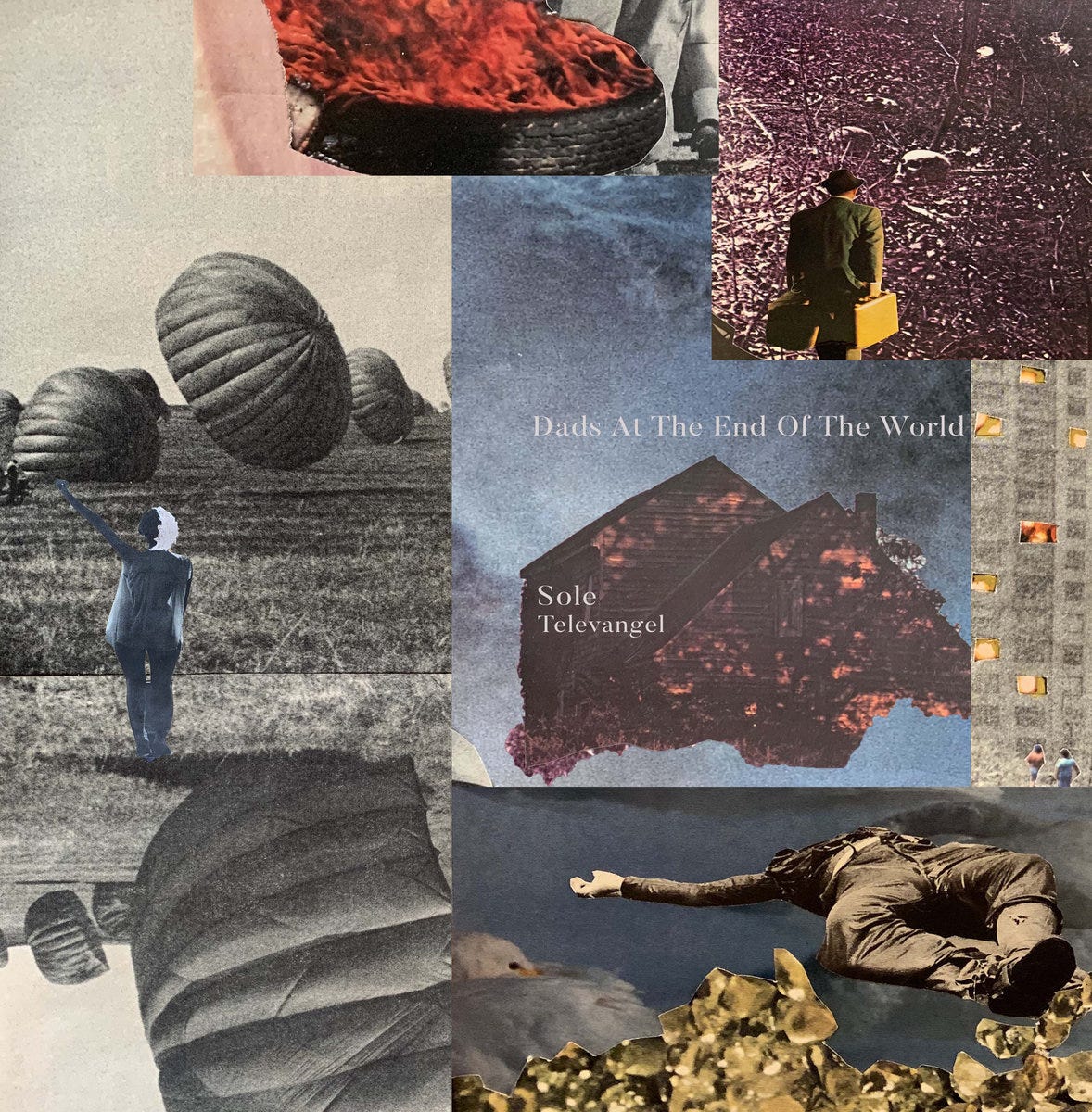
A rapper who co-founded one of the most contentious indie hip-hop labels of the late ‘90s, quit it citing ideological differences, spent the next fifteen years bouncing between political albums and side projects and anarchist podcasts, started a vegan food company, and moved from Portland, Maine to Barcelona to Flagstaff to Sedona to Denver to Brunswick—at some point that person either fossilizes into a professional contrarian or admits the contradictions out loud. Tim Holland, who goes by Sole, took the second option. Dads at the End of the World, his first full-length produced entirely by TELEVANGEL (Ian Taggart, formerly Young God of Blue Sky Black Death), is nine songs about a man who used to carry around Walter Benjamin like scripture and now concedes he just needed someone to tell him it was okay to make money. On “Rules,” he shouts out Guy Debord for the third time across the record and follows it with a confession that he’s been listening to Jeezy’s Thug Motivation because he needed permission to pull himself out of poverty. Then he says, “Puts down book. Exit building.”
The album’s center is a dead father and two living children. On “Kids,” Sole addresses his dad directly, and the specifics are merciless. A drug addiction that went unchecked. A trailer where they held a funeral nobody felt good about. A woman who got him high and might as well have killed him. A watch she promised to send and never did. Sole puts all of this down in flat, unadorned bars, no melodrama, no cleansing arc, just the facts of a man who became dust while his son was still figuring out what a father does. The flip side is what Sole gives his own kids. He told his six-year-old about Christianity, and the kid laughed at it, and Sole laughed at him laughing at it. He told his son never to pledge allegiance to a flag. They’re specific enough to be funny and serious enough that you believe he means them. The sword-to-shovel image returns twice across the album, and both times the implication is the same: fatherhood didn’t soften his politics, it just rerouted the anger into something that has to keep people alive.
Sole was from a small Maine port town, saggy jeans, cops stopping him constantly because they assumed he sold drugs. “Homies in Catalunya” runs through his whole early life in plain sequence: trading tapes on the internet when his peers were still using pagers, taking a Greyhound to Fatbeat Records in New York at seventeen because his parents, both small-business owners, let him go. A classmate tried to put a bomb in his locker sophomore year, then came at him with a knife; Sole put the kid in the hospital. He saw Serbia in flames when the ethnic riots broke out, sold his father’s apartment after the first overdose, lived on the red rocks of the Coconino National Forest swimming every day with his dog.
He worked a dot-com job, renounced a quarter million in stock options, and left. The company doubled in size, and then it disappeared. Nobody has to be a millionaire. Anticon Records, he went off and did that, and then that ended too. “Freedom” picks up a different thread, the stranger details: Bell’s palsy in the nineties, an eye patch worn to the mall while his friends mocked him, bootleg live albums sold at black markets in Belgrade and Moscow, where the bootleggers recognized him. A Swiss fan deposited sixty thousand dollars in his bank account, paid off all his debt, and then never responded to another email. Sole says he always thought he’d be rich, and when it came down to debt they ran it up, and he rode the poverty line because real wealth is in the heart even when money’s on the mind. That line could scan as corny from someone who hadn’t earned it. He has.
TELEVANGEL’s production deserves separate attention. Taggart spent years in Blue Sky Black Death building beats for Hell Razah and Nacho Picasso and Deniro Farrar, and his solo catalog under the TELEVANGEL name has drifted from ambient to post-punk to industrial without settling anywhere. On Dads at the End of the World, he locks into something more restrained. Nothing competes for attention. On “Protozoa,” a warped synth tone bends underneath the verse like a rusted gate in winter; on “The Crumbles,” a distorted bass pulse swells and recedes with the patience of a tide. Thirty-four minutes, nine songs, no filler. Compare this to the Sole & DJ Pain 1 records—Death Drive, Nihilismo, Post American Studies, Vault 1312—which ran hotter, louder, and more confrontational. TELEVANGEL dials the temperature down until the words have nowhere to hide, and Sole sounds sharper for it, more focused and less scattered than he has in years.
The politics on Dads at the End of the World have a different weight than the politics on Sole’s earlier records because he keeps undermining them with real numbers. Half the world can’t buy his vinyl for forty dollars or pay thirty to have it shipped. He’s rich enough to never beg for crumbs, but working class, so he still hustles. He got no 401K, no savings, and he says he’ll fix it with urgency. The anarchist theory that used to fill his bars gets dismantled on “Rules,” where the outro has him confessing he wanted to be “a material man doing material things, and that’s where theory led me.” On “Lift the Curse,” he asks the sharpest question on the album:
“If direct action gets the goods, then why has nothing changed?”
He follows it with a practical list instead—stack firewood, store bullets, plant 401 fruit trees, teach the kids to read and write, and to fight. Later on, in the same song, he rattles off a string of hypotheticals:
“Maybe I’ll vote
Maybe I’ll stoke a fire to end the empire
Maybe I’ll hang the jury
Maybe I’ll hang a Nazi
Maybe I’ll walk with my kids through the forest and marvel at the autumn leaves dropping.”
Those six lines contain every contradiction Sole has spent twenty-five years trying to square. He still hasn’t squared them. TELEVANGEL’s beat just keeps going underneath, patient and unbothered, waiting for him to figure it out.
Great (★★★★☆)
Favorite Track(s): “Kids,” “Homies in Catalunya,” “Lift the Curse”