

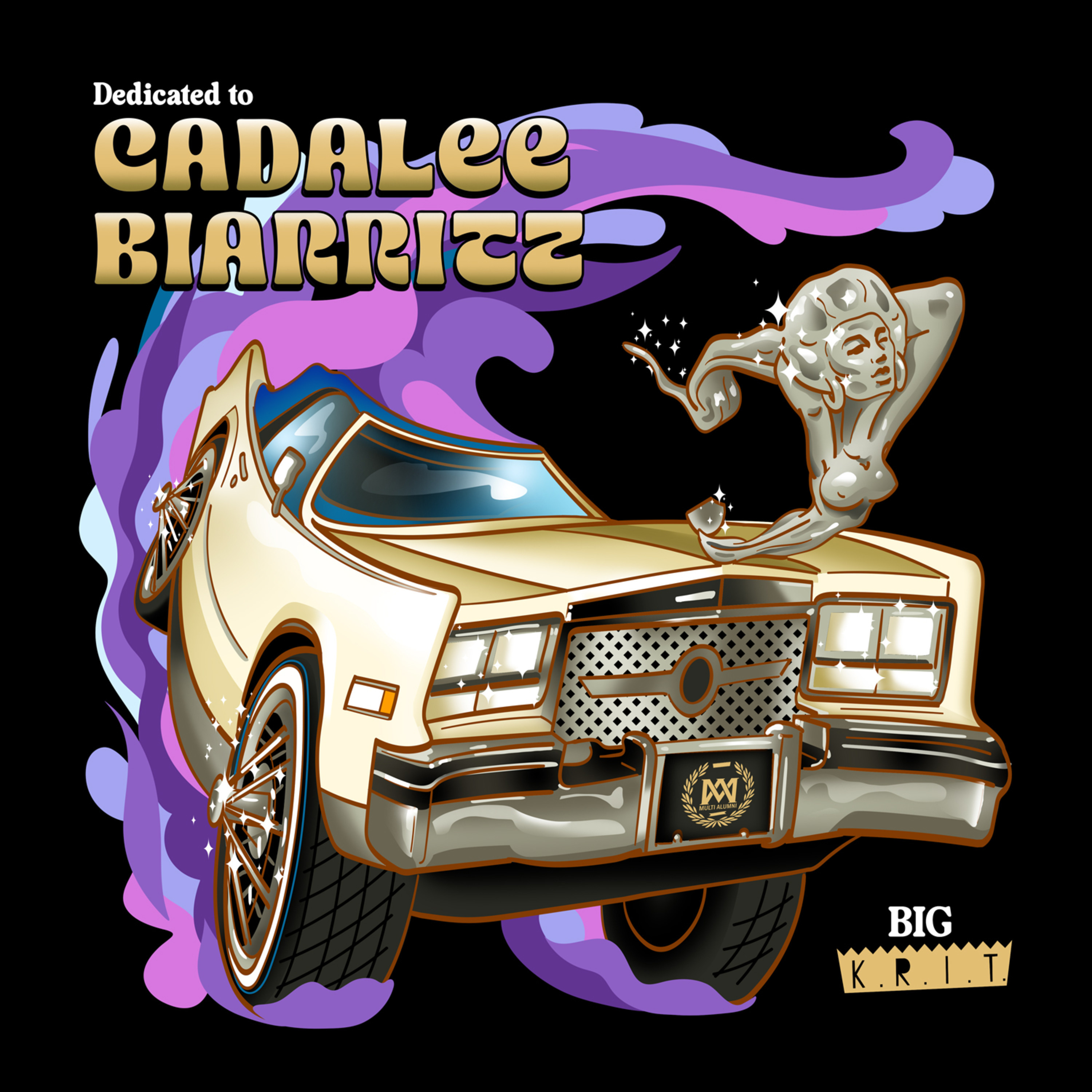
Karlous Miller’s voice spills through the intro hawking Ashwagandha and fake paternity tests. He calls himself the Chevy SS King and promises to roll it like he stole it. That line pins the whole record. Big K.R.I.T. named this thing after his Eldorado Biarritz—Cadalee, he keeps saying, like he’s courting her—and he spent building something that sounds like a radio station dedicated to slab culture. Fake grillz commercials from Scotty ATL. Fake custom-paint spots from CJ Customs. Fake rim ads from Spokesnvogues. The gimmick could curdle fast. K.R.I.T. uses those interstitials to reset atmosphere the way a DJ uses drops to remind you where you are. Every time Miller cuts in with another bit about ballers and shot callers, you get shoved back into the driver’s seat.
The car clocks distance in more than miles. “The Mileage” tallies years, losses, exits taken and skipped, then lands on a question K.R.I.T. keeps circling back to in different forms. “What good is blades choppin’ when the parkin’ lot too crowded?” He’s flagging the performative side of slab culture, the way swangers matter only if somebody’s watching. He’s also marking the pressure of getting older in a game that keeps cramming new bodies into the same lot. The imagery stays ground-level. Elbows poking out like Cam Newton dabbing. GPS useless against all the roads he’s already slabbed. Valet treated like a ballet because it keeps you on your toes. He rations car details the way some rappers ration jewelry. Chrome lady wetter than April showers. Trunk pop good with the bumper on smile. Candy paint dripping until you need towels for the I-20. The objects keep doing work. They don’t just stack up.
“Not in the Whip” lays out the record’s argument about what gets in and what stays out. No talking presidents and politics in here. No recaps of bombs dropping on the news. No scrolling past condos going up next to homeless folks. K.R.I.T. logs the contradictions without pretending he’s patched them. “What’s the use anyway? They might click off and push the button any day.” The car runs as a moving boundary line, a space where he decides what enters. The drums knock harder on this one, built for trunk space and four-lane crawling, and his voice shifts into something closer to winded than flexed. He’s rationing how much of the outside world he lets through tinted glass. The verse about the government trying to blow up the boat sits next to lines about staying alive. The song just ends with him back inside, insulated but not ignorant.
The broadcast frame lets him veer between moods without losing grip. “Old News” swats away rumor and hate with the hook’s repetition (“I done heard it all), while the drums glide under him—more groove than punch. “Hi Def” flips into brazen showoff mode. K.R.I.T. demands to be seen in 4K and 1080p, the playa from the planet Velvet Crushed. His voice clips faster, ad-libs pile up, and the imagery gets gaudy on purpose. Bubble eye with the knock. Grillz that look like the light at the end of the tunnel. Trunk popped so hard it knocked down the stars. That’s the closest thing here to a club record, and it holds because the broadcast frame justifies the gear shift. Radio stations play different tempos.
“Gotta Do It” names the lineage bluntly. UGK. MJG. 8Ball. Geto Boys. Scarface’s scar. K.R.I.T. tags himself inside that line, shouting out the playas back in the day who never faked the funk, never fucked with the fake. The Marcus Garvey reference lands fast. “Clean underneath the car seat, Marcus Garvey, I just gotta move it out of the situation that they put me in.” Self-determination tied to candy paint without making a speech about it. The beat leans on drums that hit like a throwback to the Rap-A-Lot era, and the hook’s Karate Kid framing—wax on wax off, kick back, get your lick back—plays both corny and correct. He’s talking about patience and discipline. He’s also talking about showing up polished.
The slower cuts don’t soften so much as settle down. “So Far So Good” opens with a Roy Ayers shoutout and stays in that sunshine-funk pocket. K.R.I.T. coasts through memories of flipping down the aisle with a bankroll, dodging laws and one-ways, realizing that a push from himself was all it ever took. The verse about the neighborhood changing carries more weight than any explicit eulogy could. 15s don’t knock no more. Candy paint don’t drip no more. They flatbed your ride instead of letting you lock the door. He’s mourning a practice, not a person. “Precious Metal” digs further into that territory. K.R.I.T. calls the car the safest place he knows, bending corners alone to keep his mind from racing, tinted windows holding back a world crammed with hate. The hook admits the sun don’t shine every day, but he’s here so he can’t complain. The ambivalence stays earned.
“Elevated” stacks car-as-status imagery highest. Coming down with the top segregated. Parting the sea with swangers. Geometry with the angles. Breaking backs when the subs track up to danger. The flow clips faster here, syllables crammed into tight pockets, and the “chop shop made it, sprayed it, and then swang it” turns the build process into a brag. “The Everliving Sub Knocker” treats bass as both joke and threat. K.R.I.T. claims his trunk will snatch your soul, crack the globe, expose the Earth’s core. Miller shows up on the outro counting fifteens, and the absurdity lands because the record has already established that exaggeration runs inside the ritual. You don’t just play loud. You play loud enough to signal E.T.
“I-20” personifies the car as a chrome lady wetter than April showers, dripping so hard you need a mop, cold as ice but melting in his hand as warming’s global. The extended metaphor teeters close to overcooking, but K.R.I.T. keeps the details blunt enough that the conceit holds. Bubble eye frame. Reverse to see it drop. Caution where you’re walking or you’re slipping where you stand. The outro dedicates the album to Cadalee Eleanor Biarritz, to slab riders and candy-coated providers, and spells out the stakes. Dodging potholes and scrunch faces. Haters breaking their necks to see what it takes to get a chrome woman like her.
“Celebrate the Line” closes the record with a Houston posse cut that reads like a family photo. Z-Ro on the hook. Slim Thug talking about the great state of Texas where the sun shines brighter. Paul Wall riding down Memorial flyer than an oriole. Lil’ Keke on the woodgrain steering with the top disappearing. Killa Kyleon grain gripping and lane switching. Propain pulling up hypnotized. K.R.I.T. takes his verse last, shouting out Mississippi’s crooked love for Texas, the House of Blues and Warehouse Live, the OGs who showed up and wrecked it. Regional vocabulary logged as identity. Community tallied through car culture. The line worth celebrating because it connects rather than divides. He places himself inside that line. Not at its head.
The record thins out in stretches where the car imagery stops doing double duty and settles into pure ornament. A few verses list chrome and candy and vogues without tying them to anything beyond the flex itself. The energy dips when details stop accruing meaning. “In the Rain” aims for something stripped-down—raindrops cleansing chrome, acknowledging what’s above while looking down—but the track runs barely ninety seconds and feels like an interlude that wandered into song territory. Miller’s freestyle adds color without adding much argument. A couple of the commercials land too close together and stall momentum rather than resetting it.
K.R.I.T. produced most of this himself. The drums split fairly evenly between slow-roll groove and harder knock. The bass sits low and wide, built for trunk rattle. The tempo stays deliberate, rarely climbing above a cruise. He borrows heavily from Houston’s screwed-and-chopped lineage without actually chopping anything, letting the BPMs do the work of signaling region. The samples lean soulful without drowning in strings, and the keyboards stay spare enough to leave room for his voice. He shifts how he delivers depending on whether he’s talking tough or talking tired, clipping vocables on the brag tracks, stretching them on the reflective ones. The contrast keeps the broadcast frame from flattening everything into one mode.
This is drive music that knows what driving means in the culture it’s speaking to. Not transportation. Ritual. Not flex. Identity. Not chrome. Inheritance. K.R.I.T. positions the car as boundary and refuge without pretending it fixes anything. The world presses in. Condos. Bombs. Algorithms. Haters. Tinted glass only holds so much. But the record argues that the ritual matters anyway, that candy paint and woodgrain and trunk knock constitute a practice worth preserving, worth passing down, worth dedicating an album to by name. He calls the car precious metal. He means it both ways.
Great (★★★★☆)
Favorite Track(s): “Not in the Whip,” “Precious Metal,” “Celebrate the Line”
https://davidkunt.substack.com/p/the-big-lebowski-recipe-for-a-marvelous