

Album Review: Di Hotel Malibu by Thee Marloes
A three-piece from Surabaya recorded their second album in three languages with no local scene to borrow from. It is the strongest retro-soul record Big Crown has released this year thus far.
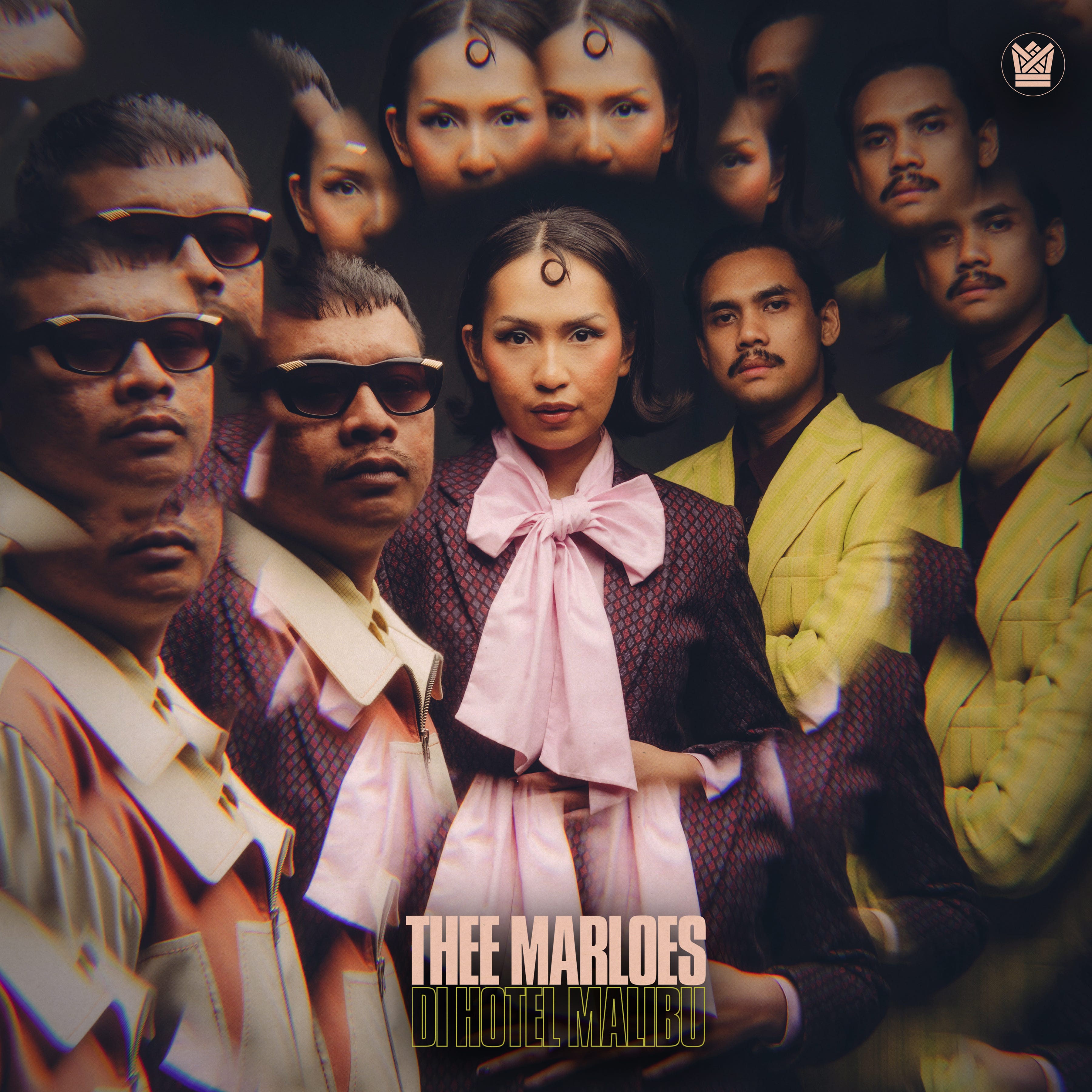
In Surabaya, the second-largest city in Java, a home studio as the only retro-soul operation in town. Sinatrya “Raka” Dharaka spent years writing songs in the studio after his work shifts. The team started forming when drummer Tommy Satwick joined them. The local ‘show’ singers’ discovery and the signing of Natassya Sianturi at a 2019 local concert finalized the creation of Thee Marloes. Sianturi, unlike Lady Wray and Lee Fields, of Big Crown, drawn by lako from Southern Gospel and Lee Fields’ North Carolina R&B, respectively, locally sourced church choir records. That difference shows on “Di Dalam”—horn arrangements in a minor key surround her vocal, relaxed and pitched somewhere between a Rotary Connection track and a song she heard in church when she was 14. No local precedent for that. Surabaya’s closest reference point would be Dara Puspita, the all-female garage band from the ‘60s.
On “6 Years,” Sianturi’s lyrics say, “Tell me when I’m gonna stop/Tell me how I’m gonna stop” over driving stabs from horns and aggressive hi-hat. Sianturi quit a stable, most likely high-paying job, at the age of twenty-nine. Her mother thought she was crazy for quitting a job that brought the family income. In the final minute, she quit asking and said, “Be true to myself, put my makeup on, and sing my song.” Raka gave something up; the arrangement, possibly the most retro-soul arrangement this spring. “Rahasia” has Sianturi saying, “Biarlah rasa tersimpan erat/Menjadi doa di dalam dada,” which translates to “Let the feeling be stored tightly/Become a prayer in the chest,” while Raka’s guitar doesn’t move.
Raka created each song with only the room’s analog devices, instruments like a clean and overdriven electric guitar, piano, brass, organ, tambourine, and a few more. For “Selatan,” he uses class instruments to symbolize issues of class. Sianturi uses Indonesian to articulate the class struggle of the ultra-modern South Jakarta through words and ‘disco-ball’ like phrases, asking, “Apakah kau rasakan terasing dan piun?” (Do you feel alienated and alone?) as the bass rattles the floor, and the organ sustains itself over the bass. This was one of the few tricks used on the album, with one singular idea used through fourteen songs. For “I’d Be Lost,” Raka used the same brass section, but this one was a dance track, and a “floor-filler” in the Twisted Wheel 1968 style. “Boru” completely abandoned the used layout; it used a tone of a striking bass and harsh drum compared to the sonics, and with nothing else on the label, it sounded more like Northern Soul than a garage style album. Who else has even attempted that?
The title song connects a serendipitous meeting to a specific hotel (“Mengapa harus bertemu?”) for three minutes, with a clean figure played by Raka on his guitar, never hitting the root note. The Batak language, which has about 8 million speakers and comes from North Sumatra, is heard on a Big Crown record for the first time. This is the boldest thing Sianturi does on either LP. An all-English LP over one groove is ‘the easy album,’ and clearly, one that was never considered. “Crazy Eyes” and “I’m Just a Girl” have competent, mid-tempo, and ‘I don’t have to tell you how to modulate the tune’ funk. “What’s on Your Mind” is a sweet-soul ballad that, like the rest of the songs, is a cleanly picked arpeggio. Raka’s guitar has a warm tone, and the rest is where you expect it. However, unlike the rest of the songs, based on the premise of patience in a new romance, this one is nowhere in particular (Surabaya, a Batak prayer, a hotel lobby, etc., all have their songs).
Perak, the 2023 debut, released eight of twelve songs as singles prior to the album’s drop—pieces of an album put together after the fact. No one noticed it, at least until Chicano lowrider communities and the BBC Radio 6 Music nod from Huey Morgan stumbled upon it. That reliance on external gatekeepers might tell you why Di Hotel Malibu continues to ignore them. Two back-to-back songs, Batak and Indonesian, with the boldest sequencing of six minutes of just soul this year, meant to be an album with no anchor of English. If Durand Jones’ second album lost the four-track characteristics and the grit, Raka edited. It looks like fewer singles, longer cuts, and one track sung in Batak. Perak would not have allowed that at all.
Great (★★★★☆)
Favorite Track(s): “6 Years,” “Boru,” “Di Hotel Malibu”