

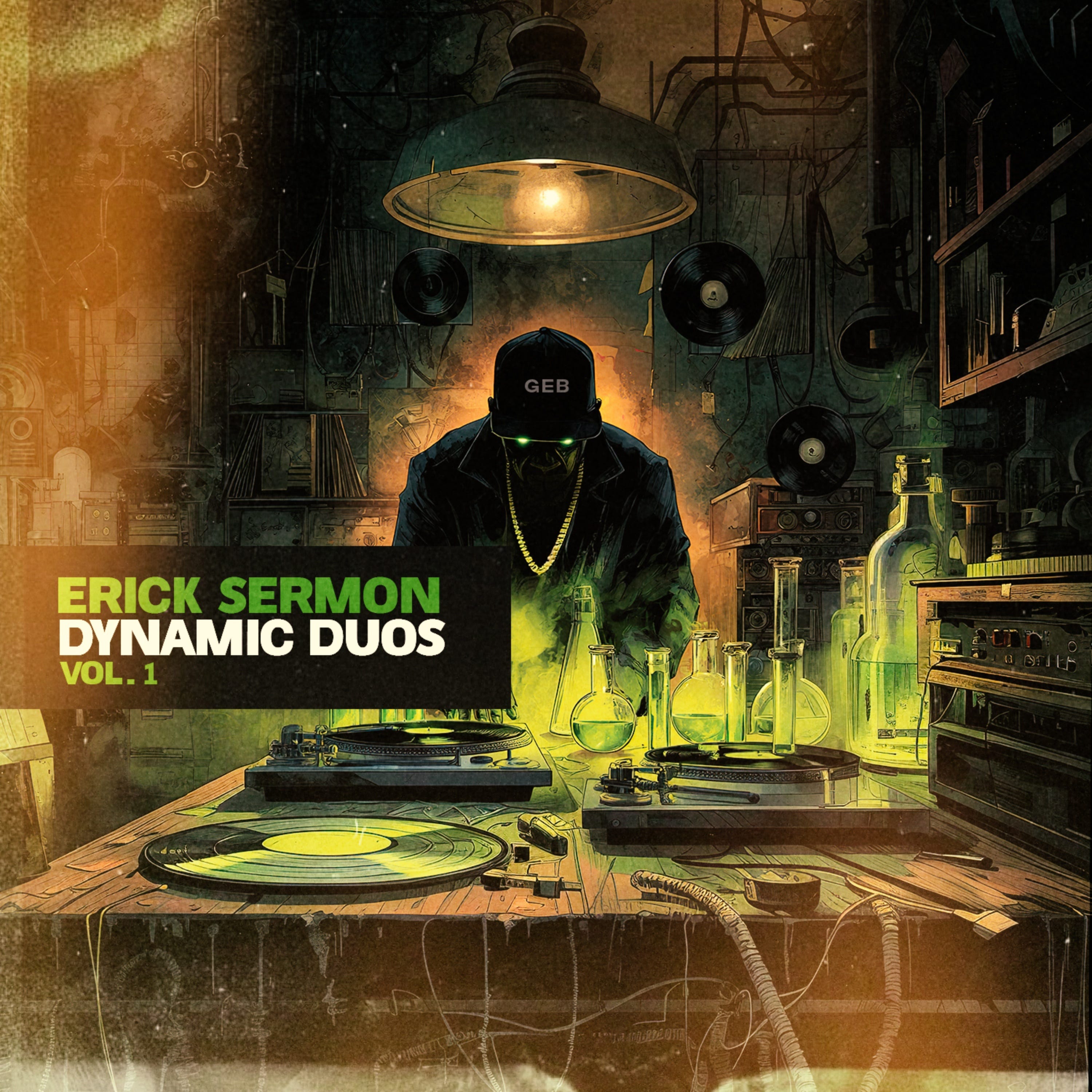
If you’re unfamiliar with Erick Sermon, which the architects did a handguide to read, spent the late eighties to early nineties building EPMD into one of the most reliably funky operations in East Coast rap, the kind of duo where “Erick and Parrish Making Dollars” wasn’t just wordplay but a working blueprint for how two people from Brentwood, Long Island could turn sample-heavy beats and unbothered delivery into gold plaques and a sprawling Hit Squad collective. His solo run followed that same template: No Pressure, Double or Nothing, Music, records that leaned into rubbery basslines and unfussy funk while the rest of the industry chased whatever was next.
Thirty-seven years into the job, he’s not trying to reclaim his spot or prove he can still rap circles around younger competition. Dynamic Duos positions him as the host and bandleader for a summit that maps out rap chemistry from New York to California, from late-‘80s peers who came up alongside him to ‘90s icons and a few newer voices he’s choosing to spotlight. Erick is threading together a curated argument about what makes partnerships work in rap, using his own production ear and taste to show how these combinations sound when he’s the one building the stage. “Dynamic” means constantly changing, full of energy, forceful, capable of adapting; “duo” means a pair of people or things. Erick Sermon turned 57 this year, and he’s still building records the way he did in 1988, with varied production styles that leave room for rappers to actually rap.
“Look at ‘Em” with Method Man and Redman becomes an essay on what their long-running tag-team looks like in 2025. Meth’s verse is all elastic bragging about bad boy doing bad things, giving a bad name a bad name, pressing delete on your mainframe, while Redman comes through with gritty punchlines about Madagascar catalog fills, Hitchcock bellies from hip-hop, and young boys lip-syncing on TikTok. The hook is a blunt survival statement: “You thought a nigga wasn’t gon’ survive, huh?” The beat sounds like an update of the muddy, swinging groove Erick gave them on Blackout! and Def Squad records, thick drums and bass that leave room for these very recognizable voices to cut through without copying those older tracks note-for-note. The chemistry isn’t manufactured. These three have muscle memory with each other, and Erick is deliberately staging the reunion to ask what it sounds like now.
“Test Me” delivers the first new EPMD song in over a decade, and the important thing is how little it strains to justify its existence. Parrish Smith’s verse is clipped and no-nonsense (“Can I think of a rhyme slicker? Think of a rhyme quicker?) sliding into Erick’s relaxed cadence over drums and bass that could have lived in 1992 but are mixed with a modern low-end thump. Erick’s not trying to out-rap Parrish or prove he’s still got it. He just drops lines about bucket hats, Timberland boots, Rolex watches, and matching chains, then hands the mic back. The song functions as proof that “dynamic duos” isn’t a loose marketing theme. He’s asking to hear what happens when two people who built a sound together decades ago step back into the same space without overthinking it.
Erick’s production choices throughout the album show how he handles regional and era-specific elements without turning them into a disjointed compilation. When he brings West Coast fixtures into his universe, he adjusts the tempo and drum feel but keeps his fingerprints visible. “Like That” has Snoop and Nate Dogg gliding over a groove built for grown-club cruising, with Ricco Barrino carrying a hook about being stuck gazing at a woman’s body. Snoop’s verses hit the familiar player talk, but the beat keeps things swinging at a head-nod speed that feels like Erick’s East Coast snap meeting G-funk lean. “The City” with Tha Dogg Pound turns into a Compton and South Central panorama, Daz and Kurupt dropping Crenshaw references, Nipsey Hussle shoutouts, lowrider imagery, and South Central lingo over drums that knock harder than the more laid-back feel on “Like That.”
Cypress Hill on “How Do You Know” brings B-Real’s nasal, machine-gun cadence and Sen Dog’s gruff counterweight over thick drums and psychedelic edges. The hook is just B-Real repeating a simple question, “How do you know where I’m at when you haven’t been where I’ve been?” until it feels like a challenge aimed at anyone who wants to question three decades of staying relevant. Erick layers keys, guitars, and vocal chops so you can tell an Erick beat from the first bar, but he’s not forcing every song to sound identical. The bounce shifts, the bass movement changes, the samples pull from different pockets of funk and soul, but the thread holding it together is his ability to make all these voices feel like they belong on the same record.
The album uses elder statesmen’s voices to talk about the present in ways that feel blunt and easy to follow. “How Long” with Public Enemy gives you Chuck D asking how long it takes for truth to get taken down or drowned out, turning social media algorithms and speech policing into something direct: “How long before this gets taken down?/How long before my words hit the ground?” Flavor Flav ad-libs pepper the track, and the beat marches forward with the kind of urgency that makes Chuck’s lines about digital syphilis and brave new words land without needing extra explanation. He’s not giving a lecture. He’s naming the problem and asking a question.
“God Mode” brings Conway the Machine and The Game together, and the contrast between Conway’s usual dense wordplay—blow leaving a pretty bitch with a snot nose, picassos hanging on condo walls, fans moshing like rock shows—and The Game’s usual martyr talk about being the last gangsta rapper alive works because Erick laces them with a dark, direct beat. The hook repeats the phrase “I’m in God mode” over a loop that doesn’t try to do too much, lets both rappers flex and posture. Conway’s verse is technically sharper, but The Game’s complaints about new rappers making the spot hot and his own staying power (“I’ma be here after the earth gone”) fit the album’s larger argument about longevity. Erick is using his platform to let voices from different eras and regions know that they’re still here, they’re still hungry, and the bars and beats carry that weight.
The joy and looseness in the record come through without turning into vague nostalgia. “Back 2 the Party” with Salt-N-Pepa should be the easiest song to mess up by bringing two legends trying to recreate block-party energy in 2025, but it works because the groove pulls from late-‘80s/early-‘90s DNA without sounding stuck there. The hook is straight: “Back to the party/Taking it back/When people partied.” Salt and Pep’s verses talk about rooftop jams, Latin Quarter memories, skate parties, and shaking off lockdown years without pretending the world is simple. The drums swing at the right speed, the bassline leans into a two-step, and the structure feels like a chant people already know, even though it’s new. “Sidewalk Executives” suggest Erick is letting Billy Danse and Lil’ Fame do what they do best: turn street codes into anthems.
Erick keeps himself in the spotlight without dominating it. His own verses slip in and out. With “Test Me,” he’s trading bars with Parrish; on “Look at ‘Em,” he’s letting Meth and Redman run the show, but he never shrinks into pure producer mode. His presence anchors songs that could otherwise feel like one-off features. He’s not trying to sound like what’s currently on the radio, but he’s also not pretending 1992 was the last good year for rap. There are moments when the duo idea is more cosmetic than essential, but the album’s standard remains consistent throughout. Parrish’s line on “Test Me”—“Draw a line in the sand like ‘Crossover,’ you get the picture”—captures what this whole album is doing: showing you the boundary, daring you to cross it, and reminding you these partnerships still have the muscle to back it up.
Solid (★★★½☆)
Favorite Track(s): “Look at ‘Em,” “Test Me,” “How Long”