

Album Review: Family Over Fame by J Nolan
His most personal album is cutting in the working life and softest when it reaches the flex template. Faith braided with hustle gets him further here than the luxury punchlines do.
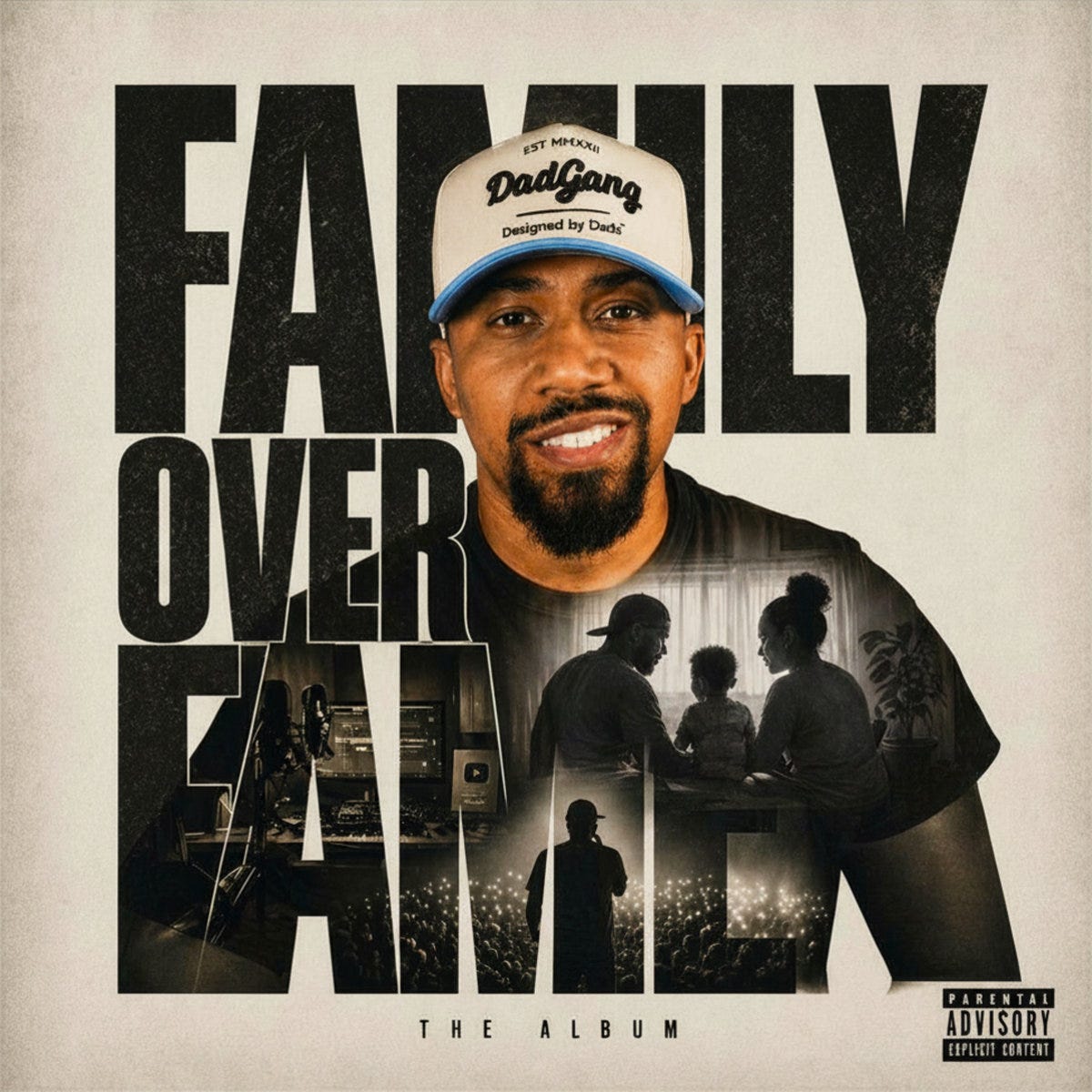
The job that funds an entirely self-sufficient rap career tends to live off-record. Writing hooks for artists with a larger budget, getting placements on television and film, a slow drift toward content creation following a marriage and the birth of a new son-this is the labor beneath the music, and it is the career J Nolan has built. He was raised on Atlanta’s Southside, in the Clayton County stretch his bars code as the Dale, a far cry from his teenage group’s closet-studio demos. Married, raising that son, he produced fifteen songs that prioritized the household over the byline.
The money in “In My Lifetime” and “Faith & Work” is sustenance, not enhancement. Where it’s stated most clearly, it is the plain reality of necessity: “I never asked to be the richest, I just need my dough/My people lean on me.” Wealth from prior generations sits beside an awareness of “people bleeding on the concrete, hemorrhaging on Wall Street,” with the very business structure he once put his faith in (one that he thought would make him a million, because talent guaranteed the contract), drawing criticism directly after-the criticism of someone who has lived its pitfalls. On “Faith & Work,” B Trenton sets the tone that faith alone won’t lead to blessings; one still needs to put the work in and get the check. Nolan responds by describing the source of that hustle—his pops, his mother’s move to Atlanta, a couple gigs, no silver spoon. On the title track, the same message, racks in the pocket, but no employment. Home watching his son after the coronavirus infection, debating a booking that could get him a paycheck.
“Bittersweet,” stripped of its bombast, begins with an inability to leave bed. Then the hook keeps coming back to one refrain, one want: “And I just wanna know what it’s like to be free.” “The World Is a Ghetto,” much like “Bittersweet,” repeats a refrain with verses that address concerns that go beyond church versus state, into the bailiwick of “people being killed in Palestine,” into the desperation of a man on his thirty-sixth birthday, wondering if he’ll see his next. Across these verses, poverty is just the cycle of making compromises: a McDonald’s dollar stretches thinner than he’d like; the rent is overdue; the honest truth, he says, is that robbery may be the only answer. On “Rain & The Drought,” the verse concludes on its knees, twenty dollars remaining and the only call that can be made, “Only got a twenty for the week, Lord/Can you tell me how I’m finna eat, God?” His siblings need more protection, he notes before the final verse, than he himself does.
Player songs do their own thing. Throughout “Off the Leash,” the drenched face of Patek, the king of my castle line, and a squad of men go from the judging stand to tending mamas. During “Poppin’,” the wall of Bennies against your Benihana, turf and options and a third check. While on “Cartel,” Ving Rhames, choking a man on-screen, is thirty-five, approaching fifty. There are jokes, and all are incisive. The man can shoot like Marbury. The heat that blackens your skin, calls it a cure, hotter than poblano peppers. Amid “Flex’rr,” the hook laments broken men who perform for women, and the following verse gives us the unflustered pimp-game of Teezy Fontaine. This swagger feels remote, given the fact that the MC seems so concerned with the home. The title freestyle of the collection punches the hardest, geometric angles, and Bobby Bonds and a Reaper put in a sleeper, and remains, still, the most conventionally written of the run.
On “Lady,” the marriage appears in a sequence: a dating app, unprovoked, a pregnant tummy in NC, the ring, a house built without a Derby, and both of their families joined together. Courting appears a bit lighter on “Right Now,” frozen wrists, the Aegean breeze and Kelly Rowland for his problem, but it is a borrowed luxury. Her devotion to him is starkest on “Never Sleep.” He is his back, spine, bride, water, and tide; he names a worth and states that he wants no manager or label, and whoever wants him.
Nolan’s most honest self-portrait comes on “Sending Love.” He makes songs for men who aren’t any good at it, working a counter in a restaurant, taking Ubers at four in the morning to punch in, praying during his lunch break that his soul is still fed, his two jobs, his overhead, crucifixion him. Then in 2020, the cash rolls in over the web, a booming site, a book published, and his lawyer wants to sue him for damages. He has been self-employed for five years and is getting chicken again, like he did when he worked fulfilling tickets. His player records remain full of punchlines, reaching for a narrative that he already wrote on a plainer page.
Solid (★★★½☆)
Favorite Track(s): “In My Lifetime,” “Sending Love,” “Bittersweet”