

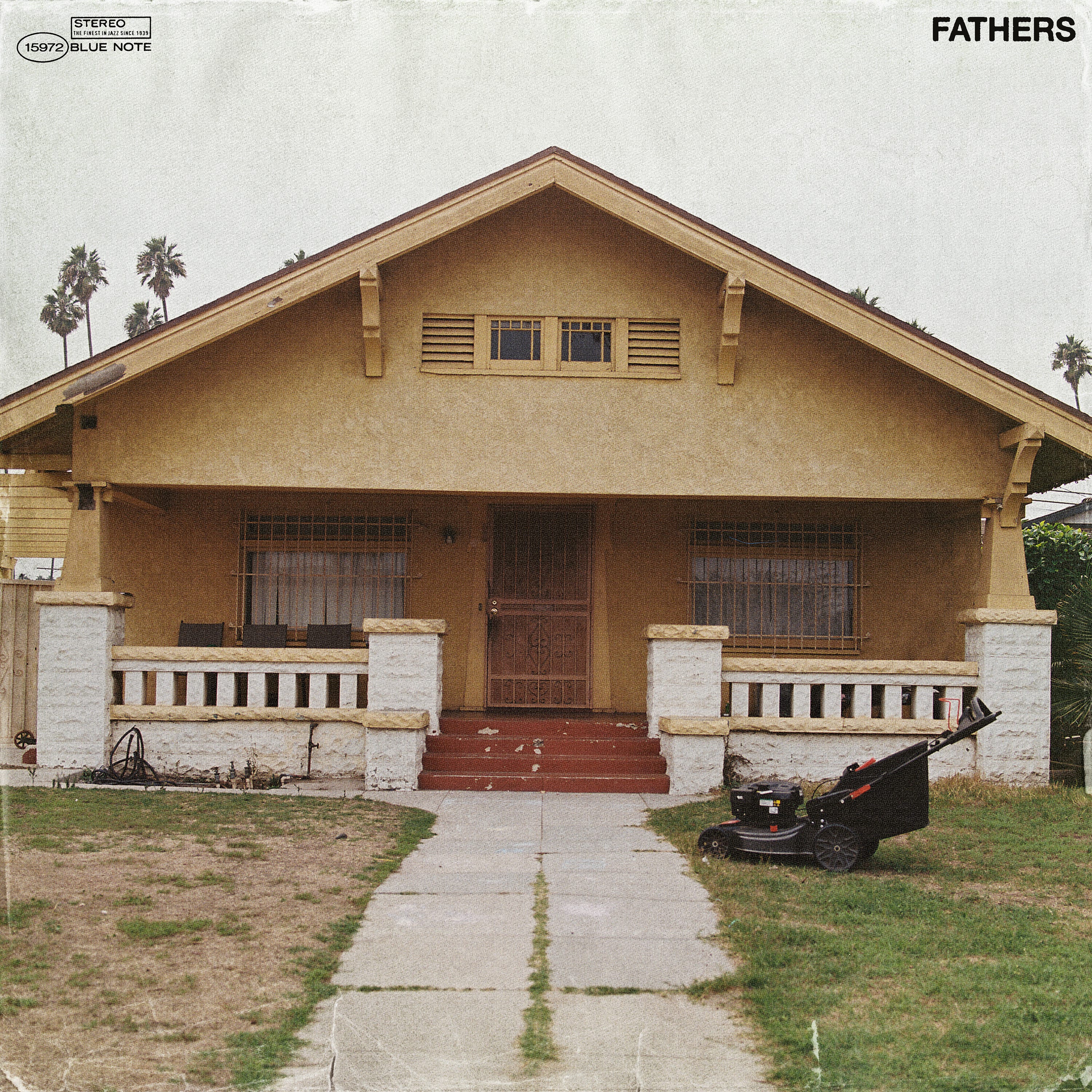
Putnam Hill was nearly finished. After spending months outfitting the LA studio with his own recording console, nothing had yet passed through it, so Kenny asked Kiefer to swing by and provide some work for the wiring. Conveniently, Kiefer was on tour with CARRTOONS and Nate Smith, three people Smith gathered in 2023 for his Montreal Jazz Festival residency and toured across the U.S. and Japan, and what would have been a mere gear check became a two-day session that none of them had expected. “Turns out the board works just fine,” Kenny later said. They left with new songs and a new name, FATHERS, inspired by the word Kiefer called anyone he liked playing with in the studio.
CARRTOONS rarely rests on any kind of root note. In “EYE LEVEL,” he converses with Kiefer, responding to him with a rolling, rounded melodic phrase, which stays active as Kiefer plays as though he were programming the groove and loosening it in the same breath, adding ghost notes and hi-hat details to keep the beat moving. Kenny polishes it to perfection and “PATCHWORK” further pushes the editing, fitting the keys, bass and drums in neat, syncopated fragments, musicians moving at the clipped, looped pace of a beat tape. Kiefer is concise, delivering his melodic phrases in short compact cells.
It pays off best on “PEARL.” With a light, slightly Brazilian-influenced groove, Kiefer delivers melody in short melodic phrases while Carr weaves complex lines between them. With nimble feet, Smith keeps the drums going fast, and the production has store-window gloss but doesn’t strip away the hand-played textures, resulting in a catchy instrumental ready to be whistled already on the second listen.
Smith approaches slower material in a different way. He keeps “THE LEAK” simmering, letting small movements inside the groove breathe life into time while Carr leaves his supporting role behind, providing long-lined melodic phrases as a second lead. Four of them play the song like it’s a live recording that was subsequently cleaned up, opening to the core and closed to the outer edge, where the tension comes from the tightness with which they track each other. “FIGURE 8” expands the most; the band cycles through repeated melodic shapes, giving them a different accent and weight with every return, using drums and bass to maintain the recurring rhythm and letting Kiefer and additional elements expand the melodic material over it.
After the stretching, they go narrow with “STUB,” fitting the material into one short, strong motif, the drums and bass delivering its muscularity, while the keys add punches and fills around it, the energetic playing sounding like a programmed track. “TOMORROW, AGAIN” becomes more delicate still, letting Kiefer carry most of the emotion in the forefront while pulling the drums back to pocket playing and leaving the bass to hold the ground underneath the chords, bringing a voice to the arrangement as another layer.
But it’s all Carr’s “FRONT YARD.” His bassline gets its melodic identity first and its weight second, allowing others to arrange themselves around it, with Smith adding small variations and fills into his patient groove, Kiefer delivering melodic lines on top of it, while the bass and keys lean on opposite sides of the beat, creating enough room for it to sound like a relaxed backyard jam recorded in a studio.
Great (★★★★☆)
Favorite Track(s): “PEARL,” “THE LEAK,” “FIGURE 8”