

Album Review: Forager by Cadence Weapon & Junia-T
The Edmonton rapper and Toronto producer Junia-T turned thrift-store hunting into a full album concept. The clothes always lead somewhere else.
The Black Sound Experience was one of the very first shows to air hip-hop on Canadian radio, and Teddy Pemberton—the host of that show—came to Edmonton to do so. He has a son named Roland Pemberton, who grew up spending as much time at the experimental electronic parties in Edmonton as he did in the city’s underground rap scenes, rapped in math class, failed math, wrote about hip-hop music for Stylus and Pitchfork before he was even old enough to get a rental car. (He has since won a Polaris Music Prize for Parallel World in 2021, after being nominated for one four times over a fifteen-year period, as well as having served as the poet laureate of Edmonton.)
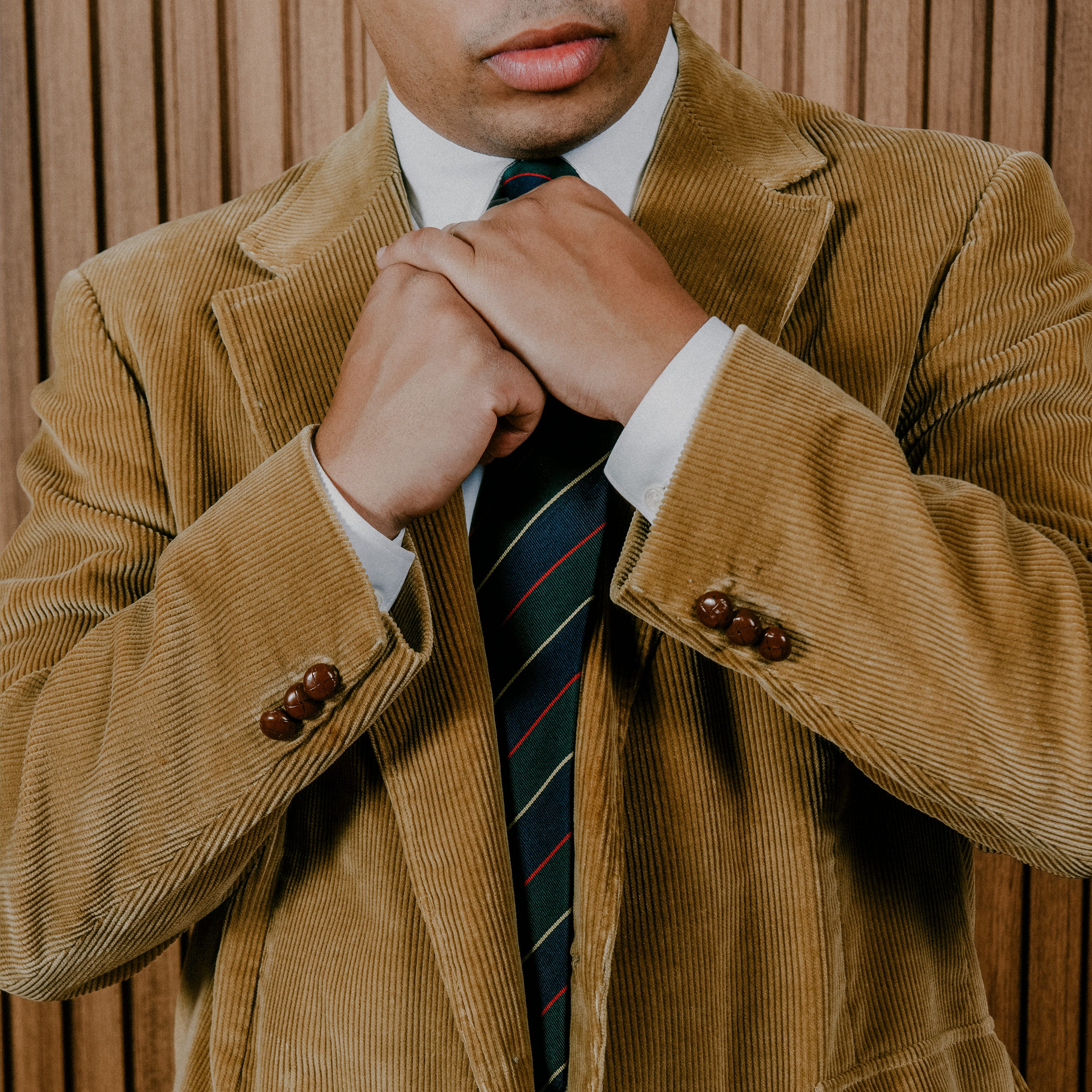
Roland’s sixth album, Forager, is the result of his collaboration with producer Junia-T and features a concept he has likely explained better than anyone else: his love for finding used clothing to wear and the methods he uses to find it. The album uses pieces, detailing about vintage items he purchased while driving to the recording sessions and how they felt, rather than simply by looking at a photo or video image of the item. He purchased a Harris tweed blazer (made out of virgin Scottish wool and handwoven in the Outer Hebrides) on his way to the studio, and when describing it to the listener, he does so in the same way that a baseball card collector would describe a rookie card.
Another example is the interlude immediately preceding the track “501XX”, when he describes a pair of hidden rivet jeans that sold for 25K at auction. Additionally, in between tracks, there are mini-interludes featuring other thrifters talking about different aspects of being a veteran thrifter, such as the importance of touch when thrifting rather than sight, as well as other items that are similar in nature to those items he has purchased. Forager’s rhythm is reinforced by interludes like those mentioned above throughout the course of the album, rather than just the raps. In “Fall 2012 Couture,” Pemberton raps:
“Took a lifetime for me to find these perfect jeans
Took a lifetime for me to find these rhyme schemes.”
For him, it is the same process of patience to find the proper jeans and the proper bar. This couplet sums up the entire concept in two lines.
Junia-T produced all twelve tracks and nearly quit doing music after releasing an unsuccessful debut in 2014. He rebuilt through Addy Papa’s Riot Club sessions and then released Studio Monk (2020), which earned him a Polaris longlist nod and a 9/10 from Exclaim. He’s also Jessie Reyez’s touring DJ, which is how he makes a living. The soundscape on Forager is much warmer and much bigger in space than any previous beat Pemberton has flowed over, no longer jagged or claustrophobic. “Babymoon” has a loop that’s soft-sounding but never runs into the verse. “Barabbas” has this addicting head-knock, but still leaves many gaps in between for Ariel’s hook to fit into. “Yves Klein Blue” includes an interlude about Klein’s blue and how it has no boundaries; the music below also spreads out to match. Whereas Pemberton’s previous self-produced records felt isolative, each of these tracks was designed so his voice could be put forward and have enough space to place his words.
Before most of his counterparts ever made a second mixtape, Pemberton completed work for Pitchfork, published a memoir, and was named poet laureate. Much of the appeal and, at times, the knotty nature of the bars that Pemberton produced on Forager are caused by their density. “Alpenflage” alone references Carlos Alcaraz (the tennis player), Dapper Dan (the designer), David Cronenberg (the director), Alan Erasmus (the artist), and the Gang of Four (the band). “Barabbas” references the War of 1812 and Bob Dylan’s awkwardness at the We Are the World session. “501XX” states that he is the Black Ryan Ferry and then drops to Oaxaca and is wearing a Mexican bracelet. For some of the best verses, he finds a groove between name-drops. The verse for “Niagara Region” talks about eating fancy cheeses with his wife, she orders Riesling, then he describes the all wool barn jacket from Woolrich as if he were outside trying to tap maple trees.
It was surprising to hear the domestic songs, starting with “Babymoon” about his trip to Miami’s Arts District with his wife before their son was conceived. Hearing the way the interlude of the babymoon was spoken as a memory that he got to share as his wife ordered a blazer was something that allowed me to realize I don’t have the same experiences as someone who’s experienced domestic life. The second domestic song, “Toronto Zoo,” states that Pemberton talks about his therapist improving his life and about how his parents could not afford to keep the lights on. “Barabbas” circles a spending addiction and a dopamine obsession, then drops to the only thing that matters: “Making sure my son’s protected and my wife is respected.” He’s still flexing on every one of these songs, but the flex is carrying different cargo. On “Fall 2012 Couture,” Pemberton raps that he’s a dad disposing of vermin, and in the same breath that he still cops a shirt whenever he gets nervous. Shopping as a tic, right there in the lyric, no winking about it.
Canadian geography is the album’s ballast. Edmonton is the origin (born 1986, poet laureate, grandfather Rollie Miles in the Eskimos’ hall of fame), Toronto is work, Hamilton is home now. The Niagara region is a weekend trip, the Riesling and the exotic cheese, Pemberton living in the country he grew up in, not touring it. And he raps about Oaxaca and Hamburg and North London too, but those places read as postcards from a suitcase; the Canadian cities feel inhabited. “Alpenflage” has him saying he just went to Hamburg and back to Hamilton, and the domestic return is the one that rings true. International references for flex, Canadian addresses for autobiography.
The loosest track on the album is “Step Out,” DijahSB trading verses with Pemberton over an OutKast-indebted hook. DijahSB raps:
“I stay bomb like the Hundreds, drip stay cold like the tundra.”
They sound like they’re having the kind of fun that Pemberton’s denser verses sometimes crowd out. “Raghouse” has a similar energy, Pemberton dressed as security at Altamont in biker boots, Ariel singing about pockets full of love notes, and the whole thing moving with a looseness that suits the rag-house conceit. The fashion bars on both tracks are funny. He needs your opinion the way he needs another tote bag. He pulls up dressed as Bebop and Rocksteady. The clothes talk is the record’s motor, and the tracks that run on nothing but that motor still run well.
Pemberton admits on “Fall 2012 Couture” that the poetry might be leaving him, that maybe his mind is deceiving him. A few bars later he pairs the jeans and the rhyme schemes into a couplet that says otherwise.
Great (★★★★☆)
Favorite Track(s): “501XX,” “Babymoon,” “Niagara Region”