

Album Review: From Takoma with Love by Oddisee & Heno.
An Ethiopian-Eritrean rapper and a Sudanese-American producer from Maryland’s DC suburbs pool two decades of diaspora into one record that names every corner.
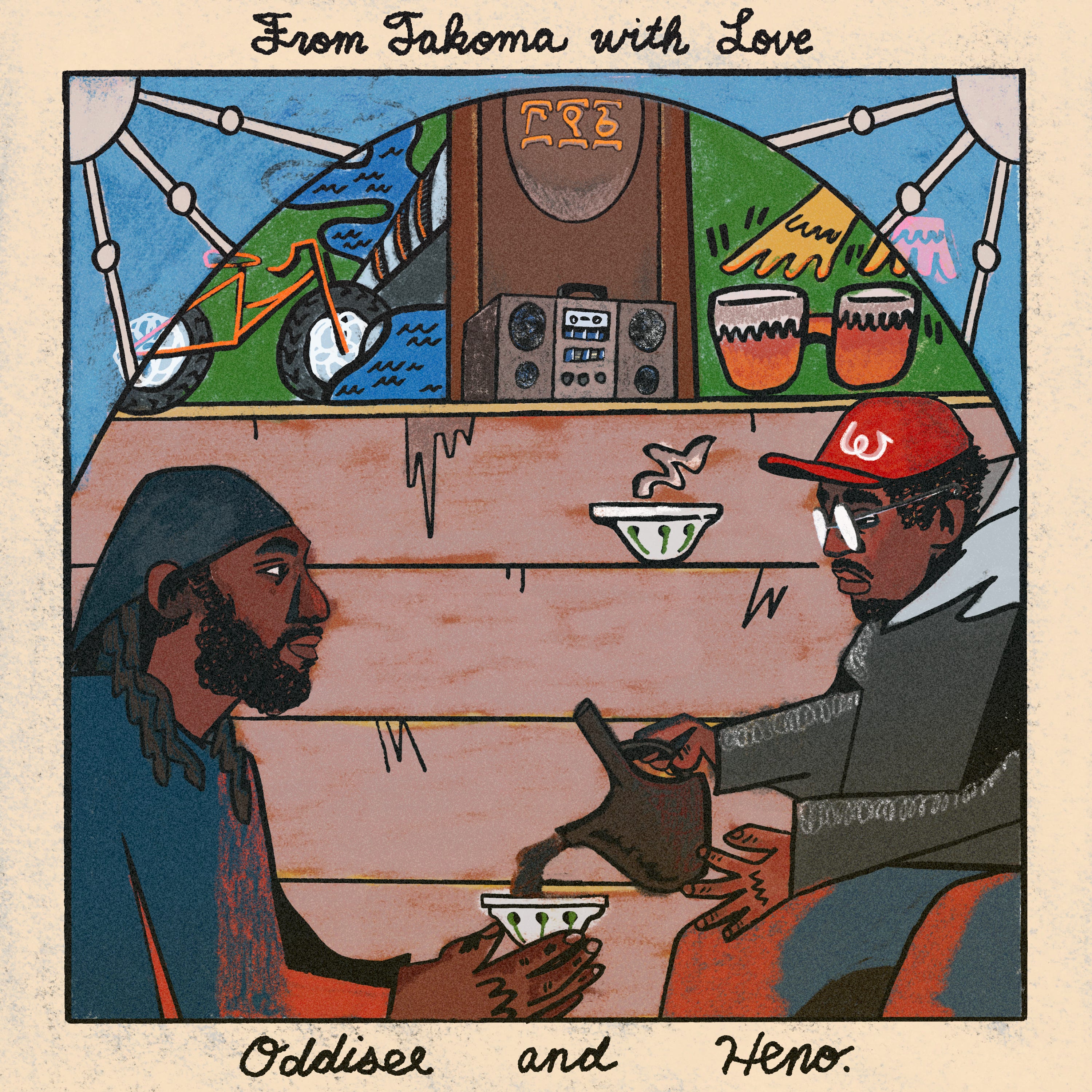
The Maryland suburbs of DC produce musicians who get called yankees by the South and southerners by the North, who rap about PG County and Takoma Park to audiences that have memorized every block in Bed-Stuy and Compton but couldn’t locate Sago Creek with a search warrant. Oddisee, Sudanese-American, raised between Silver Spring and PG County, has been making this case across twenty years of albums and production credits; his first major placement was on DJ Jazzy Jeff’s The Magnificent in 2002, and his own label, Outer Note, was built by 2020. His mother, an activist from Southeast DC, said artists have the ability to reach people that are unreachable. And that instruction sits under everything he does as a producer (an almost parental patience in how he builds a beat and then steps back). Heno., first-generation Ethiopian-Eritrean, raised in Takoma Park, a generation younger, has been nomadic since leaving—Oakland and LA and back again—carrying a name he hid for years. Yihenew is Amharic for “this is what you see is what you get.” The period at the end of “Heno.” is the punctuation of reclaiming it. From Takoma With Love is their first record together, co-credited, and the town is all over it, street names and intersections and corners where things happened to children who are now old enough to rap about them.
Heno. opens “Woe Is Me” at Maple and Lee, where he caught his first fight and saw his first play on the pavement, and then his world broke: “I was mistaken to be a drug dealer pushing pills, I was only six, dog, how you cuffing up a child?” The question has no answer. He was young, gave up smiling, the undercovers kept riding through, and he would be lying if he said he was not still bitter. He grew weed, started making beats, never thought about how far they would take him. Oddisee takes the second verse and raps his own childhood in parallel, “Product of immigration and disengagement, a combination of food stamps and visas, not came in as a student and now the teachers is overstaying,” then adds, level, “Don’t define me by what’s behind me and what I been through.” Two men in their own decades of the same suburb, one Ethiopian-Eritrean, one Sudanese-American, placing their early years next to each other inside a single track.
The first minutes of “Right Steps” feel like any other success-story track, soul-inflected chords while Heno. talks fine print and alignment, remembering being broke in a Visa line, turning goals and dreams to life. Then the beat changes and the song changes with it. “Land of the free and the home of the brave, when it be the land that was seized and controlling the slaves.” And: “just a Black man with a few shots and a white man in a blue cop.” The beat switch is the difference between the version of your life you perform for employers and the version that comes out at 2 AM.
Oddisee’s own verses arrive from altitude. On “MIMS” he sounds ground down by the very success he chased, “Just today I had a rack of stress, I’m on a DND so I could catch a breath, kids crying, I was busy driving and my mother called me, so I had to text.” He almost ran a stop sign. He doesn’t rock with music that isn’t hitting, “your top five is not mine,” and if your hand is out with no pen in it and no notes taken, he takes offense. On “Round the Way” he names Largo High, Sago Creek, brothers in Merlin, family in Toronto, “my father in Sudan surviving janjaweed,” and declares he never feels alone. On “Guiding Me” something else happens: he remembers being alone and happy, then realizing a hole had opened that only family could fill, a void he didn’t recognize until it drew him close. Heno. writes from the scramble, trapping and robbing and getting out. Oddisee writes from the years after, when making it revealed its own kind of confusion.
The roll call happens on “Round the Way.” Heno. names himself: “I’m Amar, I’m a Roma, and I’m Tedraz, and I’m Eritrean too,” and follows it immediately with “it’s still free Palestine, they were rooting their land.” Family in the Bay who ghost ride, people in LA on both sides, women in VA who go both ways. Oddisee’s verse matches the reach (Largo High, Sago Creek, Berlin, Toronto, “my father in Sudan surviving janjaweed”) until both of them have covered most of a globe from inside one song. And on “Woe Is Me,” Heno. watches “Zionists debate about it” while he’s still bitter about getting cuffed at six. The personal and the political share a sentence on this record because in Takoma Park they always did.
Self-hate gets a name on “Guiding Me.” “Programmed this way, it ain’t no accident,” Heno. says, then goes specific: “offer up minimum wage and respect it,” memories of kitchens with bath holders, “started robbing in the tenth grade, thinking about it all give me headaches.” Did it occur to anyone that he shouldn’t have to fight for his own life mattering? Zaïna’s chorus, “I’ve been in my head too much, that’s a place I don’t like to be, hate anxiety, blame society, but I got angels at all angles guiding me,” gives the song a prayer’s cadence after a record’s worth of grinding and justifying and keeping score, faith and exhaustion sharing a breath for the first time.
Food stamps and jewelry pawning and moving units and the bando: “Trish Status” has momentum but recycles without the Maple and Lee precision or the “Right Steps” surprise. “Can’t Look Back” says what its title promises and not much beyond it, you can’t look back, you’ll crash, karma is true. These are songs where the I-made-it voice outruns the detail, where the writing says I outlasted my beginnings without specifying which block or which winter. Aurelius Street in Germany, herbal tea, a set nobody expected: on “Good Habits,” nobody there had heard of him, then he did a show and suddenly they urgently wanted to work with him, and he earned a fee, and he let his purpose feed from him. A kid from Takoma Park who learned a set of codes around the same time he was told to eat his vegetables, now halfway around the world, rapping about the same things to people who can’t pronounce his name either.
Great (★★★★☆)
Favorite Track(s): “Woe Is Me,” “Right Steps,” “Round the Way”