

Album Review: Greed Tastes Like Power by SUBSTANCE810
SUBSTANCE810 raps about money as maintenance work here, from credit repair to reinvested checks to a box truck at the post office.
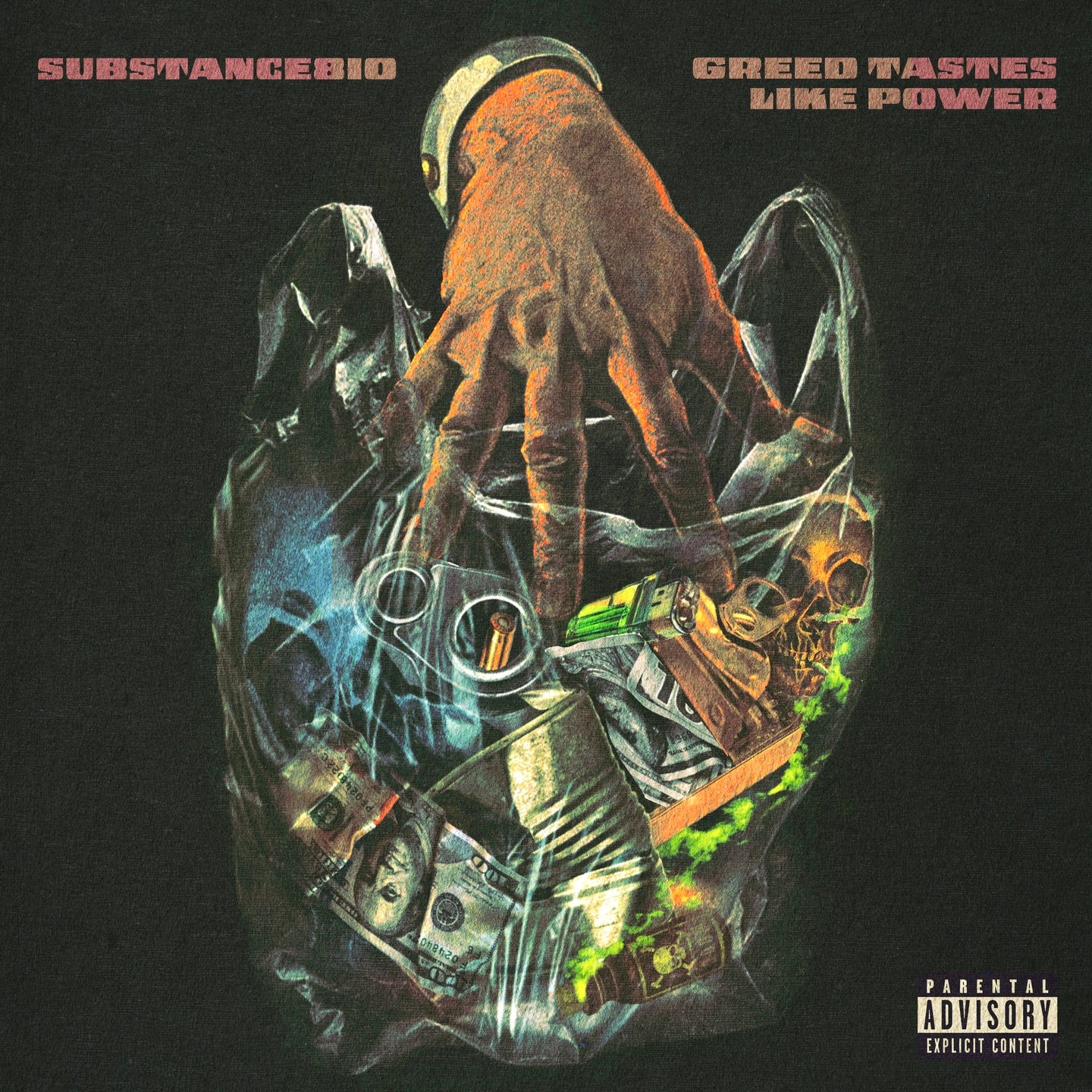
SUBSTANCE810 spends his time cutting a record with a certain producer, releasing it into the world, selling a few hundred copies to those who still pay attention to who produces their music, and begins making another one during the rest of the month. He comes from Port Huron, Michigan—the 810 comes from the local area code. As a member of Umbrella Collective, he releases his solo work with Greed Tastes Like Power, which deals with the money aspect, how to acquire it, keep it and what is required for a person not to get angry during the process.
The mood on “Gordon Gecko” looks like paperwork. He smashes the post office with a box truck, re-deposits a check and pockets the gross amount, and does the credit repair for a while to point out that seven-fifty or higher makes one a heavyweight. He says that he has learned to simplify and delegate. The lesson of “Money Never Sleeps” is the most elementary lesson in any business: not how much you make, but how much you keep matters. Below that verse, you find that it also describes household chores, keeping the line in the water, selling it to a well, the premature failure and freedom as the major goal. “Kindness for Weakness” features him doing jobs of a shepherd and baker, moving the units like chopping grams, playing his hands like playing Monopoly and being certified in making distinctions while using his verbs like Swahili. He can handle both burners, the oven and the blicky. If he does not see the legal CREAM, he schemes and does it dirty, and it arrives with no ceremony at all. He keeps his collectibles in a top loader. There is nothing aspirational or oversold here.
You know, overselling is what “Gluttony” is for. The threat lasts just a couple of rhymes – using a few non-Snap-on, and then it is precise with metal as with CNC. This rapper thinks his first plan works well enough so he doesn’t even try to create some other. Your rap is soft, he says to whoever wants to hear it. No one is looking at you anyway; people look through you. He is as rough as uncut yola without soda. Later he reaches his peak, and he is ready for the action; the last five years seem to be the culminating moment. After that, he leaves you where you were for his family; that is the one thing he is honest about.
Van Ness Street is a place where honesty comes true, and on the track “Self Preservation,” he tells about being raised on this street and not having been raised weak, according to his words. He says that he saw drums long before he made his first beat; in that case, the pot was boiling, but no one was preparing tea. As he raps, his boat was poked with holes, and it did not get water. Being a hustler, he compares selling his words to being a good salesperson.
The selling of words transforms into doubting of them in “Clear Conscience” outro. The character calls himself paranormal due to his unusual gift. However, he changes his mind, seeing that everyone tells him he is different, and he is afraid that he is normal. “If you do not write the story by yourself, others will do it for you”, he states. He mentions some mornings he does not feel like getting out of bed, but gets up, as there are worse people. His son grew up, no longer a child, and the rapper has to do many things as time is limited now. His son even made the honor roll, although he hated going to school, as he carried packs to teachers out of spite.
“Bee Stings” continues the cycle of spiteful raps, and Squeegie Oblong, who comes out of nowhere, with Amazon helping people to move and has a special clock which he punches when he wants. Squeegie says that he does not perform any additional shots or punchings and likes his music. His words, “Born and raised in the jungle/Moved on, got caught up in the zoo of life feeling like a domesticated uncle,” made the people think about their lives and dreams. At the end of the song, Jamil Honesty comes in asking where the skills for building are and answers with the Viking vowels, the devil dancing on the Sabbath like Cab Calloway and a flute opposite the tuba.
The fourth voice of the fourth song takes the last verse in “I Can Feel It.” The character who was talking was making money through investments, not stocks. His mother sings Amazing Grace; memories in pictures on the wall can be seen when one makes it. Later, dialogue takes place, and the song is no longer personal. The hook “Money Never Sleeps” fades away, becoming the general message about enduring rain, snow, or sleet, something that can belong to anybody.
Company forces him to work; that’s all that is heard in “Monopolize” and “Mice and Men.” He is filling a second safe, thinking about generations to come, planting seeds and reaping them, collecting lottery bags and the pile of money he claims is where he needs to be. John Jigg$ sells his music and says that it feels like he is dealing again. P.U.R.E. eats sautéed asparagus and snails that he calls escargots, then names himself made man, bound by the cable tow. K-Prez threatens to cut off his cousin because he is shady; blood is thicker than water, but not enough for anything. On “Michigan Time,” competition falls away, and he is cruising through Michigan with Josiah the Gift. Over a DJ scratch hook, saying that he is not the weatherman but umbrellas should be used as it is going to pour and get dark as a tar porter. After that, he is hitting corners in the mitten, twisting a spliff in his ride, eating chips with a dip on the side. Nothing in that verse is about winning. He simply likes driving.
Great (★★★★☆)
Favorite Track(s): “Self Preservation,” “Bee Stings,” “Clear Conscience (Outro)”