

Album Review: I Am a Woman Again by Vahn Black
Vahn Black closes a trilogy rooted in Gladys Bentley’s 1952 forced confession with an album that refuses the same bargain and gets free by giving in to someone worth giving in to.
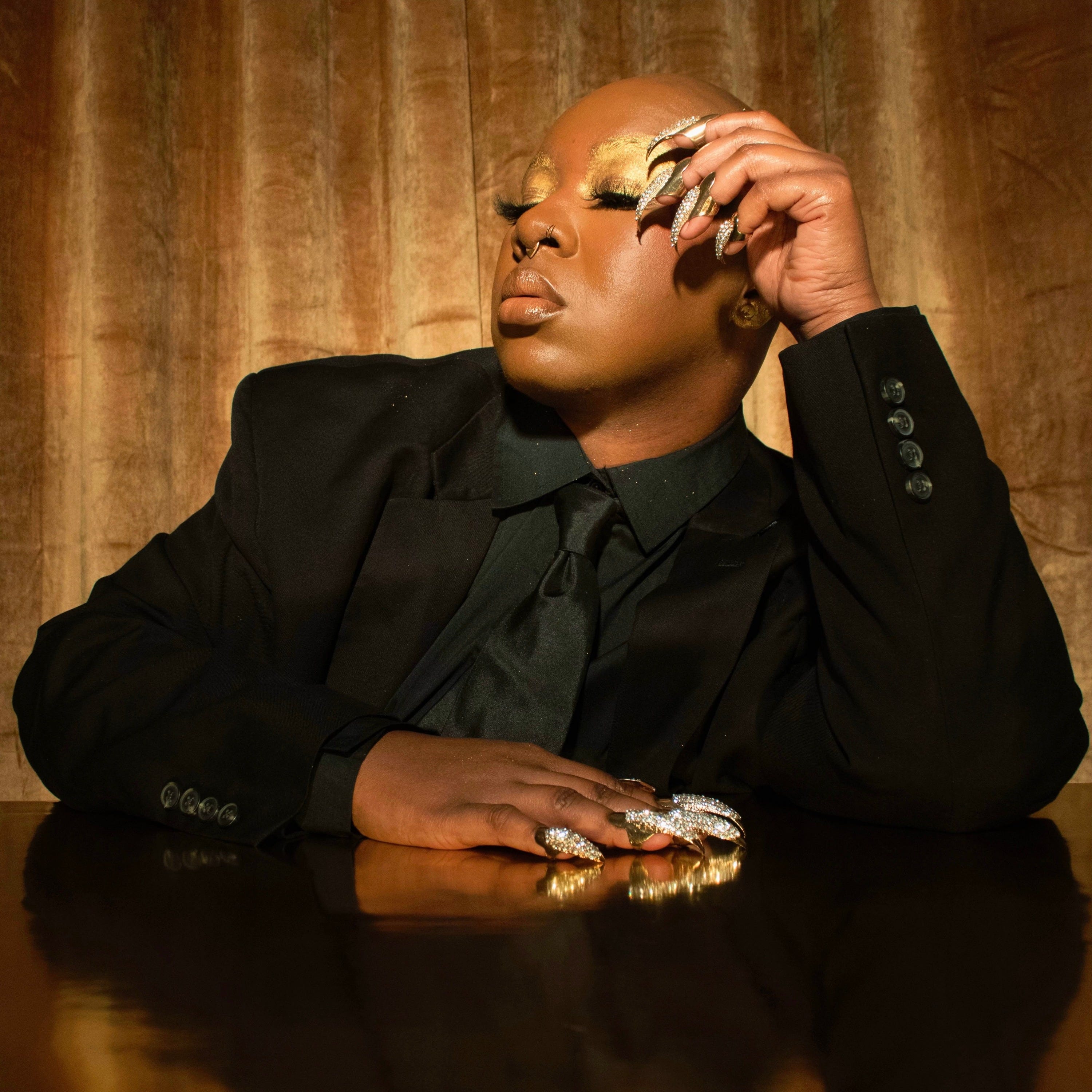
In August 1952, Gladys Bentley published an essay in Ebony magazine titled “I Am a Woman Again.” Bentley had spent two decades as one of the most visible queer performers in America, a blues singer who headlined Harlem speakeasies in a tailored tuxedo and top hat, who flirted with women in her audience, who once claimed she’d married a white woman in Atlantic City. By 1952, the McCarthy era’s Lavender Scare had made that visibility a career death sentence. Censorship tightened and bookings disappeared. So Bentley wrote the essay, claimed hormone injections had “cured” her, described marrying a man named Charles Roberts, and announced her return to womanhood. Scholars who’ve studied her life read the essay as a calculated retreat. Bentley needed work, and straight domesticity was the only pitch left. Five years later, she was showing a Chicago Defender reporter photos of both her husband and her wife. She died of pneumonia in 1960 at fifty-two, newly ordained as a minister, the paperwork never finalized.
Vahn Black, a Detroit-born, Atlanta-based vocalist and self-taught producer, found that essay and spent the last three years building around it. Petrichor: The Joy of Gladys Bentley (2023) covered the early freedom. Walk in the Rain (2025) took on the unraveling. I Am a Woman Again is the final installment, released today, and it carries a question Bentley answered under duress that Black answers on her own terms. The title track puts the whole thing on the table in the first few lines as she says, “You’ll never get it right/Won’t see me eye to eye/I told you exactly who I was/And you said it was all right.” Someone accepted the terms and then renegotiated after the fact, and the speaker is done with it. “I know you want me to say/That I am a woman again” borrows Bentley’s headline, but the song drains the submission right out of it. Black is throwing the expectation back at whoever needs to hear it and refusing to satisfy. The demand gets specific in the next section.
“Can’t be a model of the standard form
That you’ve been told that you want
The loving, childless mother
With duties of a married wife
Foolish expectations, I will see no end.”
The romantic refusal on “I’ve Changed My Mind” takes a different shape. The speaker admits the sweetness was real, acknowledges they went past lust into something deeper, then shuts the door anyway. “You’ll never be the one,” she sings, and there’s no softening or maybe-later attached. The tenderness falls away completely in the next stanza, where she tells the other person their smothering affection is drowning her, tells them to give it to the air and let it breathe. Black sings that part as an instruction, not a plea. She has already gone. The song just makes it official.
On the opposite end of the album’s refusals, “What Can You Do” digs into something harder to absorb.
“The voices tell me to do things I wouldn’t do
And I see them all the time dancing around you
And I’m caught on many things I feel to be untrue
All the potions I refuse.”
She’s talking about hallucinations, medication, the daily negotiation of staying stable and deciding for herself which treatments she’ll accept. She describes hiding a scary state of mind, walking daily on a line, playing a dangerous game with time. And then a single request drops in, directed at God or a therapist or whoever’s pitching salvation that week: “I really need a savior/So is it true.” When someone who has refused every other remedy asks that plainly, you hear the desperation in the grammar, stripped of framing or performance, just the question sitting there bare.
“Drive” opens the album’s other register. Where the first few songs are about saying no, this one is about saying go. The opening paints someone polite with dangerous eyes, a shadow that only follows night. The next stanza dispenses with all code, jumping from “Take me to Venus, outer space” to “the floor or the balcony” in the same breath, covering interplanetary fantasy and the nearest flat surface with equal hunger. The bridge finishes the thought: “Let me ride, let me ride/Gas it up and let me ride/Don’t say where you’re going/Just surprise.” Surrender, here, is the whole point. She is choosing to let someone else steer, and the joy is in not knowing the destination.
“Stretch Me Out” picks up that trust in a smaller, stranger space. “Can you die for me,” Black asks, then adds that many have tried and most have failed. And then, quieter: “Like a prism, I’ll be here undone, open for you.” That “prism” stops you. She’s not describing transparency. She’s describing refraction, light bending, the self splitting into visible parts. “Homegrown (Show You Some Love)” shifts register again, from urgency to patience. The speaker brings a simple gift, whatever you want, given happily, all for loving her. The post-chorus states its philosophy without embarrassment: “Don’t take for granted the giver / ‘Cause I find pleasure in taking care of mine.” On a record full of refusal and crisis, this song just brings food to the table and asks nothing back.
The album’s strangest song tells a third person’s story. “Oasis” follows someone described as a “boy child” who dabbled here and there, went through tricky lovers, and showed heavy in the end. That “boy child” carries weight. It’s a description of gender before gender has a name, and the song tracks this person through a string of failed recognitions, people who underestimated her, lovers who couldn’t hold up. By the second stanza, knowledge itself has failed her, and she’s maybe now a river, or oceans of the same. The warning, directed outward, is blunt: “You say I don’t have the answers to it all/But you don’t either/So don’t go playing with things you don’t know.” The refrain, “Don’t play with water,” is a caution about fluidity itself. Not a celebration, not a condemnation. Water moves, water ruins things, and water keeps you alive, all at once.
Everything on the record funnels into “Undone.” The speaker who refused to perform for the title track’s audience, who cut a lover loose without apology, who described her own mental illness without flinching, who chose surrender on her own terms in “Drive,” ends up here, and the armor is gone. She sings about a heart and mind made heavy, about forgetting how to use vulnerability, about being lighter in someone’s presence. Then further in.
“Oh, the tender parts of me you’re holding now
Can finally make me complete
Oh, surely you’re my superpower
Gave me my wings, but I don’t wanna use them
Cradled my softness when others would have used it.”
That penultimate line is the one. Someone gave her the ability to leave, and she’s choosing to stay. That distinction runs through the entire Bentley trilogy. Bentley performed domesticity because the alternative was exile. Black arrives at tenderness because she tore up every false version first. The bridge puts the difference plainly: “You found a way for me to let you love me all bare.” “All bare” is the opposite of “a woman again.” One is a costume, while the other is skin.
Black self-produced every track here, and her background in jazz and classical training at Detroit School of Arts shows up mostly in the patience of the arrangements. Instruments enter and exit with room around them, and her voice never has to compete for space. She placed runner-up in the Detroit Jazz Festival’s Youth Jazz Vocal Competition in 2014, performed at NPR’s Tiny Desk on the Road in 2023, and has opened for Anthony Hamilton and Maze featuring Frankie Beverly, acts that prize vocal command above all. You can hear that schooling in her restraint. Even on “Undone,” where the emotional stakes peak, she doesn’t oversing. She goes where the words need her to go and stops. The record runs eight songs and doesn’t pad.
Great (★★★★☆)
Favorite Track(s): “I Am a Woman Again,” “What Can You Do,” “Undone”