

Album Review: I Guess I'll Never Learn by S. Fidelity
S. Fidelity’s third LP runs seven vocalists through the same doomed love cycle. Most of them sing the heartbreak better than he could, but chose where every wound goes.
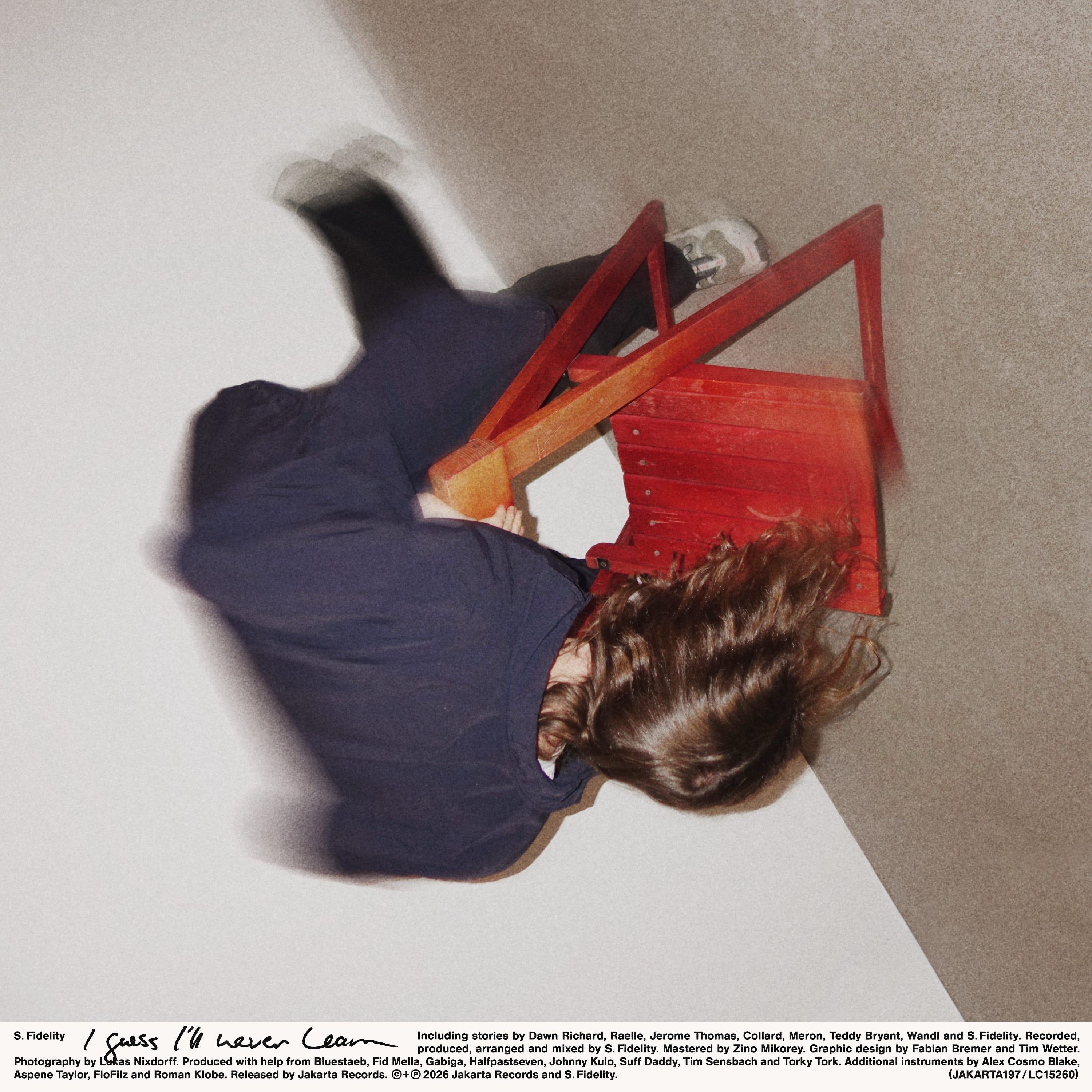
S. Fidelity grew up in St. Gallen, Switzerland, burning compilation CDs with his friends, competitive ones, where the whole point was finding records nobody else had heard. He started DJing and producing on his mother’s computer at thirteen, no lessons, no formal training, just obsession. That collector’s ear is all over I Guess I’ll Never Learn, his third release on Jakarta Records and the first one where he stopped trying to prove how many genres he could fit into a single listing. Fidelity Radio Club from 2021 was a radio-show concept with contributors bouncing between hip-hop, house, jazz, and funk. This one has thirteen cuts, seven vocalists, and a single subject. Wanting someone, having them, losing them, wanting them again. The production is warmer and more patient. The music matches that readiness, no dead air between ideas.
Dawn Richard opens “Play” like she’s already halfway through the night. “We like to fuck/we like to play, babe,” and she rides it for four minutes without parrying. She wants the rules broken, the privacy optional, the whole meal, and by the third section she’s spelling it out:
“Make it drip drip like raindrops
Lick to center like it’s a blow pop
We can roleplay you’re the good, I’m the bad cop”
Richard is one hungry artist. Jerome Thomas picks up a similar charge on “So Good,” singing “I’m picking up that body like I stole it,” but his voice carries a sweetness that undercuts the bravado, and when he sings “it’s the best I ever had,” he turns more grateful than greedy. His second appearance, “24h (Joyride),” complicates the pleasure. A woman wants a lover, daily calls, a strong base, a home. Thomas tells her, plainly, “I don’t want you for life/But I want you tonight.” He’s not cold about it. He spells out what he can’t give, singing “I don’t think I can give the full scenario/passion for just one night, though,” and the slow-building keys and drum patterns underneath never quite settle, mirroring the offer exactly. Twenty-four hours, jet flights, then the trip expires.
Collard and MERON put “Limbo” in a different place entirely. “I wish I was somewhere else right now” is the opening confession, and neither of them can get past it. Collard’s delivery splits between singing and something closer to talking, and when he reaches, “I could die in pursuit of you/I’ve already crashed twice, it’s true/I’m already baptized in you,” the weight of those three rhymes piles up fast. Raelle, who appears on three of the project’s thirteen tracks, gets the most internal writing of any voice here. On “Siena (64kbit/s)” she admits she can’t choose herself over the other person, can’t stop losing herself in them. On “Crimson (64kbit/s),” both tagged with that lo-fi compression label and both sounding like they’re being heard through a phone speaker left on a nightstand, she asks to be allowed into someone wholly, not partially (“You held me like I had something good in me.”). On “Grey Mirror,” she flips (“You took my power/I’m coming for your blood.”). The same woman who couldn’t stop losing herself is now tearing apart everything she loved, spreading her poison, demanding validation for the pain. Raelle’s three songs, taken together, are the sharpest character work here, and the way S. Fidelity places them across the record lets her anger arrive with a history behind it.
S. Fidelity himself sings on two joints, and they are the most interesting spots on the record. “When Dumb Thoughts Learn How to Walk” is built almost entirely from three phrases, “on my way out,” “let it go,” and “break the surface,” stacked and layered until they blur into texture, someone rehearsing an exit. “Two Steps on the Water” is mostly instrumental, with vocal fragments that surface are scattered and unguarded. “Bobby Hollywood,” another instrumental with an Alex Cosmo Blake guitar contribution, gives the LP its one clean breath of air. Two vocal pieces and an interlude, and they’re where S. Fidelity’s personality shows up most clearly.
“Glass on the Floor” is the hardest song to sit through. Collard returns, and everything that was stuck in “Limbo” has broken.
“Another hang time
Another landslide
Your fingers brush mine
For the last time.”
He is bargaining with God: “If hope doesn’t float, and we no longer cope/then I’ll pray for a deity that I can cling to.” It is the most defeated moment across all thirteen songs. Collard opened his first appearance unable to leave and now closes his second unable to stay—the sequencing’s cruelty feels deliberate. Wandl’s title track follows; all exhale. “Hold it tight, let it go.” “Real love is free.” “Every day I spend with you is a blessing.” The simplest language on the record, the slowest pulse, FloFilz’s strings curling underneath.
The casting is the bet, and it pays. Teddy Bryant’s “Limelight” opener, all promise and warmth, singing “let me change your life today,” is the ‘weakest’ song precisely inasmuch as it’s the most uncomplicated, but the LP needs someone that earnest at the front door before everything goes sideways. Dawn Richard and Jerome Thomas carry appetite and its limits. Collard carries paralysis and ruin across his two turns. Raelle moves from self-loss to rage over the course of three appearances, and Wandl closes everything in surrender. S. Fidelity, on his own two cuts, contributes confusion, the kind that doesn’t clean up into a verse. The vocals were recorded through that Sontronics valve mic into an Apollo Twin X, processed in Ableton, and across seven singers the tonal differences are wide enough that each voice enters carrying its own weather. What keeps all of it cohesive is the production’s refusal to push any of them toward the same place. No wasted song, and the cycle spins exactly once.
Great (★★★★☆)
Favorite Track(s): “Limbo,” “Play,” “Glass on the Floor”