

Album Review: In the Hour of Chaos by Allison Russell
After two albums telling her own survival story, the Montreal songwriter starts making house calls. Her third is the warmest, most crowded record of her career.
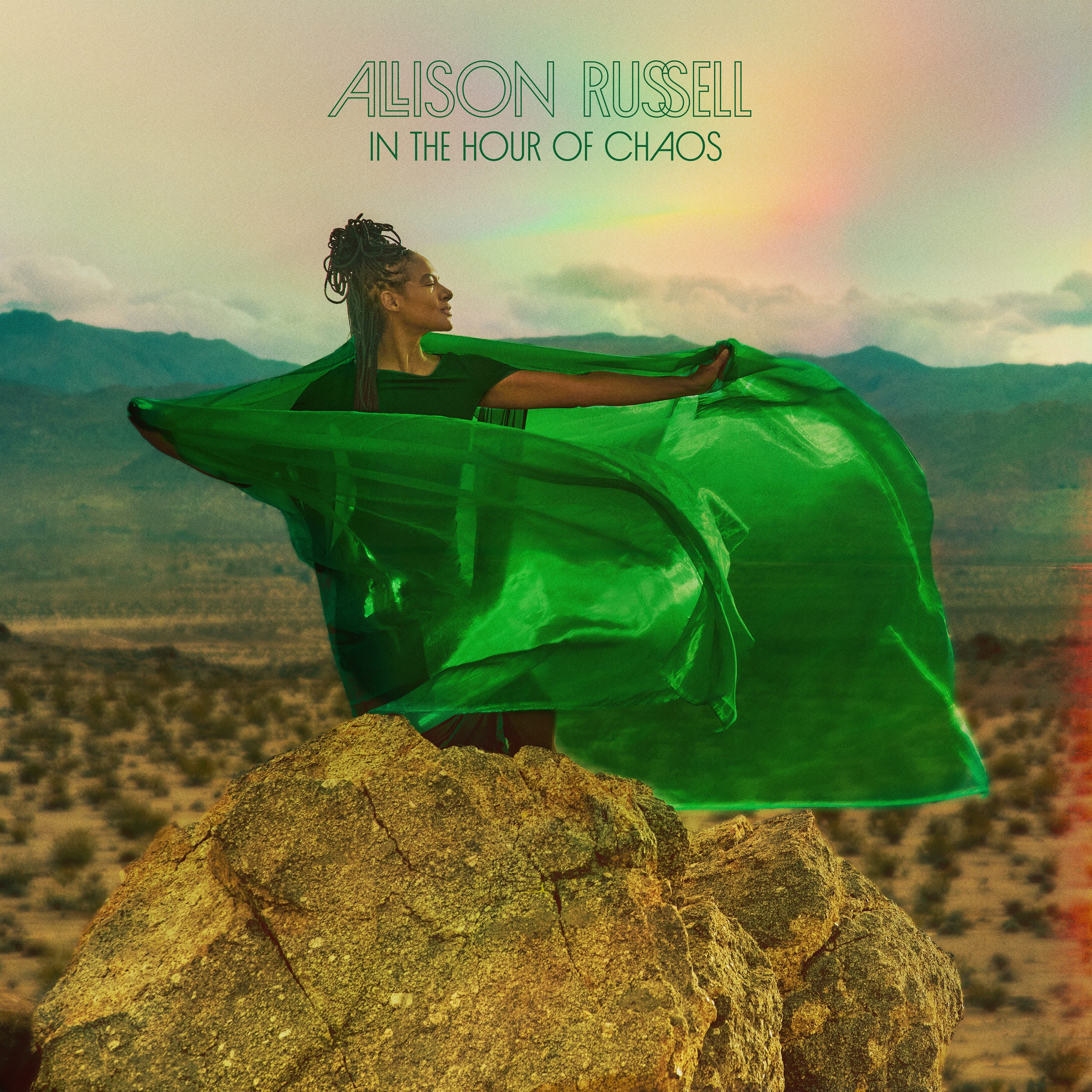
For two albums in a row, the story belonged to her alone. Outside Child put a name and an address on a Montreal childhood behind an abusive stepfather, and The Returner threw the survivor her homecoming party, making it big enough that “Eve Was Black” earned her the Grammy for Best American Roots Performance. Allison Russell writes and produces with dim star, the musical partnership of her husband JT Nero and Drew Lindsay, and the three of them pointed her third album, In the Hour of Chaos, the other way, towards the people she loves and the trouble they are in. She brings with her a banjo, a harp player, a youth choir, and more duet partners than there are chairs at a Thanksgiving table.
One of those doors leads inside a woman whose fight-or-flight cannot be turned off, and Russell comes through in “Black Lavender” bearing cures, asking “What’s it gonna take to bring your heart rate down?” and answering “Palo santo incense, lavender tea and kindness” as items on a nightstand, Brittney Spencer’s voice adding earthiness to a chorus addressing the sufferer as a black swan who has “rivers of adrenaline” in her and just needs an ocean to pour into. She offers the same cure in “Chaos Theory” in more casual clothing: “We can watch something stupid on TV,” fingernails stroking the small of the back slowly, slowly, with Wendy Melvoin’s acoustic guitar grounding the song, and Kyshona and Sara Watkins harmonizing around her as the arrangement builds. She promises it in the chorus: “In the hour of chaos/In the hour of despair/You’re gonna feel my love coming down/You’re gonna feel my hands in your hair.” Then she goes to “Miss Mary Mack,” the old hand-clap rhyme, and sings it for a friend who reached too high, “Come back, come back,” until the asserting becomes “Mary, choose us.”
The same woman begging for Mary to come back down from the sky starts “No Springtime” counting songbirds, three in the meadow and two by the lake, hoping the right number can make easier “What’s gone is gone is gone is gone,” and sings it to a friend trapped in a loop, rubbernecking a car wreck on the highway and seeing herself dying on the road. She nips the sermon at the end of the chorus with Joy Oladokun singing a more grounded lead underneath her: “I’ll never cast that stone on you/’Cause oh my God, I do it too.” The caretaker gets tired on “Really Real,” a slow, settled duet with Norah Jones, where she confesses “I’ve been driving while you sleep” and “You never see my indigo mood,” then wonders whether anyone will relieve her when her own eyes get heavy. Kashus Culpepper opens “Searchlight” with the life of a refugee, fleeing from himself in the middle of burning buildings in the night, and Russell sings back in kind: “Lately I’m more lonely when you’re home than when you’re gone,” texting from the next room. They close the song trading parts, with Russell singing the searchlight part and him taking over as comeback kid.
Russell provides the rescue on another one of those songs on her banjo, the jittery, picked pulse running around “Two Stars” along a duet with Chibueze Ihuoma, which opens where breathing is hard and where it is safer to hide in the back of one’s mind; her cure is a hiding place as well, “a place where I keep/All the reasons you forgot for living,” plus a pep talk with the sugar distilled out of it: “There’s no time to fuck around.” Devon Gilfillian turns “Love Is a Golden Lion” into call-and-response over a steady beat, two voices taking turns singing the vow, “My love is a soft rain/My love is a golden lion,” both of them promising that their love comes roaring back the second the other stumbles. And Ahya Simone’s harp ticks the clock on “Good Omens” as minimalist and suspended as a ticking clock could be, while Russell reads omens in a black butterfly the size of a sparrow in sunlight on brown skin and light on freckles, a white dog trotting in front of her through the greenwood.
That greenwood is a short walk from a grandmother’s window, where Russell sings “Rainbows” under black clouds that hang low on the sky while the child looking out of the glass feels warm, safe, and maybe blown away. Russell explores childhood with the tongue exploring a loose tooth, the horn sewn onto the pony’s forehead, stars stuck to the ceiling above the bed, and an old willow bending its branches over the little one, and in the middle of the warmth she warns about her own trade: “I can sing you words and words and words/But, baby, don’t trust us mockingbirds.” It is the most direct expression of the limits of her own cures she allows herself.
Ruby Amanfu sings on the song she would have you trust anyway, her clear second voice floating over the claps and keyboard push that make “Just Like Saturday” break free of the slow sway some of the surrounding ballads slip into, the same bass, drums, and keyboards underneath a few of those ballads, waiting on a guest vocal to save them. Grief travels in the middle of the song anyway: “Like six white horses pullin’ somethin’ beautiful/Six white horses pullin’ somethin’ beautiful away,” every day going Sunday. The two of them are building something out of a stone that was pulled out of a mountain stream, on the most straightforward terms in the song: “If you shelter me, I will shelter you.”
The sheltering deal passes down to children on “Cold April,” which opens with a counting rhyme: “It’s one if you’re scared, two if you’re sad/Three if you know it’s really that bad.” Russell answers it with her inheritance: singing that sometimes it snows in April, a song she learned from her mother when she was a child, when 88 keys and a broken heart couldn’t heal but made it feel alright. The second verse teaches the lesson to a father, as there are 99 ways he broke her heart, and still “He couldn’t make it bitter ‘cause we took back the night.” Kara Jackson and Denitia add rough edges to the harmony around her, and when the Explore! Pop Choir takes the refrain, the message beneath becomes clear: “There’s not enough bullets, not enough guns/They can kill the bird, but not the bird song.” She calls all birds in the nation to come together for a new murmuration, and the youth choir responds, a room full of new voices singing her mother’s weather back to her.
Great (★★★★☆)
Favorite Track(s): “Cold April,” “Chaos Theory,” “Two Stars”