

Album Review: in this body by Sparklmami
Cut live and mostly in single takes, Sparklmami’s debut moves between Spanish and English over a band steeped in boleros and 1970s Brazilian jazz.
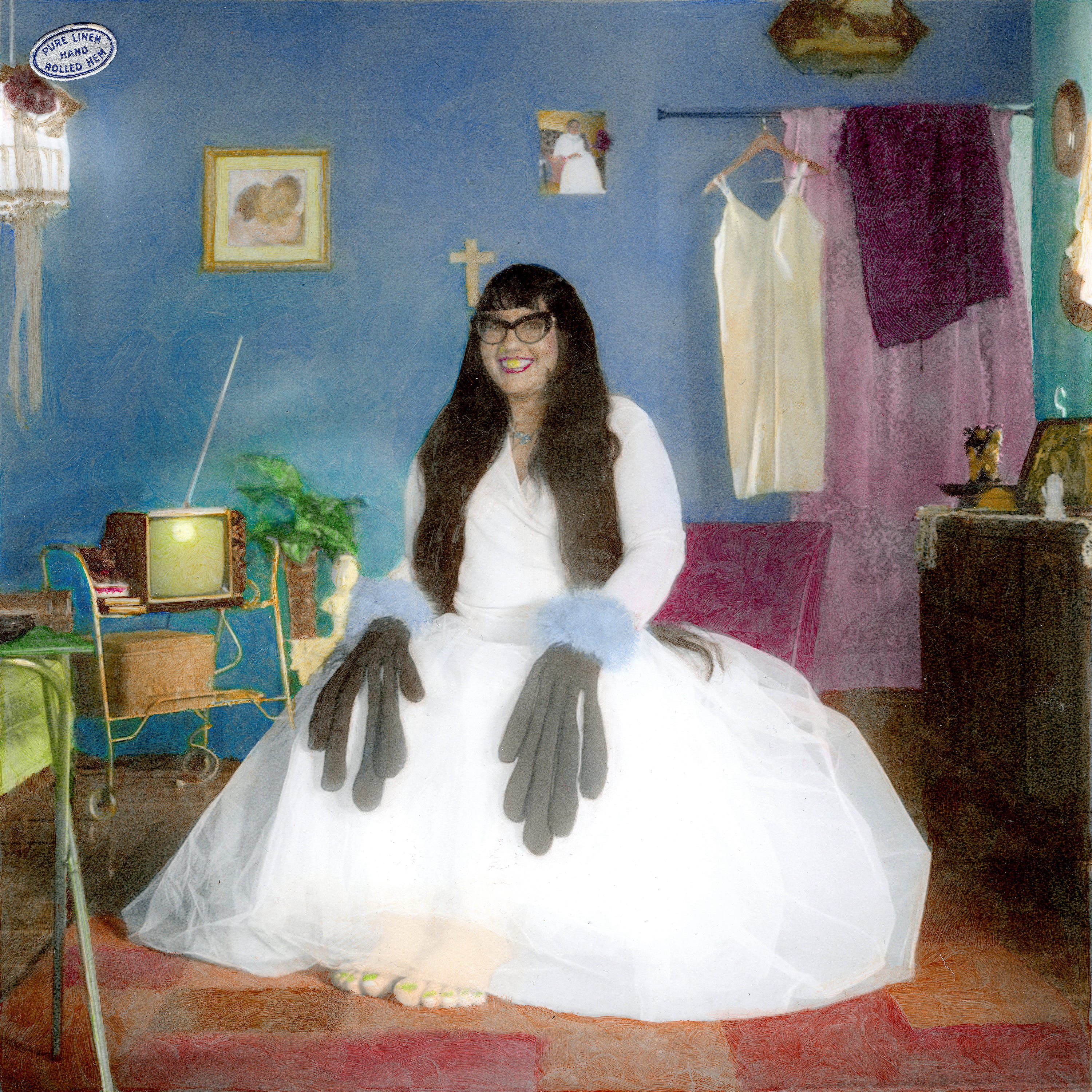
The records came first. Ariella Granados’s mother kept stacks of CDs moving through the house in Texas, corridos and norteos, cumbias, boleros, a little Spanish rock and the odd electronic record, and from about age ten to fifteen she sang in a church band with her cousins, driving out on weekends to play services around the state. At the University of Illinois at Chicago, she later built her childhood home again in ceramic and recreated the telenovelas she grew up on against a green screen, art-school work that kept circling memory and the rooms she came from. She records now as Sparklmami, and her debut is the first time all of that material gets to move at once, in real time. She and her band cut most of in this body live, in single takes, and she has said she sang straight from her subconscious onto the recordings.
She opens by building somewhere to broadcast from. “no te vayas” (don’t leave) starts with a voice doing radio-host patter, welcoming everyone to Sparkle Mommy Radio, “Where here anything is possible/Your dreams come alive and your fantasies too.” What follows barely counts as a song in the usual sense, a chorus turning over a few times between scatted runs: “No, no delusions/No, no legends/See, we’re connected/You and me.” At the close the host comes back to offer a glimpse of the land of desire and dreams, to thank everyone for tuning in, to promise one more pass. The whole thing is an invitation more than a statement, a frequency she wants someone to find.
The homesickness gets a face on “quisiera.” Singing in Spanish to her mother, she reaches for a closeness the distance won’t allow. She opens by wishing she could tell her how all of it feels, “Ay, mi madrecita, si te pudiera contar/Sinceramente cómo se siente estar yo aquí y tú allá,” and she settles on telling her it isn’t easy. The chorus holds two wants at once: “Ay, madrecita, ah, cuánto te extraño/Oh, cómo quisiera, ah, que me conociera.” She misses her, and at the same time she wants her mother to actually know her. The second verse goes harder and quieter: “Tú estás allá y yo aquí/Tú hablas más y yo a mí/No me escuchas, no, ni yo a ti.” You stay over there and I stay here, you do the talking and I talk to myself, you don’t hear me and I don’t hear you. It runs longer than anything else here, and it is where she says what she means with the least cover.
Most of these songs run on a line or two and the band behind them, and the band is good enough to make that hold. Cut live by a core of drums, bass, percussion, keys, and Kenneth Leftridge Jr.’s saxophone, the playing keeps a loose, jazz-schooled give that owes as much to 1970s Brazil as to the boleros she grew up on. “running” is mostly its chorus, a few lines about chasing someone who only stares back, “Running, trying to reach you there/Running, when all you do is stare,” kept aloft by the players long after the words give out. “vaga” goes by in under a minute, a teasing scrap aimed at someone who can’t sit still at home, “Eres bien vaga, nunca quieres estar en la casa” (you’re restless, you never want to be in the house), before it ends on a shout. And the lone instrumental, “penso en voce,” lets the group play with no words to answer to, its Portuguese title meaning I think of you.
Keeping watch over someone else’s pain turns into sharing it on “fajas.” The hook keeps to two lines, “Buried witness to your pain/Wrote you letters in your sleep,” and the verse opens it wider. She has been waiting not only for someone’s return but for something stranger, “The arrival of the unknown, of the untouched, of the unfelt,” and she is left with one line, “Empty pages and a pen on the floor.” With the last lines, she has folded herself into the hurt she has been minding: “I also buried the witness/I am also pain.”
On “grounded,” a single word does several jobs at once. It moves through being grounded as a kid, grounded in debt, grounded like a live wire, “Grounded you’re dead/Grounded in bed/Grounded in debt,” then turns the same word into a way out, “Grounded I’m not dead/Grounded now I’m free.” The title song makes that turn plain, opening on the hook “In this body, in this body, in this body, I’m my own,” then “I am whole,” then “I’m not alone,” then “I’m safe,” the body claimed as the one room nobody can take from her. On the way out, she turns the shelter outward, telling someone, “I’ma go, but you can stay/You’ll be safe within,” and offering the room instead of keeping it.
Great (★★★★☆)
Favorite Track(s): “fajas,” “quisiera,” “it was 5am”
I just saw Sparklmami open for Patrice Rushen as part of Millennium Park's summer concert series and was really impressed. And of course, I wasn't surprised when I looked online for reviews and articles about them to find that one of the only things that comes up is from Shatter the Standards, and that it's excellent and on point.