

Album Review: INFINITY SONG by Infinity Song
Four Detroit siblings busked their way through New York into a Roc Nation deal on family harmony. A 553 credit score and a homesick plea carry their debut's sturdiest writing.
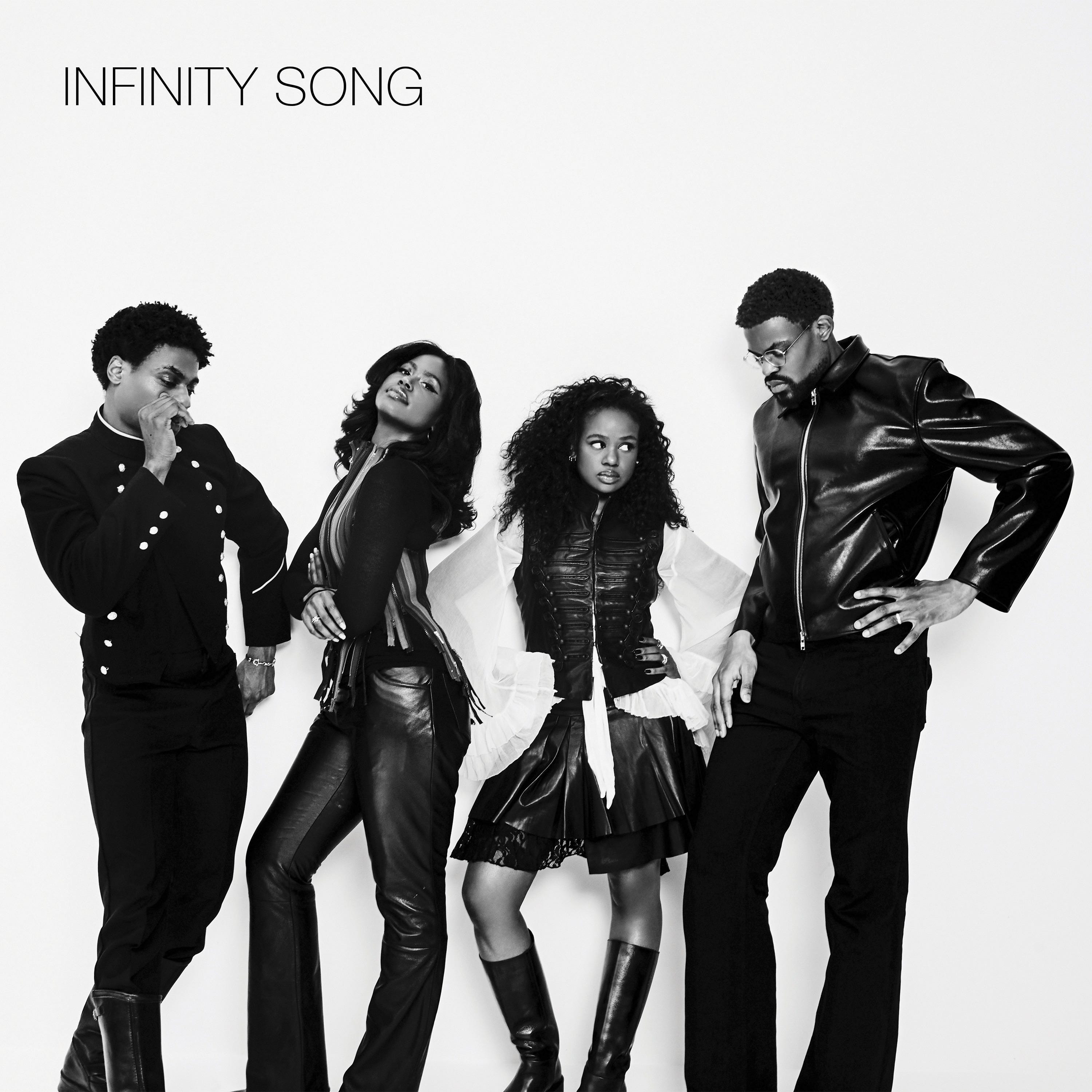
Four kids who grew up around a Detroit choir decamped for the east and began street-performing the loudest, liveliest rooms in the city—Bethesda Fountain, Times Square, the marble floor of Grand Central. They knew before they were signed that a song stands or falls on the way voices nest against each other, and Abraham, Angel, Israel and Momo Boyd carried that subway apprenticeship with them to Infinity Song and Roc Nation, a decade ago, and the method hasn’t changed. Voices first, the band stays a half-step behind. So much of the sound lives in the low and low-mid range that nothing turns sharp, so the drums never have to be pushed to avoid muddying the harmonies, which stack up and talk to one another. The group feels most present with something real stakes inside that blend, and more of it than typically survives in the family-harmony genre bin.
The songs that stay with you, though, are always about the leaving, and the person left behind, and the songs here just keep letting them bleed into one another. “Michigan” is all water—lakes that love the singer back, “But not as much as the rivers do,” under the surface a worry that the state, itself, is already gone, and “It was a kindness to us all/To leave the last place we were kids,” and nothing now feels “The way it was in Michigan.” “Sayonara” takes that loneliness west, and leaves the singer stuck, worldly rich and homeless, grass nowhere greener, until the whole saga boils down to one plea, “Can you leave the porch light on?/ I want to come home.” “Running Away” brings that ache to another person who is always keeping “an arm’s length/Of distance between us.” The bridge cuts: “I was the shoulder you leaned on when you cried/Now I’m the corner you’re trapped in when you lie.”
Money makes the group real, and it makes it self-conscious. “All of My Friends” hums on the dissonance between how life looks and what it costs: a “separate check at a restaurant,” thrift-store clothes “you couldn’t tell by the way I wore it,” a train ride that bests friends with black cars, a doorman the singer recognizes. The hook, “All of my friends think I’m rich,” and the line below it give the ruse away, then a couple of bad decisions from “living under a bridge.” The harmonies bloom into something warmest, most communal, right under the admission, “I don’t let them see me sweat.” And then, one song goes so flat it has nothing to catch it: credit score, 553, announced aloud.
Most of the time, the band sticks to that low, rounded pulse, but a couple of songs rely more heavily on it. “Hurricane” is the song that unleashes the bass; the drums are more urgent, and the whole thing is body-shoving in a messy two-step, with the leads passing around the microphone until the chorus settles on no one voice at all. The song spells out infatuation as a storm you would never, ever choose to escape, claiming the “eye is where I feel safe” only to push past it in the bridge: “I would rather drown in the memory of love/Than entertain the notion of giving you up.” “Blossom” lands at the far end of this scale. The mix turns easy-listening warm, and the vocal arrangement has as gospel slowness, the rhythm section giving the singing voices a level surface on which to set down its suitcase. It’s also the place where the writing is the meanest—a break-up song designed to send the recipient into his new life remembering who it was that carried him: “And when you’re reaching for the sun/Just remember who it was/That held you close/It was a storm.” They hold that last word until the singer takes it: “I am a storm.”
Target a song, and the writing gets quicker. “One Foot Out” is a clear command at someone commitment-averse, and the lyrics cut down to meet the urgency: “Why don’t you say it like it is? Tell me something real,” they demand, and the chorus puts the line in: “If it’s not right now, it’ll never be again.” “Stranger Danger” is much funnier and more frazzled; someone talks to them and then walks her to the train, interrupting her favorite song, and the chorus spits taunts back over her shoulder: “So deluded, really stupid... Kinda ugly, please don’t touch me,” and then the bridge pivots to lay bare the fear underneath the jokes: “You could be a killer on the run... You could try to put me in your trunk.”
The water and weather images appear in nearly every other song, and the most compelling ones keep it physical-those first rivers and lakes. They break down when a song hands over the metaphor entirely. “Deja Vu” is the song here that feels the lightest and moves the quickest; it’s a premonition for a new boyfriend that has seen it all before: “First, you’ll say you love me/Then you’re gonna leave/You’ll think I’m special/For only a week.” It states the cynicism rather than suggesting it, and it pushes that single idea into the lengthy cessation, “Till there’s no time/Till the sun won’t shine/Till the world ends.” It’s this even distribution of warmth that fails them; the soft glow lights up both the slight and the substantial, so “Deja Vu” sounds almost as substantial as the others.
The song that most clearly points forward is “Break Out,” the brightest and most open song on the album, the only one where the band permits the dynamics to soar. It builds on a quiet confidence that he will still get the prize, despite the lag time: “Sitting in the dark ‘cause you know I’m hibernating,” before the payoff, “Coming to the light/Open up my eyes/It’s time.” The kids who busked Grand Central until a crowd gathered around now have a major label record made entirely of those tightly woven voices. “Break Out” is the walk out into the sun: “The world has been so gray and blue/Since I have known you.”
Great (★★★★☆)
Favorite Track(s): “Michigan,” “All of My Friends,” “Stranger Danger”
Michigan and Hurricane have also been some my favorite songs! I love this album ✨️
Beautiful album! Similarly, my fave tracks so far are: Hurricane, Michigan, All of my friends.