

Album Review: IRIS by Karen Bernod
A Brooklyn singer returns after a decade with a record that grieves less than the rollout promised, and is stronger for it.
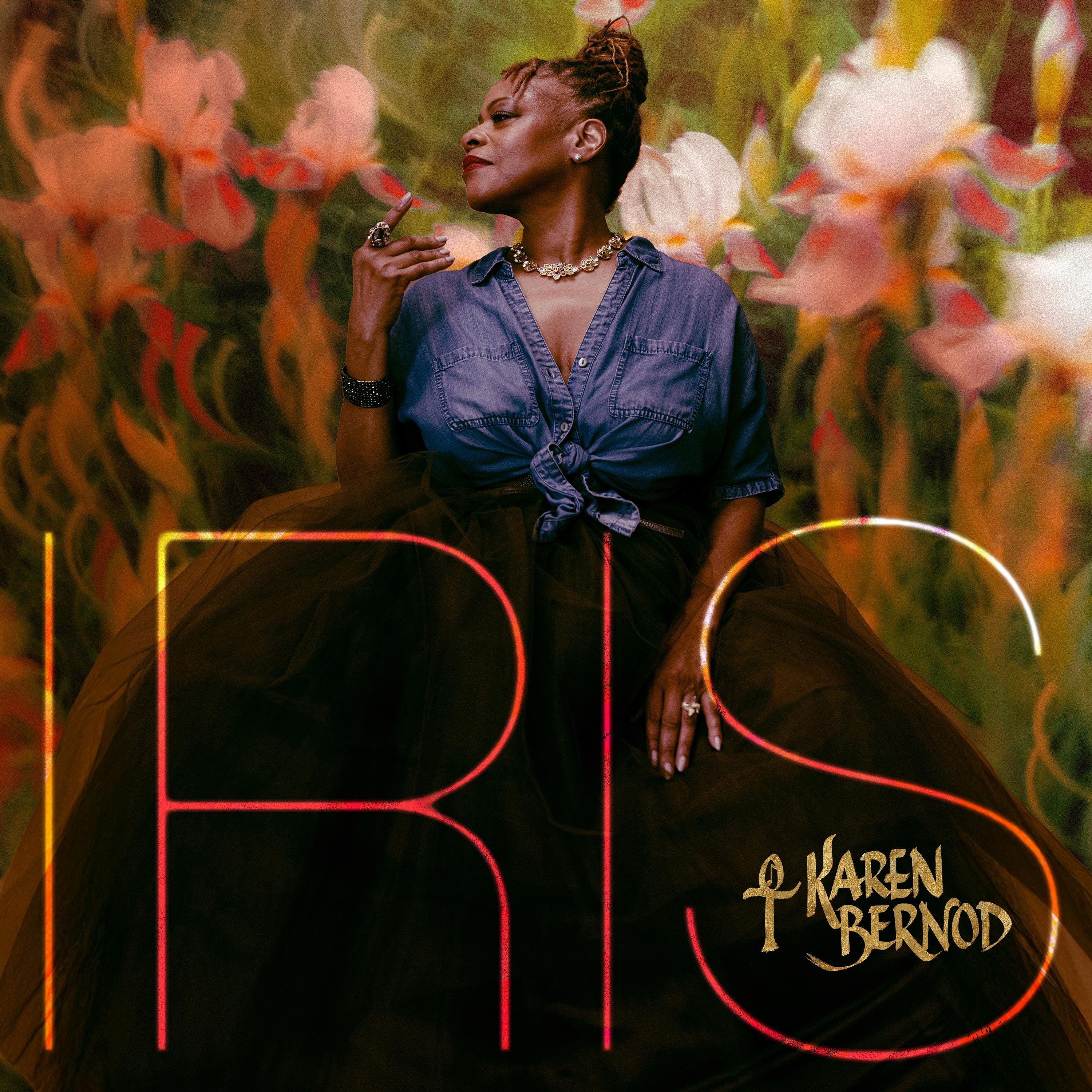
“You got a girlfriend, I got a boyfriend right now/Time does not allow us to be soul to soul,” Karen Bernod sings on “2getha In Spirit,” before insisting that life has a way of bringing them together anyway. Her first solo release in roughly a decade gets this one right where much of what surrounds it is content to be pleasant. Press copy reads the project as a tribute to her late mother Iris Cox; only the title track, “Rain On My Star,” and this one engage loss. Elsewhere, music itself becomes the companion on “Alone (You Will Never Be).” Indecision gets named plainly on “I Don’t Wanna Go.” Survival quotes Corinthians over funk horn stabs on “The Ringer.” A grown-folks two-step rolls through “Beautiful Soul.” Inside the rollout’s construct hides a wider album than its cover implies.
The track (“2getha In Spirit”) was written in 1998 with Rob Sauthoff and produced by the late Gil Small Jr. Pro Tools session files corrupted as the software changed formats. In 2022, Bernod’s manager DeWayne Snype handed what was left to a producer called 6th Sense, who kept her original vocals from the 1998 take and built new instrumental tracking underneath. Halfway through, the obstacle gets stated without coding it, and the arrangement holds its patience underneath, working the same way two people separated by other commitments still find each other anyway.
She says what she means, where most singers would code it. “Inside my head, don’t wanna live here/In a dark and empty space of insecurities” runs inside “VR,” with a flip outward in the next verse: “Outside of my thoughts, such a scary existence/It seems love, honor, and empathy has subsided.” The disease gets named as “Me, me, I, I, me, me, me, me, I, I,” before a five-word follow-up asks, “Whatever happened to we and us?” “I Don’t Wanna Go” delivers its relationship verdict in a four-word fragment: “Ain’t no perfect relationship.” “Beautiful Soul” teaches the two-step in three lines pulled straight from the song. “Grab your partner by the hand and do-si-do.” “Slide and we glide across the floor.” “This is old folk music.”
Greg Spooner, her longest-running production partner dating to Some Othaness For U in 2000, gets a co-credit on “VR,” though the staccato pocket and the synth bed there do not belong to his usual neo-soul lane. Spooner stays on most of IRIS in a live-instrumentation mode of stacked piano chords, walking electric basslines, and choir harmonies. “VR” breaks that mode open. “Social media, a blessing or a curse?” Bernod asks late in the cut. “Has it been a last better, better, or worse?” On another artist’s release this would have led the singles rollout. It earns the slot here at track five, by sounding nothing like the music around it.
Most of Bernod’s catalog before IRIS lives on records with somebody else’s name on the spine. Erasmus Hall High School in Brooklyn produced her, along with Will Downing, Stephanie Mills, and Kedar Massenburg. Senior class president. One year at SUNY New Paltz. Twenty-five years inside other singers’ phrasing followed. Lead vocal on Incognito’s “Marrakech,” from the 1999 LP, plus two other Incognito leads from the same record. Vocal consultant on Paul Simon’s Capeman with Marc Anthony and Rubén Blades. Co-writer of the underground house cut “Motherland” with Winston Jones in 1990. Backgrounds for Chaka Khan so close to Khan’s lead phrasing that the work folded into Khan herself. Unlike the typical résumé recap, that history earns its place here for one reason: when she sings on “IRIS (MAMA)” like she’s looking across a kitchen table, the unembarrassed pacing was learned from a chair just off-mic, where the room had to sound full without her being the one in the spotlight.
“Love Is All We Need” wastes its five minutes preaching. She opens it by spelling out L-O-V-E, runs a morning-prayer-into-evening-prayer architecture, and stays at sermon altitude on the rich-poor-homeless triad (“In a world full of rich, poor, homeless, hate, and greed/L-O-V-E, love is what we really, really need”). “Alone (You Will Never Be)” greets the listener with no buffer (“Hello, good morning, good day, or good evening to you”) and offers her music as company in verses that repeat the offer until the gesture loses its edges. Both songs were written toward a listener instead of from inside one. A leaner version of this album with both cut would be the stronger record.
Restraint shows up on “IRIS (MAMA),” the song this writer expected her to overdo. “When I needed a friend, you always let me into your heart/Even though we’re years apart, mama,” she sings over warm piano and gentle strings. The lyrics thank her mother for sacrifice, for raising three children, for getting her out of a jam “big or small,” for carrying her nine months. No plea for the mother’s return. No claim about what the loss means. Just before it, “Rain On My Star” lets weeping strings and a dragging tempo carry a tearful soaring falsetto into the album’s one moment of breaking open, and the title song recovers its composure right after and just talks. A decade away from solo work and a decade inside the Brooklyn Interdenominational Choir under Pastor Frank Haye taught her when to leave a song alone. Thank you, mama, she sings. “I’m so glad I got you.”
Solid (★★★½☆)
Favorite Track(s): “2getha In Spirit,” “VR,” “IRIS (MAMA)”