

Album Review: Iron Curtain by Myalansky
The Wu-Syndicate affiliate builds a street-rap concept album around narrative control, media manipulation, and hustler governance, using the Meyer Lansky myth as both shield and instruction manual.
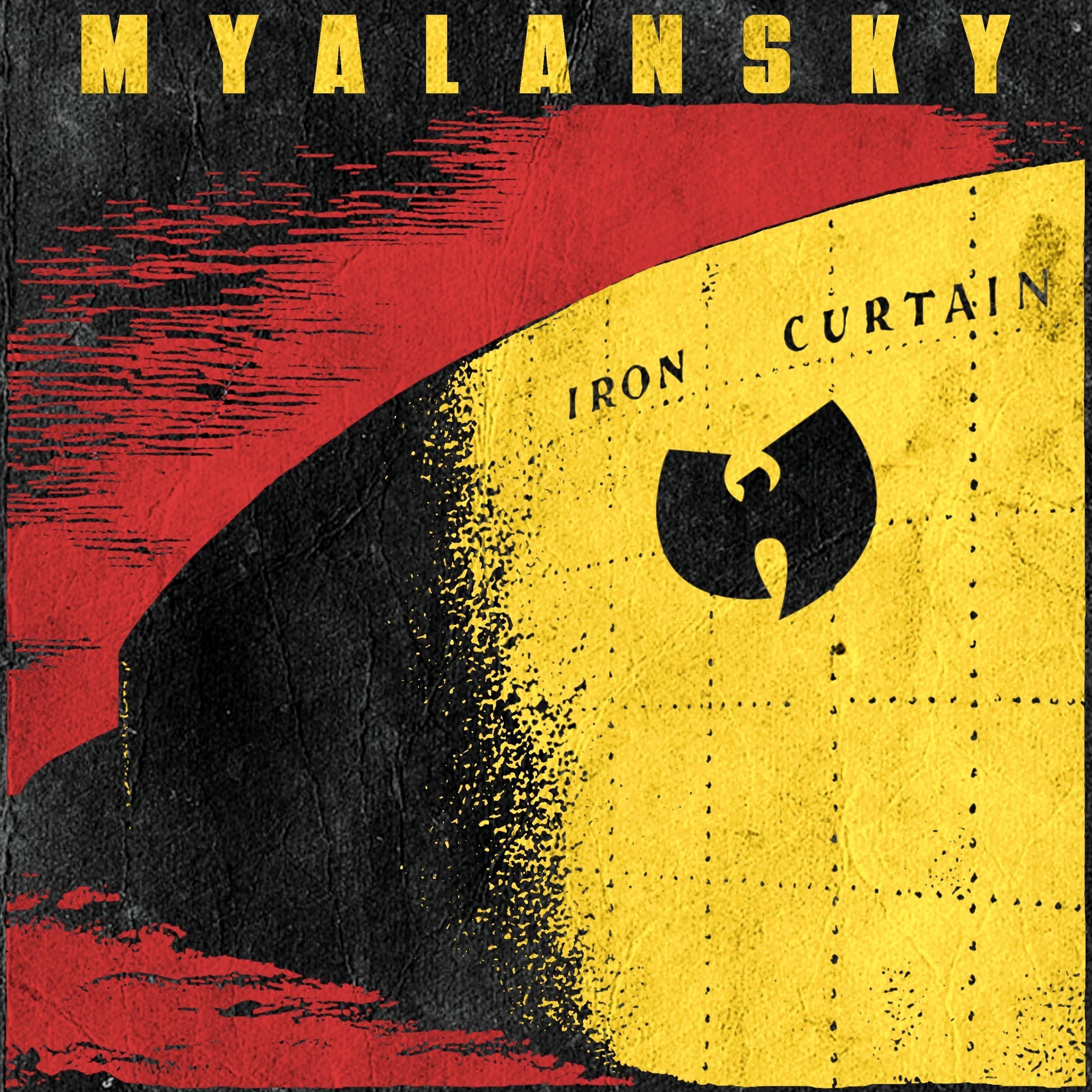
Wu-Syndicate combined the Killa Beez loose collective with the Wu-Tang’s Staten Island sound and produced a Southern tidewater translation in the late nineties. Myalansky came up through that camp, and the organizational discipline stuck. The name itself tells you where his head’s at: Meyer Lansky was the quiet accountant behind Murder, Inc., the man who never fired a gun but controlled the money, the one who died in his eighties while everyone louder than him got buried or caged decades earlier. That’s the posture Iron Curtain adopts across its runtime. The boss who moves through the world suspicious of every headline, every camera, every “official story,” because he’s watched how those things get weaponized.
“Manufacture Consent” starts the album off and acts as a sort of mission statement. It is a skit composed of Lansky audio, and he is explaining why he is being pursued by the American authorities. An audio clip of Lansky states a case where a campaign from a newspaper garnered enough attention so that now, “they have too big an investment in me.” This phrase is the focal point of the entire album. Activating public attention, in this case attracting/activating a public audience, is the goal of the campaign, and once activated it is a challenge to turn public attention off. No matter how false the allegations, if a public campaign sets their sights on you, that is the media and public attention weaponized. This record explores the rest of the album trying to figure out how to navigate a game with broken/unfair rules.
The theory of knowledge gets laid out on “Tricknowledgey,” and that’s also where the album strains. The track opens by mocking college education—“Ain’t really no money in that major damn shame what your parents spent and you still a fucking failure so embarrassing”—then pivots to PPP scams, Donald Trump’s “system glitch,” and Warren Buffett’s GED. The argument is that formal schooling is a con, that real education happens in the hood with “mathematicians” who teach Five Percent lessons without buses or classrooms. His delivery is direct: he stacks examples, moving from IRS extortion to Rothschild conspiracies to the “virtual world full of illusions” that social media created.
But the Five Percent passages that punctuate the track—the “poor righteous teachers” versus the “bloodsuckers of the poor”—give the whole thing a catechism feel, sorting listeners into saved and damned before they’ve had a chance to decide for themselves. Myalansky genuinely believes he’s dropping jewels, and that conviction gives the bars force. It also means he never questions his own framework. He warns against misinformation while trafficking in Illuminati shorthand and “they” pronouns that never resolve into specifics. The song lands as atmosphere, a rapper performing the role of the man who sees through everything. As actual argument, it’s shakier.
The most ambitious swing comes on “Casualties.” The first verse reconstructs 9/11 from street level: a man carrying his panicked boss down fifty flights of stairs, the second plane hitting on live news, bodies landing ten feet away before the tower crumbles. Myalansky writes with physical precision and the imagery carries real weight. The second verse shifts into war-fever mode by Haylo da G.O.D.: “Flags wave, everybody loading up/Fuel for the bonfire, the media going nuts/Controlling the kids, what they showing us.”
By the third verse, Sicarii’s invokes kamikaze pilots, gas drums, hotel monopolies on “lost property,” and the question of whether there’s “a line in the middle” between victim and perpetrator. He asks who knew about Bin Laden on September 10th, claims he did, then immediately says “not bragging these are actual events.” The tonal whiplash is disorienting. He wants credit for knowing something without explaining what he knew or how. The song rides emotional force with the terror of watching the towers fall, the rage that followed, the suspicion that the public story was incomplete, but it blurs the line between asking questions and making accusations, between skepticism and innuendo. It’s powerful and irresponsible in roughly equal measure.
Money doctrine runs through “Controlling Shares,” delivered with the confidence of someone who’s watched enough people fall. The hook is pure hustler economics.
“A fool and his money separate is clear
That’s why my goal is always keeping the controlling shares.”
He talks about watching the feds raid Puffy’s house as a cautionary tale, about greed as an addiction that leads to crucifixes and Hell. The psychological thread running through the song: success invites scrutiny, scrutiny invites downfall, so you better stay humble or “they’ll come and take it all.” He’s rapping about money while also rapping about the paranoia that money creates. The feature from Two Onez blends in without disrupting the mood, and the track holds together as a statement of principles. It’s the album’s most disciplined moment.
Violence as theater takes over on “The Town” and parts of “Emmaculate.” Haylo da G.O.D. and Sicarii trade bars about throwing spikes in streets, eating flesh like cannibals, organs shifting and brain fragments scattering. On “Emmaculate,” the syndicate talk gets more granular: pipe bombs, torture for anyone who takes a crumb off the plate, families left with horror, death before dishonor. These tracks are intimidation, worldbuilding for the mob-boss persona. They’re competent posse cuts with enough graphic detail to land. But they also feel like pressure-release valves, moments where the album stops arguing about information control and just flexes muscle. The violence is theatrical and consequence-free in a way the rest of the album isn’t. It’s Myalansky letting his collaborators do dirt so he can keep his hands clean on the concept tracks.
The Lansky mythology pays off on the “Foolish King” and “Iron Streets.” Oddly enough, they’re both skits. Myalansky is building a model for how to carry yourself in a world that rewards noise. The former features a spoken-word story about running into Lansky at a Miami restaurant called The Forge, and the latter extends the idea with Betty Lansky describing her husband as “a giant” whose influence came from how he spoke and how people listened. This is the thesis that, in a media environment designed to manufacture consent, the only response is to become the kind of figure who doesn't need to explain himself, who commands respect through presence rather than volume. However, the problem is that Iron Curtain doesn’t always practice what it preaches. Myalansky’s concept is tight, but his execution is uneven. The Five Percent interludes and conspiracy-adjacent passages undermine the “say less” philosophy the Lansky clips endorse. He is a capable rapper with a distinctive voice, but he’s reaching for a statement record that his material doesn't fully support. He’s trying to say something about how attention gets weaponized and how a smart man survives it. That’s a worthwhile project even when the execution wobbles.
Above Average (★★★☆☆)
Favorite Track(s): “Controlling Shares,” “Foolish King,” “Iron Streets (Outro)”