

Album Review: It Gets Greater Later by Courtney Bell
A Detroit rapper keeps a gun next to scripture and cocaine residue next to a prayer, and never once pretends the two cancel out. The faith is real; so is the body count under it.
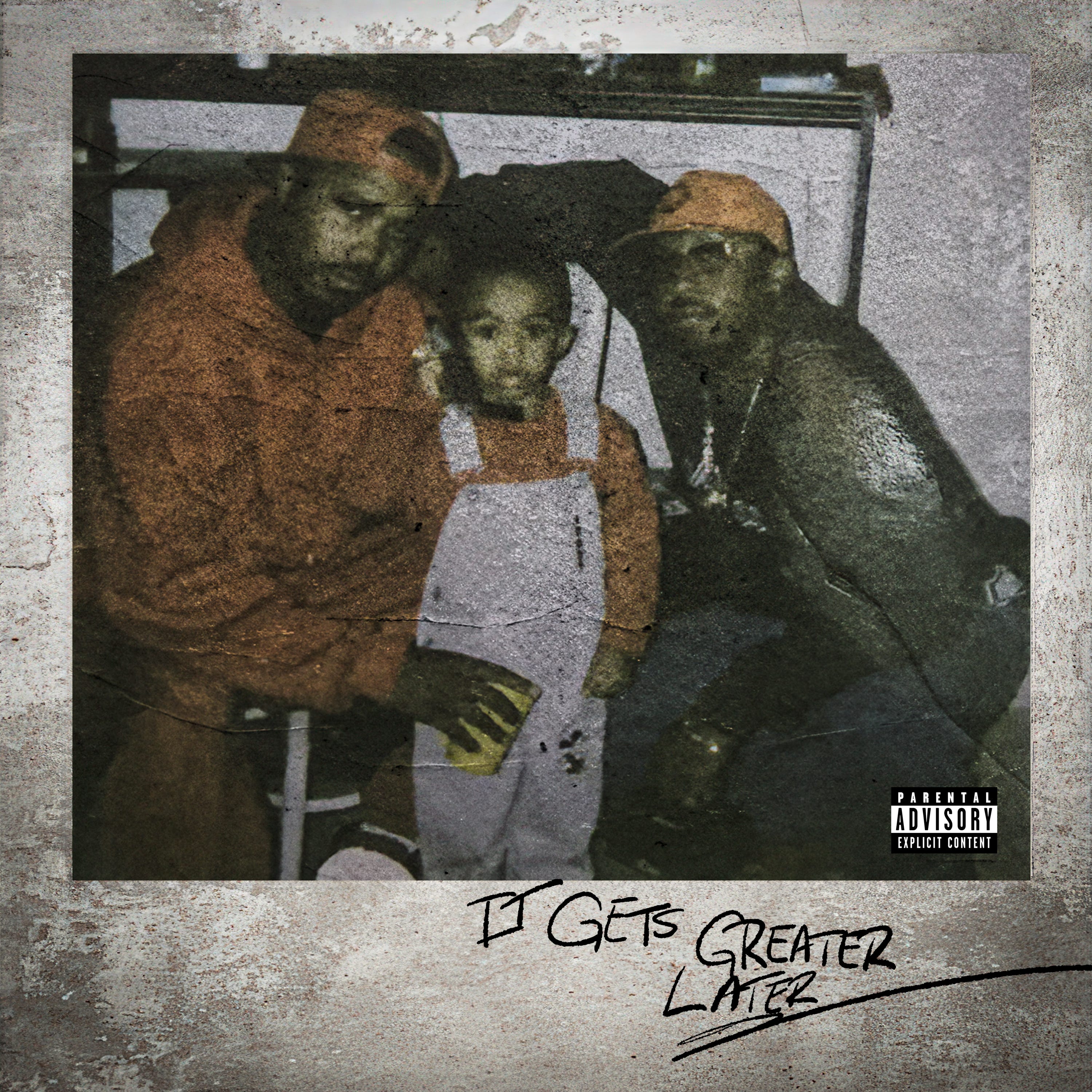
Courney Bell’s promise to turn every verse “to the word of God” remains one step removed from the pulpit, and the pulpit is where rap is boring. On “Wounded Healer (Book of Eli)” Bell hands you the sermon you’re expecting and moves straight past it into “Plannin’ to make my exit, headshots on my checklist,” a suicide plan that he documents under “divine protection” without breaking stride. The church-rap interpretation doesn’t stick one step into the Wallo bar he uses to define the intro, where a friend tells him, “Your image don’t match what you spittin’, you look like you slain,” and Bell only answers that if his friend “only knew how far I came.” The scripture isn’t an accessory to flexes, but the thing keeping him away from the checklist.
Bell’s neatest gift of grace is on “Stumble,” where he notes he fell “as a sign to hit my knees and pray” and swears he heard “angels call.” But then he drifts, lists the general collapse (falling planes, economic disaster, a robot-raising babies, a cheating pastor), mistaking a list of bad news for a comment on it all. “ISO” tries it from the other direction, stretching a basketball metaphor to the point it stops meaning anything, letting a conceit stand in for good rhymes, before it gets a catchy hook and gets out before it has all of it. But here and there, when he quits cataloging and starts confessing, the floor drops out under him in a good way.
“Problems” puts Bell inside other people for the most part: the friend who “use drugs to run from his problems,” who’s history he reveals, finally, as “Found out that he was touched”; an absent father and an addicted mother; a woman who, “insecure about her body,” pursues a body like a model’s, rumored to have had surgery, “loved by a man who’ll cheat and mistreat her.” He just gives the damage without reaching for a diagnosis or a lesson; the lens stays steady, and when the hook loops around to him—“Before I seek therapy, I seek a bottle/Fuck I look like telling strangers my problems?”—he pushes the most naked statement he’s willing to make into a shrug.
The promise of “Everyday”—“Said I’d go sober, but I can’t”—is one you make to yourself at three in the morning and break by noon. This song is the tight loop he can see the edges of but not step out of: Mondays that feel like Fridays, “Getting fresh, getting by, getting high,” the habits that “fuck up my stack” sitting right next to the paranoia he feels “when the shit going good.” “Virgil” turns that into a wellness routine with no off-switch (Reiki once a week, breathwork, psilocybin micro-dosed “in my thoughts deep,” yoga instead of coffee) coexisting with “Back to back funerals, I black out at the coffin”; breathing exercises don’t fix the paranoia.
Through “He Don’t Know,” it borders a courtroom in Wayne County, 2009, a fifteen-year-old sitting in the defendant’s box, and a girl observing in the gallery. Ron E sings the hook about upgrades and Vogue covers, and Bell’s verse on Teslas and front pages still functions more as a backdrop to the trial than its substance. This loyalty song resolves into “Even if we don’t get back together, you still my nigga” in the end, the least negotiable part of their relationship. The flowers are negotiable, but the year is not.
There was a time Bell was “fresh up out that well,” before the boardrooms, when the come-up was the whole story; on “Bang” the past detonate into present as pure bravado (“This that 9/11 planes crashin’, World Trade collapsin’”) putting him “that Big L, that Pac, Nas, Rakim flow in the flesh” while also calling hip-hop “This orphanage called hip-hop need restorin’.” It’s a privilege to be able to say “I make it all look immaculate” if you black out at coffins because you haven’t yet. Benny the Butcher’s verse is a mirror image, his BSF gospel of “courtrooms for them skets, now I’m in boardrooms with execs,” his legacy a matter of kitchen sweat converted to Neiman Marcus, his glory derived from profit rather than presence. Two survivors compare the rate of exchange of pain for money and find it more or less the same.
On “Hope You Understand,” the confession gets to be blunt: “Cocaine residue sitting by my money counter,” money that “keep on piling,” a faith that he describes “the size of mustard seeds.” The hardest hit is “Discipline will separate you from the ones you thought would make it,” a deceptively plain sentence about the price hidden inside the song’s promise. He keeps a gun near and says, “Had to close the gap, that’s where I found God,” collapsing the distance between pistol and prayer in a single line. When Dawn C closes the song, she makes a mockery of the title: “I’ll be a masterpiece soon as I master peace/I heard that it gets crazier later.” Greater, crazier: she echoes the title back to Bell as a question he doesn’t answer.
Bell is clear about the price of things on “Costly”: “Closest homies to me was plotting, I had to off them niggas,” and Nick Grant comes through with a Pac comparison that he claims he never wanted (“I hate comparisons but don’t care if you like or not”). “Thank You” seems impossible on paper, but it lands like stand-up comedy that’s somehow also a prayer. He thanks God for “my two DUIs,” for the officer who found him the night “I should’ve died,” for healing “Auntie Neecy from her cancer,” and for “RCA and Sony taking a chance/I was young and fucked it up.” The thanks last and list for long enough, and indict enough, that it could be a rap sheet, spoken loudly, by the defendant, prepared to do the time. Other rappers use God on a close as a formality; Bell thanks him for keeping him alive, to stay there and keep score of everything that was supposed to keep him away from that checklist.
Great (★★★★☆)
Favorite Track(s): “Wounded Healer (Book of Eli),” “Virgil,” “Problems”