

Album Review: Kingdom Music for the Hard Rocks by Cargo Cults
Over Zilla Rocca’s hard production, the New York MC swaps wisdom for arcade quarters and funeral suits, a bracing and very funny account of what your forties cost.
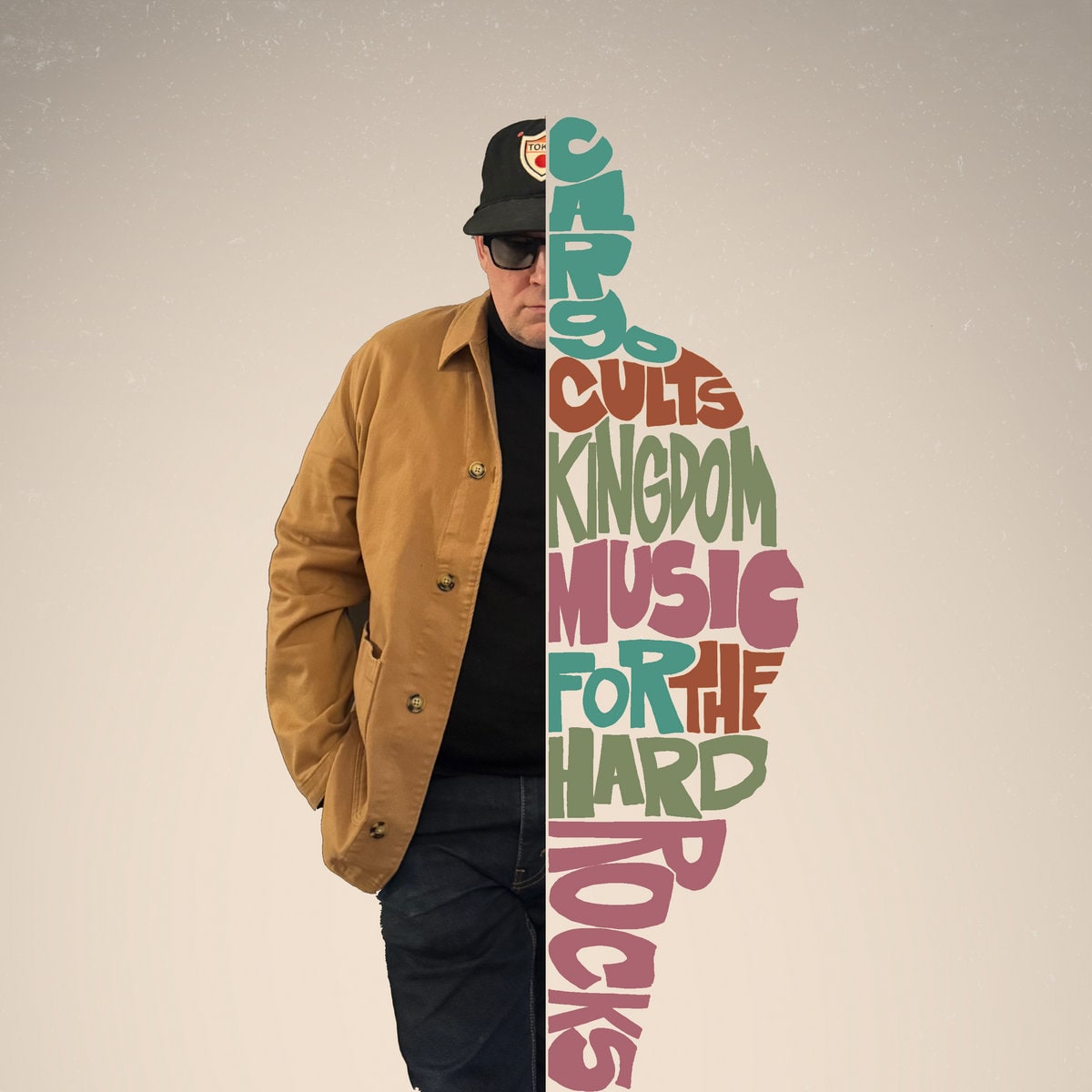
The moment when Zilla Rocca first heard the rapper around whom he would create his own group a decade later was when he was shelving the new arrivals at the record store. In 2013, the two rappers finally met and got to be on the same bill in New York City. As the producer from South Philadelphia told Bandcamp Daily in 2020, he was looking for a family man in his 40s who spent all his life being obsessed with rap. Thus, Cargo Cults was created with Alaska writing rhymes from New York and Zilla Rocca sending beats from Philadelphia. Alaska keeps everything in one drawer along with the arcade quarters and dead classmates, and his voice doesn’t change when he goes from one thing to another.
He says that the neighborhood where he lived was called “Amberlands,” a very poor neighborhood of white flight and blue-collar families and single mothers; it included twenty-six buildings in total. He describes how a local kid stole the tires from his bicycle and how he punished this kid for it. He mentions that divorced dads drove Trans Ams and that there was a motel which took in transients; there was also a kid who had a tattoo of a panther and some guy Benny who was connected to everything. “This wasn’t the environment for softer kids,” says Alaska, “It wasn’t always violent, but you always had to talk the shit.” There was also a clubhouse outside, filled with nudie magazines wrapped in plastic. Finally, there was the conclusion: “Sixth grade Darren got murdered, it was tragic/And just a month or two since that crack took Travis.”
On “Same Song Same Rhyme,” the death of his friends due to natural causes is a more recent problem, and the phone only rings with one news. Alaska witnesses the discussion, What happened? and He just collapsed and Oh man, that’s awful, then comes the not humorous joke: “We survived the rowdy years, the drugs and booze and violence/Just to be murdered by our DNAs and crummy diets.” Alaska’s daughter tells him she’s going to study sciences, and if she studies hard, maybe she will be able to find a cure for death so that he will see his friends forever, and there will be no more crying. It makes him proud but breaks his heart at the same time. The party on “Half Life” is also made of household goods. The dead friends come back for one night, not as zombies and ghosts but whole, and on the table there are bogeys, pierogies, hoagies and illicit substances for anyone who is jonesing. Some friends stay in shadows, dozing, since parties always made them nervous. One friend spent a whole week cleaning for the sake of coming back and died of an overdose. The others did not want to bother coming and preferred to grieve from afar rather than to appear and feel awkward. The only thing they ask Alaska about is to bring flowers while the house is full of laughter and cheap booze.
In order to succeed in such conditions, Zilla Rocca has to create short looped phrases and stick them to where they are so that everything will depend on the rapper. “Nostalgia Tripping”—one looped phrase under three voices of roller skating Zilla Rocca in a church basement, cold Coors Lights on warm nights and Jesse the Tree in a car with Limewire downloads, with his older friends who take whippets in the bedroom to Phish music. “Castro’s Home” comes and goes very fast. We have here such phrases as neighbors cursing their doors with eviction notices, quarter JanSport for fashion and not for homework and Curly Castro on a rooftop with lullabies hummed by fireflies of New York.
With “Old Fogies,” Breeze Brewin shows his brand new tricks for old dogs. He confesses that sometimes he tries to feel, and at other times, he is numb. He explains how he was a shorty but knew nothing of law. He watched how his hard work was outsourced. Now he knows a few things because he has seen things, he says. This verse can be called one of the best ones, talking about farming, people planting seeds, and people wanting peace. Alaska raps about Miller Time, where he once was aggressive. Now his main goal is to help his child achieve what she wants. Reef the Lost Cauze calls his song “Yankee Stadium” masterpiece theater. He calls himself a “golden geezer” and wants nothing but simple things like sleeping and living good. He says rappers are termites in cheap wood. In this same song, Dr. Jays mentions a store where you can go shopping before shops started selling Rocawear.
The guidance on “Buy the Ticket Take the Ride” is not original, and Alaska seems to know about it. Thus, “Add up the adages, calculate the clichés/Never trust people who say words from people these days” appears in the middle of a verse comprised almost completely of other people’s sayings. Young kids have small problems, while old kids have big problems. His mother told him to put one thing in the win column. Gifts are obligations, and conversations often lead only to problems; everything is a spiral, and the most direct lines defeat us. Alaska finally tells everyone to get ready for a bumpy ride. Nothing Alaska mentions in the song is wrong; nothing is his, however.
He is accompanied by bourbon and some BBC series on “Lightweight.” All punchlines come from the same home in which he is living. The artist identifies himself as a satirist like Mark Twain and travels by R train, drinks Old Gold and remembers that he robbed a 40-ounce of Private Stock. However, David Foster Wallace turned him off reading, and now he scrolls through Twitter while sitting on the toilet. He dreams about being a rapper like Of Montreal. “Too Damn Old to MC” shows his colder side. Twenty years ago he used to have wild times, but twenty years from now he will likely be on dialysis, and the bourbon he drinks replaces the Rumple Minze from his childhood. The rapper measures the distance the same way in both directions: I’ve been on this journey since check out my melody/Forty years from now you can check out my elegy. He ends his verse with the statement, “The thoughts and opinions that’s expressed here are all mine,” and the box-cutter scar he has acquired while trying to defend someone from getting jumped in arrives in the same verse.
The next morning after breaking up, J Scienide gets into “Skate Like a Limo.” Waking up is always slow and hard for him, but today he has got a reason to sleep longer—he should recover after breaking up. At eight-thirty in the morning, he is looking at his phone for signs of Reconciliation, sees that the TV set is still switched on from the previous night. He puts on cartoons, puts some cereal into the bowl, looks at Ice-T on the Cheerios package and reviews bills with how much he owes. Cereal, unpaid bills, cartoon rerun, and Ice-T looking at him from the box in the morning, eight-thirty. He goes to the studio and writes a rap record.
Great (★★★★☆)
Favorite Track(s): “Amberlands,” “Same Song Same Rhyme,” “Half Life”