

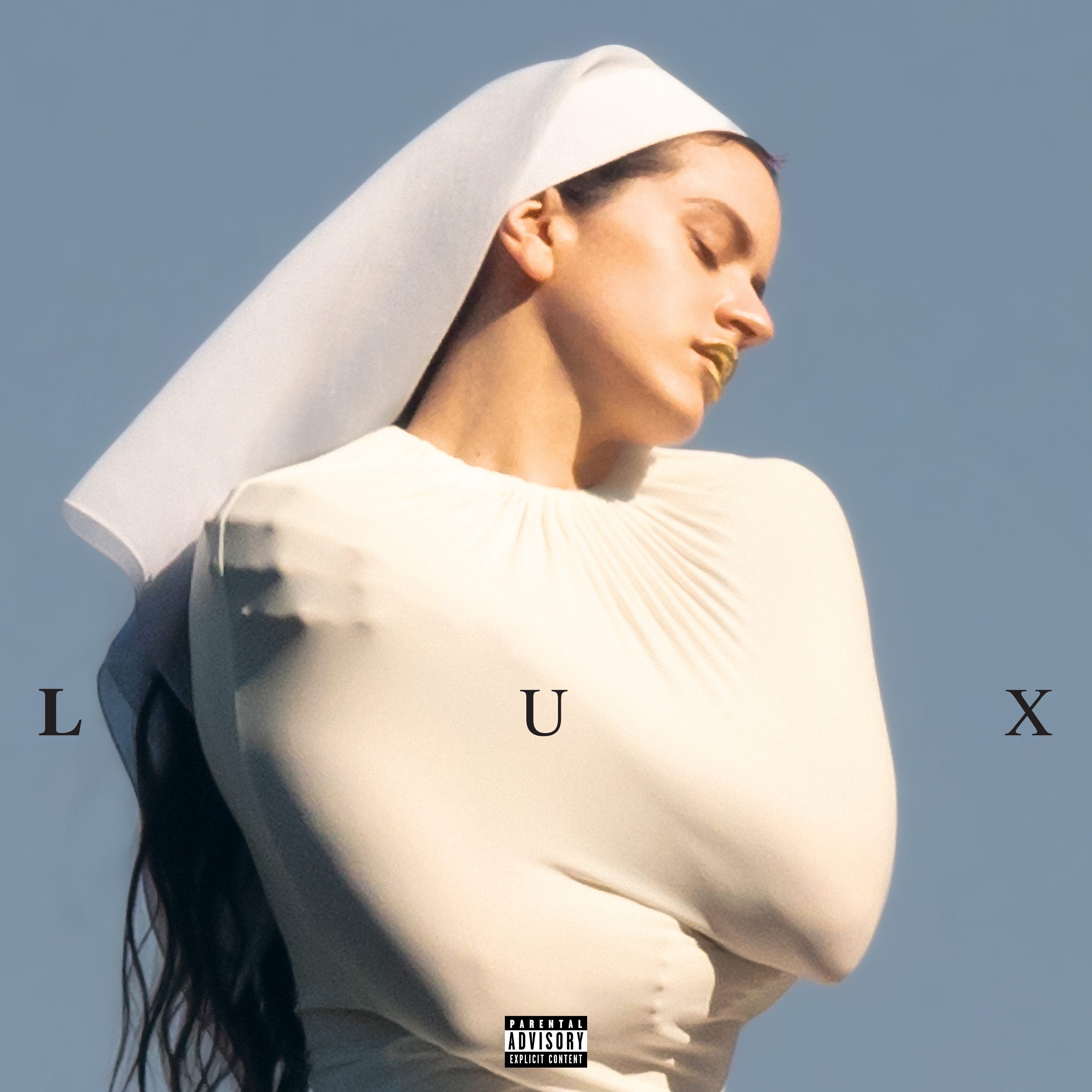
It’s tempting to read Lux as a response to the breakneck pace of modern celebrity. The Spanish singer’s last LP shook the world with dembow basslines and viral TikTok snippets, yet the project itself was also a study in duality—a rider on a motorcycle and a vulnerable “mami,” a poet and provocateur. After years of scrutinizing fame, ROSALÍA seemed exhausted by its algorithms. In a recent interview with The New York Times’ Popcast, she talked about her new record as something that demanded more from fans—a deliberate reaction against streaming platforms’ quick-fix dopamine hits. The refusal to chase virality is evident from the opening notes: instead of trap beats, she unspools a dense lattice of strings, harpsichords, and hand-claps, layering liturgical harmonies over minimal percussion. The tension between her mass appeal and her disregard for pop’s rulebook drives every act of Lux.
Her willingness to throw out the template makes sense when you remember how long she’s been running from rigid expectations. ROSALÍA grew up north of Barcelona, discovered flamenco when she heard melismatic palmas blasting from a friend’s car at thirteen, and decided instantly that it would be her life’s work. She trained under José Miguel “El Chiqui” Vizcaya and earned the only annual spot in the flamenco program at La Escola Superior de Música de Catalunya, graduating with a degree in flamenco vocal performance. That academic discipline underpins even her most radical experiments. Los Ángeles showcased bare-bones cante jondo, El Mal Querer turned her thesis about a 13th-century Occitan novel into a concept album that fused flamenco with R&B and electronics, and Motomami tore up reggaeton and hyperpop to meditate on fame, gender, and cultural appropriation. Lux is the following metamorphosis: an 18-track cycle (15 tracks on streaming, 18 in physical form) split into four movements, each tracing a different emotional arc. It’s not a return to tradition so much as a synthesis of everything she’s learned—a maximalist embrace of baroque orchestration and global languages that still honors her love of glitchy beats and Auto-Tune.
The first movement, titled Desgarro, tears the ground open. Lux opens like an overture: rapid violin flourishes, timpani rolls, and a choir of boys from Escolania de Montserrat shout lines in German, Spanish, and English. The album isn’t consumed as discrete singles. Instead, motifs bleed into one another—clattering castanets morph into industrial snares; a phrase in Sicilian repeats against a cluster of strings until it becomes incantatory. In “Reliquia,” a Michael Nyman-esque string arrangement suddenly collides with a frantic, glitchy rhythm reminiscent of Aphex Twin. Rosalia’s vocals leap from whispers to operatic bursts, harnessing the melismatic techniques she honed on Los Ángeles to portray shock and ecstasy. When she sings “Mio Cristo” entirely in Italian, the melody hovers above a droning organ; she even leaves a studio interlude of herself laughing and directing musicians, letting the imperfection register as truth. These early tracks are confrontational, not because they are loud, but because they challenge our ears to adjust to her syntax. She sings across 13 languages—including Spanish, Catalan, English, Latin, Sicilian, Ukrainian, Arabic, and German—treating each tongue like a different instrument. “If I could, I would have sung in all the languages of the world,” she said at a press conference out in Mexico City, explaining that learning each language was a way to understand other people and thus herself. It’s a kind of sonic Babel that both disorients and invites because even if you don’t parse the words, the cadences carry emotional weight.
The movement’s centerpiece is “Porcelana,” a composition that lurches between a waltz and a breakbeat. Its verses are sung partly in Japanese, flamenco handclaps anchor the chorus, and at one point, ROSALÍA gives way to a spoken interlude from a London Symphony Orchestra violinist counting down to the next entry. This mixture of playfulness and severity runs throughout the first act. “Sexo, Violencia y Llantas” begins with whispered prayers and crescendos into a tribal rhythm; “Divinize” swirls in Auto-Tuned arpeggios over woodwinds; “Reliquia” dissolves into a glitch storm. She’s not interested in writing hooks, but she’s sculpting moods. The shock comes not from the volume but from her restraint—moments of silence and near-silence punctuate the chaos, forcing you to listen harder, to fill the gaps with your own heartbeat.
The second movement, Eco, slackens the pace and turns her gaze inward. Here we encounter songs such as “Berghain,” “La Perla,” “Mundo Nuevo,” and “De Madrugá.” “Berghain” is the one piece people have heard in isolation; it features Björk and Yves Tumor and was recorded with the London Symphony Orchestra. Over swirling strings reminiscent of Vivaldi’s Winter, ROSALÍA sings in German and Spanish about a lover’s fear and rage, while a choir declaims, “Seine Angst ist meine Angst, Seine Wut ist meine Wut, Seine Liebe ist meine Liebe, Sein Blut ist mein Blut”—“His fear is my fear, his anger my anger, his love my love, his blood my blood”. Björk appears like a specter to intone “The only way to save us is through divine intervention,” and Yves Tumor arrives at the end, barking a profane Mike Tyson quote through distortion. The adjacency of sacred strings and obscene outbursts brings to the fore the album’s central tension: transcendence and desire are inseparable. It’s a love song and a prayer, an assertion that devotion can be erotic and that obsession can feel like religion.
“La Perla” slows everything down into a 3/4 sway. A dramatic swell of strings and brass is followed by ROSALÍA giggling as if to undercut any pretension. She lashes out at an unnamed ex, calling him a “gold medal in being a motherfucker” and an “emotional terrorist.” The venom is offset by the arrangement: waltzing strings and murmured backing vocals that could pass for a 19th-century zarzuela. Her voice is raw, not pristine. In “De Madrugá,” she sings in Ukrainian and Spanish before the orchestra surges and the song changes key mid-phrase. “Mundo Nuevo” employs a Portuguese fado singer to trade verses with her, the timbre of fado’s saudade rubbing against her clear, bright soprano. Throughout Act II, percussion becomes limited, and the instruments breathe. The digital glitches remain, but they’re spectral, reminding us of the chaotic world she left behind. She trusts negative space, where many passages are just voice and one instrument, recalling her earliest flamenco training. In a pop landscape obsessed with maximalism, this commitment to stillness is radical.
The third movement, Elevación, turns toward the sacred. Here she adds Auto-Tune to her flamenco melismas, raps on “Novia Robot,” and deploys a sped-up vocal sample at the start of “Focu ‘Ranni” that feels like a house producer’s DJ tag. On “Sauvignon Blanc,” she crafts a melody that you could imagine being transposed into mainstream pop, but she never indulges the impulse to repeat it; instead, the song vanishes into a chorus of wordless oohs. “Jeanne” ends in a whirlpool of strings and wordless vocals, while “La Yugular” uses microtonal violin slides and heavy kettledrums. “Dios Es Un Stalker” swings between hushed confessions and choral outbursts; she sings about God as if He were both lover and voyeur, the instrumentation alternating between minimalist piano and full orchestral blast. Elevación feels like a high mass for a secular age: she invokes saints and martyrs, references Joan of Arc and Santa Lucia, and lets the orchestra swell to cathedral‑scale proportions. The glitchy electronics that once felt abrasive now serve as counterpoints to the reverent mood, reminding us that holiness and modernity coexist.
Expansión blows the world open. “La Rumba Del Perdón” is one of the record’s rare overt nods to Latin America: a rumba written with El Guincho and featuring fado singers that heightens her ability to inhabit multiple traditions without flattening them. “Memoria” loops a Portuguese refrain over electronic pulses, and the writing meditates on the fragility of memory. In “Magnolias,” the album’s conclusion, she gathers the languages and motifs into a single appliqué: lines in Catalan and Spanish, backing vocals from a boys’ choir, a guitar figure echoing Camarón de la Isla, and a sample of her grandmother’s voice. Even in its most grandiose moments, Expansión holds onto intimacy. You hear her breathing, laughing, counting down. One might wonder if she’s chasing euphoria, but more so, she’s building a communal space where vulnerability feels triumphant.
The album builds the emotional architecture rather than commercial momentum. Desgarro rattles you; Eco invites you to sit with grief and devotion; Elevación raises you into a sacred space; Expansión releases the tension in a swirl of voices and languages. It’s the opposite of a streaming-optimized project—the “hits” are hidden and unusual. “Porcelana,” performed partially in Japanese, and “De Madrugá,” with its key change and Ukrainian lines, challenge your ear. “Mio Cristo” and “La Rumba Del Perdón” reward patience with operatic drama and ancestral rhythms. She hides the hooks within orchestral swells and liturgical chants, but if you give the record real attention, there are pleasures to unearth. A pressing question arises: Is this still pop? The debate over whether Lux counts as classical is raging. ROSALÍA herself seems undecided, laughing after a particularly dramatic waltz to puncture any pretension. Yet that ambiguity is the point. Pop, by definition, is music made by a popular artist within an industry; she uses those resources to stage a high-art opera and invites Björk and Yves Tumor into her world. She’s breaking pop’s rules not out of contempt but out of curiosity.
Lux also reconceptualizes ROSALÍA’s relationship with fame. During Motomami, she seemed exhilarated by the chaos of being a celebrity; here, she looks at her life from a distance. The album’s religious imagery isn’t PR positioning but a lens through which she contemplates devotion, sin, and sacrifice. Several tracks reference saints or adopt confessional tones. The artwork shows her veiled like a modern Madonna, inviting jokes and memes but also signaling the seriousness with which she approaches the feminine divine. “Divinize” might be the most literal statement. She sings in Latin about turning bodily love into spiritual union. Elsewhere, the feminine mystique appears through references to Jeanne d’Arc, Inanna, Santa Lucia, and mythic magnolias. The messages aren’t always clear. She often lets images float by without explanation. But there’s no sense of cynicism. Her aim is not to shock for the sake of shock but to explore what an artist can express when freed from commercial structures.
At times, Lux feels unwieldy. The four-act movement structure can seem like an affectation when some songs blur into one another. There are passages where the orchestra feels overbearing, and occasionally the glitchy electronics intrude rather than complement. But these imperfections also humanize the project. Unlike some of the sterilized reggaeton on Motomami, Lux embraces rough edges. ROSALÍA has led us through ritual, confession, and communion. It’s an album that asks for your attention and gives you something extraordinary in return. In refusing to obey pop’s rules, she reminds us why we fell in love with her reinventions in the first place. If El Mal Querer taught a new generation about flamenco’s storytelling power and Motomami pushed reggaeton into digital art-pop, Lux proves she can synthesize her classical training, her global curiosity, and her pop instincts into a unified vision. There’s no formula for an excellent record, but there is something close to grace when a musician trusts her instincts this completely.
Standout (★★★★½)
Favorite Track(s): “Reliquia,” “Berghain,” “La Perla,” “La Rumba Del Perdón”
I enjoyed reading this review after listening it to the fist time, now I can understand better and look forward to listening it again
Such a great review - you tie together the songs and capture the essence of their sound and meaning so well here.
I wrote an article which critiques the album for how it engages race and culture. This is it, if of interest: https://open.substack.com/pub/leftiejane/p/rosalias-new-album-lux-is-a-deeply?r=pm4cz&utm_medium=ios