

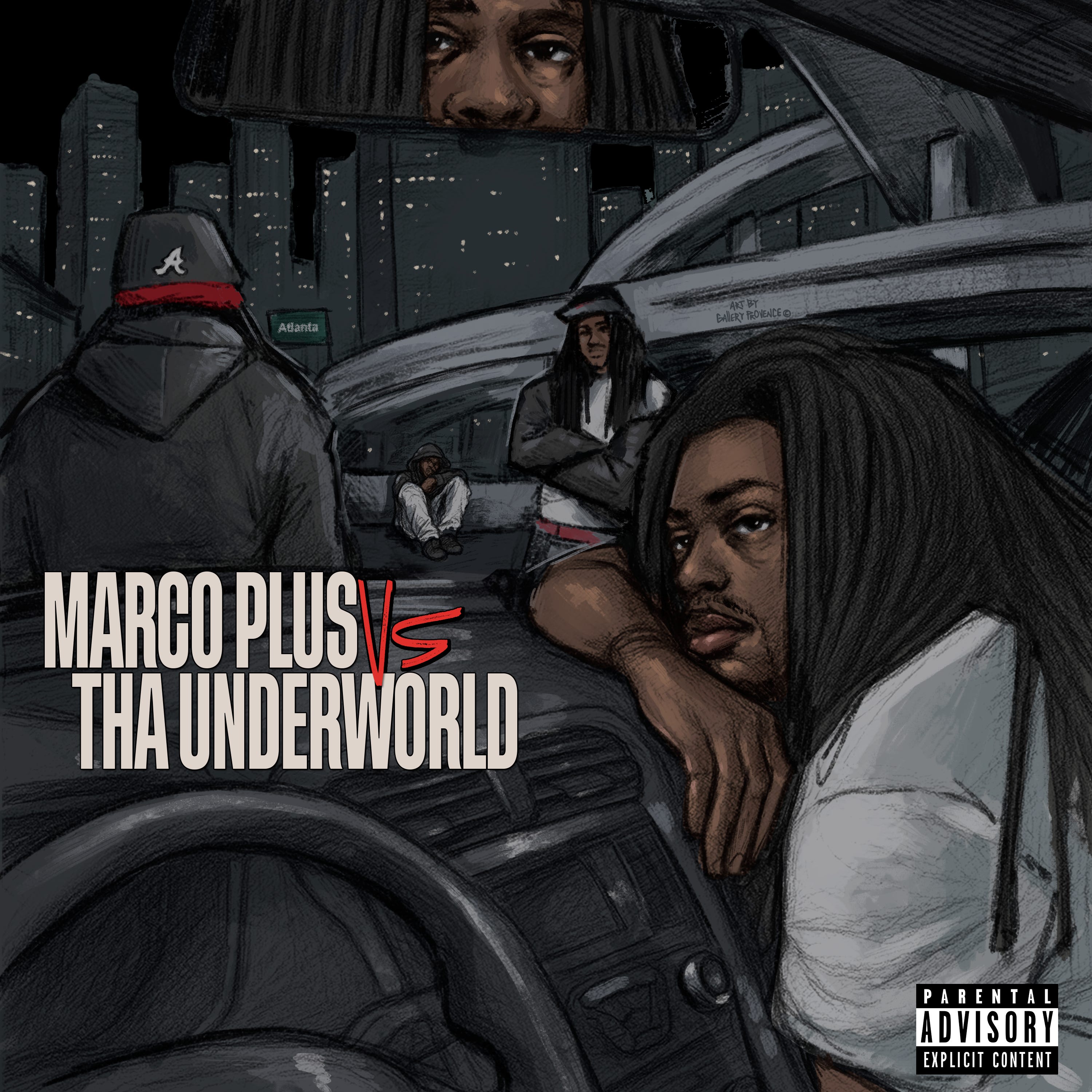
The argument at the start of MARCO PLUS vs. tha Underworld tells way more than any press release or interview ever could. We hear a woman asking where he’s going. He snaps back, “Why you need to know all that?” That sets things up: “Do you know what the fuck is out there?” For Demarcus Pollard, pulled between College Park and streets that keep calling him back, the answer isn’t ever simple. Out there is money, motion, anxiety, violence, family ties, spiritual hunger, and the feeling that none of these things will get resolved. Out there is the underworld.
For MARCO PLUS, “underworld” isn’t mythology, it’s the everyday world he navigates. South Atlanta, where his cousin was killed and the killers were never found, where weed is oxygen, guns are accessories, you grow up watching Hot Boys videos and end up at 22 contemplating seeing 23. Growing up, he dropped out by tenth grade, moved between his grandmother’s place and his father’s house in Pensacola, got a GED that led to dead-end jobs, then clawed back to Georgia to build a rap career that’s produced six albums since 2021, a Cinematic Music Group deal that led to a Roc Nation distribution slot, co-signs from J. Cole and JID, and an opening slot on the God Does Like World Tour. A career that comes off as a success story, but lyrics that gravitate toward someone who knows success hasn’t solved a thing.
The sharpest songs on this album use money as a necessity for survival, not for luxury. The “Opening” verse says it best, “My mother in debt/And my brother be stressed as it get/I mean vexed as it get/Need a check, nigga quick/Spend they last to invest in a zip.” Here, Marco is measuring his life expenditures not for the market, but out of worry for his family not having anything. “Parlay” says, “I can’t parlay all day, I’m on a grind/I just checked my watch, and it say that it’s time to shine.” It’s not “grind for your shine.” He doesn’t care about “shining”. He’s just tired of not being able to rest because he needs money for food and rent. The track’s second verse begins with his situation in detail about why he cannot rest, the cold apartments, his need to feed his daughter, and the spiritual and real world warfare that makes him require “a gun and a vest.” When he gets to “I grew up on the side where some niggas was never found/Some niggas went missing and niggas was never found/Some niggas got chipped and they killas was never found,” the recurrence is inventory. The list of circumstances is building because he has more specific details.
His daughter appears throughout as a consistent motivation. “I had to stop being selfish and get to the paper/Cause this shit way bigger than me”, maintains the transactional aspect of fatherhood. His daughter is why he keeps moving towards survival. Here, he considers the emotional impact on top of the stress: “Dealing with imposter syndrome plus survivor’s guilt.” The implication reads to the listener as self-aware, but not necessarily therapeutic. He is not processing his trauma. He is simply identifying those factors as causal to his stress. He makes it clear that his intention is to push through them.
Faith is present throughout the album, but as an unresolved hunger. Marco doesn’t feel satisfied with religion, and he doesn’t feel satisfied with atheism. “Smokin’ All Day” gives the clearest articulation of where he is spiritually. “Get high and try to talk to god cause I can’t with religion/I thought bout now that the nigga would’ve came in a vision/Oh well, I guess a youngin just got to wait for the visit/They call me stubborn, shit I just got a mind of my own/Seekin’ the truth in need of some truth, thats the timing I’m on/Church ain’t helping, I guess it’s something I’ll find on my lone/Through weed, paper, grabba, and bongs.” The prayer-through-smoke is not new in rap. The honest admission, “I lost my faith as a teen, but still not really sure what atheist mean,” provides an honest perspective of his reality. He wants peace and substitutes it through Posano (to ward off death), weed (to cope with the day), and xanax (when relationship issues become unbearable).
In “Sagemode!!!,” he says, “I’m fightin’ demons every day and I been leavin’ with welts/At least I’m fightin’.” The reference to Naruto and Jiraiya’s sage mode training arc provides a cheeky but potent metaphor for the necessity to remain steadfast. “I just wanna find my purpose/I swear this shit so deep, but they not seein’ past the surface,” has less of the look as a complaint and to a greater degree, as confusion. He is doing everything Jadea told him to, yet none of it brings him spiritual peace. While the violence is present, MARCO never fully convinces himself of its efficacy. Often, it seems as though the violence is either a necessary caution to his listeners to be aware of or an effective deterrent. “GMFU” contains a notable paranoia:
“Ironic how the niggas with dreams don’t get a lot of sleep
Still in the hood, matter fact live on the hottest street
Where guys are beefin’, straight bullets will hit ya partner cheek.”
It separates straws from a partner’s face, then effectively conveys his worry.
“In a place where niggas can’t smoke weed in peace
The other half either dead, broke, or in the streets
Ridin’ with heaters and rebels
Sitting right in the middle
Dodgin’ the demons and devils
I got my feet to the pedal
Just tryna get through the underworld.”
The violence is not comfortable. In “Hood News,” MARCO creates a vignette structure to the verses, detailing Jamal, a shooter at a party, and Peaches, a victim of coercion by the police. In both vignettes, MARCO does not attempt to tie up the situation for the listener. He shifts mid-verse into an interlude about the people speaking about the gossip.
“HELL YEA” does not offer specific violence. Instead, they offer phonetically catchy, but ultimately empty threats. “Strap with a drac’ and a forty/Bitch get a check like I’m Gordon/Don’t want the sex, I want torment,” “Stick his neck out he gon get beheaded/Hoe say I’m jaded I told her forget it/I’m a young coach I’ll call that blitz.” These threats read as a motion to convince his listeners that he is from the streets and does not care about anyone but himself and his profit. “Money, Cash, Hoes + On the Souf” opens with a homage to JAY-Z’s “Money, Cash, Hoes,” while the context in the production is appreciated, the attempt to mimic JAY-Z’s misogynistic aura as well as the violence of Memphis rappers like Project Pat and Juicy J results in an attempt with little payoff. The violence at this point has become catalog because he stopped introducing it to personal relationships in Atlanta.
The skits and spoken samples do mixed work. The opening domestic argument earns its placement by establishing real tension between staying safe and chasing motion. The Andre 3000 “south got somethin’ to say” sample in “Sagemode!!!” functions as lineage. There is a mix of utility in the Mike Tyson “best ever” sample in “OMM.” The skit at the end of “Parlay” furthers the danger presented as paranoia in the record. Two former classmates contemplate robbing MARCO because of his rap success. This provides utility for building the world around him.
Within the confines of relationships lies an additional source of pressure, rather than solace. Romantic attachment is depicted through the song “Fallin’” as a chemical disaster: “I tried to smoke you out my head, and it ain’t work/Ran through a zip it wasn’t enough I bought the pound/Felt like I need the stronger drugs I bought the perc/Poured me a 4 up of the mud and then I drown.” The progression is obvious, as each substance becomes more dire. When he corrects himself with “Sike, I’m lyin’, I’m just going through some pain,” it gives the game away: He won’t threaten the competitor, but he’ll disclose that he’s hurting; he just can’t dwell in that disclosure for long. The song concludes with a series of lyrics that could be interpreted as either spiteful or defeated: “If this love shit was a job you’d be fucking fired/Shit, I’m not really sure what love is/I just know that it ain’t this.” The uncertainty, not nihilism, about romance. But genuine confusion keeps the track from tipping into either melodrama or stoicism.
“Out My Way” features Smino, and the comparison is illuminating. MARCO PLUS opens the track with succinct aggression (“Bitch, you out yo rabid ass mind/I swear to God I told you ‘that’s the last time’/Girl I ain’t dumb, I see through all that bad lyin’/I’m bout to pass yo stupid ass, like Matt Ryan”), and then Smino arrives with melodicism, humor, and lines that bound instead of attacking: “BBL, bitches be lyin’, on God, I don’t make no rules/NFL, niggas fee lying online, like hoes arguin’.” Smino’s lightness shows what MARCO PLUS gives up in all that focus: He rarely jokes, he rarely pauses. The track succeeds because both modes are allowed to function without priority.
On “Cool It Out,” guests Kai Ca$h and Jiggs bring different energies. Ca$h raps about being afraid to meet his moment, clothes as armor, success tasting like Teramana, and Jiggs sneaks in with player energy and wordplay (“Squeeze the rod ‘til that bitch squeak like a bed spring”). Neither bogarts the track, but both demonstrate how much MARCO PLUS dictates his own mood: When they arrive, the energy softens, and when they leave, his tension re-enters.
MARCO PLUS’s sound is a blend of Southern trunk music and early 2010s blog-era boom-bap. You have mid-tempo drums that knock without rushing, and synth washes that inspire anxiety instead of partying. On “Parlay,” the beat is nervous even when the topic is successful; on “GMFU,” the production is low and menacing, mirroring the paranoid rhymes without exaggerating them. Cadence-wise, MARCO PLUS fluctuates between short, punchy staccato flows and speedier double-time flows, never maintaining one for long. The André 3000 comparisons MARCO PLUS opens himself up to by including the 1995 Source Awards speech are not a reach, his flow has that Southern stretch to it, but he’s darker, less interested in character acting, more determined to stay within the bounds of his own personal narrative.
“Venting 2 + I Can’t Feel My Face” is the album’s pivot point and its emotional core, which is one of the only spots where his inner workings are dwelt upon. The first section begins, “Searchin’ for myself/It’s getting harder with each passing day/I hope we get to find one another before we pass away,” and takes the divide between self and self seriously. Of course, he deals with his own emotional suppression (”I thug it out I won’t tell a soul/I could be contemplating the worst but you won’t ever know/But what’s the fucking point of talking bout it”), admitting that his girlfriend is the only person who ever sees him stressed. The second section, “I Can’t Feel My Face,” enters into the mode of realization: “Why nobody told me this what it takes/I ain’t know this was the price of trying to be great.” That phrase, “the price of trying to be great,” sums up what the rest of the album conveys: greatness is expected, sought after, maybe even earned, but it is exhausting.
He’s said in interviews that he wants to be the greatest rapper of the 2020s. It’s a heavy statement for an artist who is just beginning to get his foot off the ground, whose albums are still heard mostly by people who are seeking this kind of thing out. But it tracks according to this album’s logic. If the underworld is where you exist, and if no amount of movement ever really gets you out, then why not strive for greatness there? Whether he’ll achieve it is not part of the album’s world. Only the striving is for just over forty-two minutes.
Great (★★★★☆)
Favorite Track(s): “Parlay,” “GMFU (Extended Version),” “Venting 2 + I Can’t Feel My Face”