

Album Review: Midnight in Houston by DJ DMG & October London
October London and The Colleagues deliver real-band R&B that peaks at the blackjack table and flatlines at the slow jam.
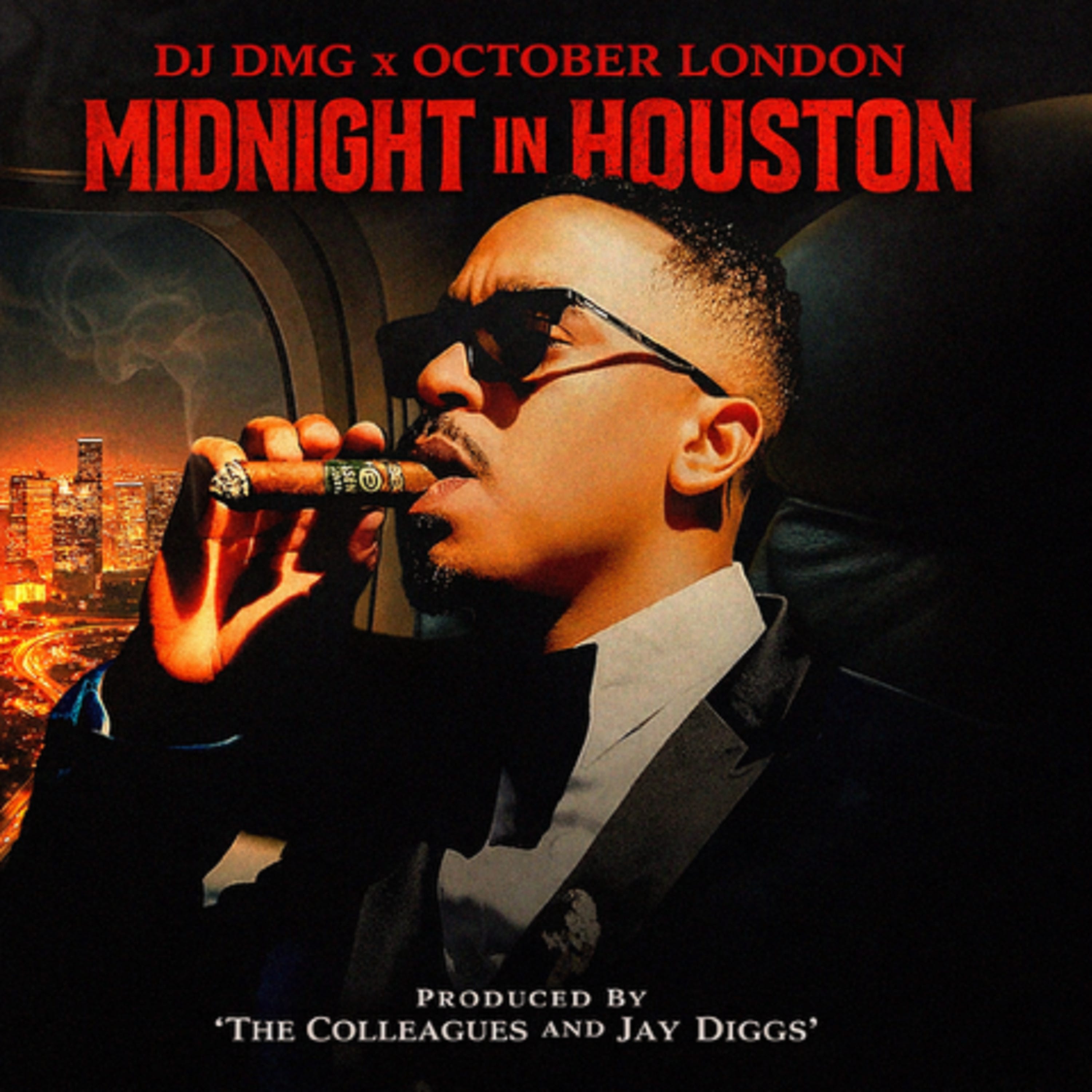
Karl “KP” Powell and Harrison Johnson have spent the better part of a decade doing something that barely exists in R&B anymore. They pair a vocalist with a production team and let that team shape an entire project from the ground up. As The Colleagues, they did it three times with Raheem DeVaughn, and now they’ve been running the same play with October London across the Love Language EP, its deluxe reissue, a fistful of singles, and this album. Jay Diggs, whose solo debut stuck its head fully inside the ‘80s and refused to come out, co-produces. London, signed to Death Row under Snoop Dogg and fresh off a nine-consecutive-week Billboard Adult R&B number one with “Back to Your Place,” spent two albums channeling Marvin Gaye so faithfully the impression swallowed the man behind it. October Nights started peeling that away. Midnight in Houston is supposed to be the record where he’s just himself, singing about gambling and sex in a city that accommodates both after dark. He gets most of the way there.
The gambling songs are the sharpest material on the album because they actually disagree with each other. “Penny Slots” watches somebody else burn hours at a machine. London isn’t playing here; he’s spectating, and the contempt is specific: “You’re a bird without wings,” he tells the person glued to the screen, “blinded by lights, trapped in a dangerous game.” The neon is a con, the cha-ching a narcotic, and London delivers the whole thing with the furrowed concern of a man who has seen enough to know what the casino floor does to people. Then “Feeling Lucky” kicks that sermon straight into the gutter. London is rapping, bragging, flying higher than a 747. Women blow on his dice. Crown Royal flows. He claims roulette bought him three or four yachts, drops a Robin Givens reference, tosses off “It’s hard to be a slave with this whip and this chain” without a blink. The most telling line sneaks in between the flexes: “I don’t even play Uno with my son no more, I hate to lose/He be hittin’ me with like four plus fours, and that ain’t cool/I taught him well.” A father so allergic to losing he quit a card game with his own child. He’s laughing about it, but the admission lingers.
“Gambling Man” collapses the bravado entirely. London opens with cards in his hand, whiskey in his system, and a couple grams up his nose. He’s seeing double and wishing his chips would do the same. The escalation from a Jackson to a Benjamin to the ATM and back again is specific enough that you can feel the carpet under his shoes: “Who the hell am I foolin’?” He says he’s done, says no more. Then, a beat later: “Unless I hit on old black twenty-four.” The poker section goes deeper.
“Adrenaline, heart is racin’
This the one I’ma hit it big
Can’t wait to see look on faces
Monday mornin’ when I quit my gig.”
He’s already spending money he hasn’t won, already imagining the vindication. “If you let me win this hand, I promise I won’t bet again/No more” lands as a prayer that knows it’s lying to itself. That three-song sequence gives the album its only real argument, and “Gambling Man” is its strongest individual track.
Desire without risk is most of what fills the rest of the record. “I Need Your Love” sets a scene (drink poured, joint rolled, Marvin Gaye on the speakers, her clothes coming off) and London casts himself as the exception to every man who’s disappointed her before.
“Rest assured I’m here to prove you wrong, girl
And show you that there’s change.”
It’s a familiar promise, and the track doesn’t push past it into anything surprising. The third section drops into body-focused territory with “I got the key, you got the lock/Those feelings you can’t fight,” which is direct enough but does the work of a slow jam and nothing more. “Nose Wide Open” is more interesting because its writing keeps betraying its premise. London says he’s open for love, then immediately names lust. He’s “shivering, shaking, and a-feening.” He doesn’t want to be caught up in a feeling, and stays anyway. The addiction language takes over the love-song framework until “can’t get enough of it” carries the desperation of a habit, not a crush. The pull between those two readings is real, though the song never fully goes where its own vocabulary points.
London writes better when the romantic material has a gimmick to lean on. “Pretty Thief” tells a meet-cute as a stickup. He’s walking to the corner; she tells him to freeze; he throws up his hands; she grabs his heart right off his sleeve. The robbery conceit could collapse into cuteness, but London keeps it moving until the playfulness burns off and both people are actually negotiating:
“Please, love me and set me free, don’t you leave
As long as you don’t do it to me.”
Two people bargaining from identical fear, asking for the only guarantee either of them wants. She’s wearing masks and gloves, he’s surrendering, and underneath both costumes is the same panic about getting left. The closing pledge gets sentimental, and it’s corny on paper, but the back-and-forth running through the rest of the record earns London enough goodwill to get away with it.
“Heart Strings” goes further. London has been waiting to confront this woman, and when he finally gets her alone, the fury almost swallows the words:
“I couldn’t wait to get you all alone
To tell you to get yourself—”
That unfinished sentence is the best single moment of writing on the album. He chokes on it, or he censors himself, or both. Then the chorus contradicts itself in real time. The lead vocal sings “I know the things you say to me are true” while a second vocal murmurs “(They’re not true).” He’s arguing two positions at once, unable to pick one, and the closing line picks the anger over the hurt and calls it a victory. Manipulation as another form of gambling, and London on the losing end of that too.
Most of the album stays indoors, in bedrooms and casinos, which is why the final stretch feels disorienting. “Don’t Stop Me” is a party cut that does its job and nothing else, Prince by way of Zapp, champagne and disco lights, a song built to move hips at a roller rink in 1983. Then “What Is Happening” clears the room. A veteran stands on a street corner with a cardboard sign. Broken families, substance abuse, incarcerated brothers, inflation, a healthcare system that poisons the poor.
“No healthcare for the poor
Whoa, these pills are making us sick.”
London stops singing to anyone in particular and starts asking questions nobody on this album has been asking.
“Do we care for who has fought
Or do we leave them out there lost
In a world that’s just unfair?”
The specifics save it from platitude. But nothing else on the record prepares you for it or follows up on it, and the song drops into the tracklist with no relationship to the gambling and seduction that surrounds it. Whether the record needed that detour or whether London needed to say it and this was the tape rolling is a question the sequencing never answers.
Above Average (★★★☆☆)
Favorite Track(s): “Pretty Thief,” “Gambling Man,” ‘Heart Strings”