

Album Review: No Era for Margins by Rasheed Chappell
Active since 2009, Rasheed Chappell takes his time centering Christian, Five-percenter, and Islamic imagery, while Reckonize Real gives him low-lit boom-bap to fill.
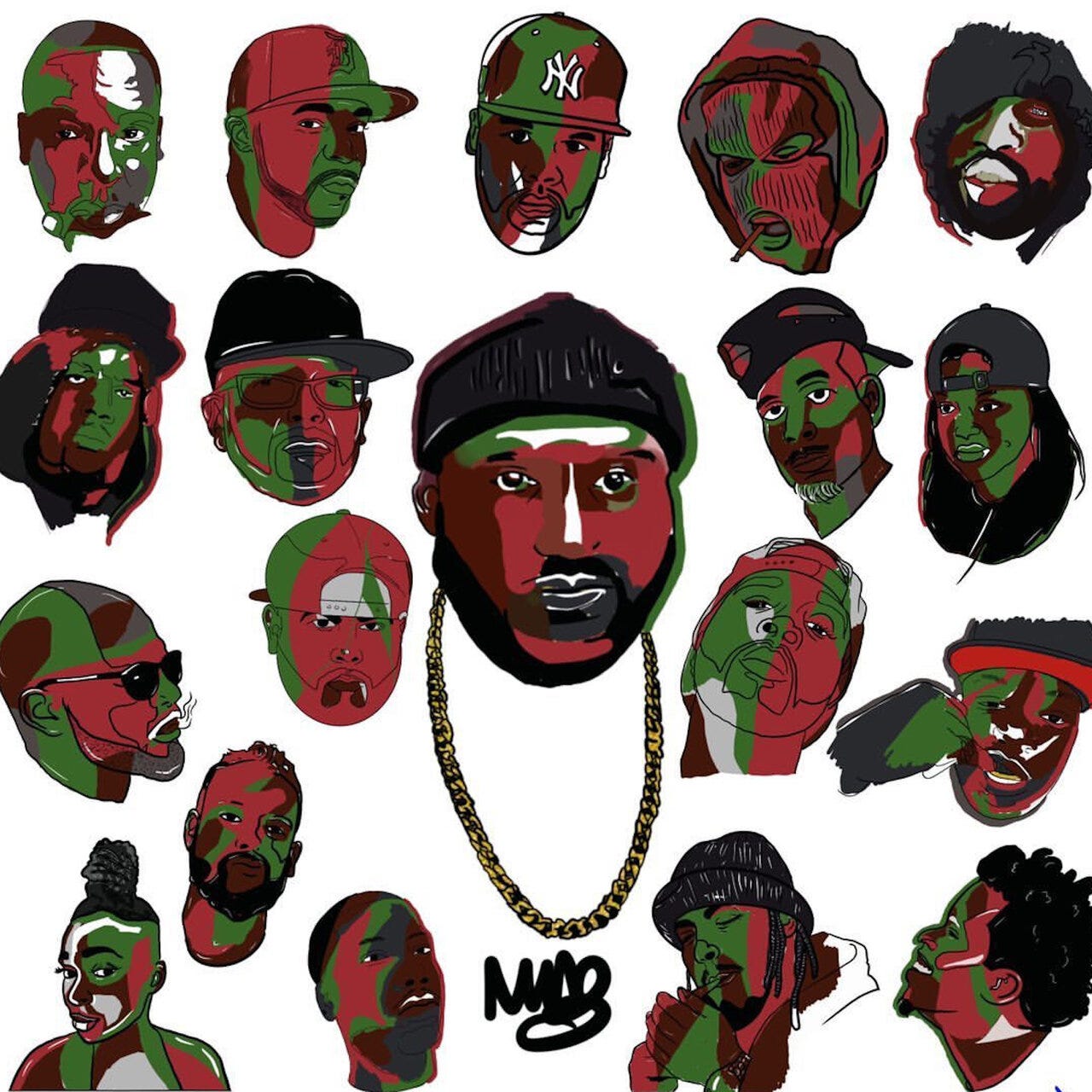
Passaic sits across the river from the part of New Jersey that’s written about in song and gets less traffic than Newark by a mile, and is close enough to Newark to use its exits and far enough that no one wants to claim it. It calls its worst Project City, and a rapper has been living there since 2009, when he dropped a single (eventually titled “Resurrection”) that got a little buzz but was ultimately ignored, and then again in 2011, when Kenny Dope blessed him with production on his first record, and all the buzz and attention kind of remained minimal. Rasheed Chappell has spent two years issuing goods and lineage- centered records to the few people who could hear them, and the rest of the world, most could not. One of the few was O.C. (appears on the intro and interlude on the album), who, in 2012, two names he seemed interested in paying attention to—Chappell and Kendrick Lamar.
On “Muscle Memory,” Chappell raps survival as something the body learned before the mind signed off on it. “Muscle memory, we hustle out of reflex/Hazards of the job is the way that we see death,” he asserts, and sets the violence next to the church, the way the block really keeps them, no seam showing: “No saviors, just sinners and Holy Ghost/With the blood of Jesus, we make a toast.” Second verse enters the drug war, stops on a man who “got seven kids in a ward,” arrives at the prisoners, ghettoized men pinning their hope in methadone prophets, then delivers a feeding machine that feeds the industrial prison, supply or direction.
Chappell opens “Earners” with a band of mercenaries with a conscience, outlining the lifers in Pelican Bay and placing his rules with the rats: “I stay silent in the face of the law/While these polygraph niggas out here telling it all.” Flee Lord responds with duress, firing back at the refineries spitting flames at his wheels. Che Noir, the aggressor who completes the song, raps about growing up black, broke and a girl in a game that gives her face a reason to hate herself and calls dark skin ugly. “Beat the odds, did it all as a single parent child,” she concludes, finishing her timing “Camp Lo” with a cheat code of fly talk, Vic Spencer sharper than a Phantom whip and Hus KingPin standing on his own current, up against himself, in his league, pumping his way before he gets any credit for the name. “T.O.N.Y. Ran Kings” seals the talk tight, Chappell engaged to the streets by his name carved in stone, the two other voices trading rank without warming the cold an inch.
One man is in “Hawks Out.” He’s the dogpark man, flagging down nonexistent cabs, dragging a Newport that he stows in his durag, an old head dubbed Mighty Mouse who still knows the best way to use his hands. Chappell follows him back through the usual debris, a man thrown off a project roof and the guffaw when the body hit, jailhouse-yard years, a homecoming and failure to exhaust his plea. The hook turns cold into a warning: “When you feel that chill in the air, you know the hawks out/Hard to make a sellout here when the hawks out/Better keep an eye on your kids when the hawks out/Yeah, you be talking that talk till the hawks out.”
On “Peace Beloved,” Chappell appoints himself first principle, originator, the nucleus stone as monument, image and resemblance of God, before He did a remodel. Planet Asia and Supreme Cerebral place their gods and Islamicism in the low, languid ambiance; the story is loud and unbroken through the lineage to “Kufi & Jalabeeya.” Calling himself the offspring and child of Willie Lynch, the name jumps from Bobby Seale to Huey Newton to Condoleezza Rice in the House to Condoleezza Rice, the whore and the master. Then ends with a tip of the hat to the KRS, and back to the beginning—self-destruction.
Chappell is snapping on “1000 Words.” He’ll photo the neighborhood: has and have-nots, dreams fractured into stone and steel, before he’ll tell a story he knew as a boy: “Nappy head, burnt chest, snotty nose, dirty clothes.” The boy recites “The Message” off an album cover, while the father sniffs cocaine off the cover and lies about it. Yolanda Sargeant sings on “Mother’s Cry” by the camera looking out over a Passaic news of a man dead on Main Avenue near Garden Street, one woman, mother of a son who pulled the trigger, one woman, mother of a man who caught the bullet. It leaves the two mothers, side by side on one night, and both on their knees before the same blockade. Chappell’s third verse is powerful.
“Yeah, two mothers, one night, both lost they sons
Death is what the street life cost they sons
One life behind bars for the life he stole
One life now gone for the life he chose
Two mothers now connected by the singular pain
In this concrete jungle, Black boys are preyed
Black boys are trained
In single-family homes, Black boys are raised
By mothers who fight and struggle, do the best that they can
But can’t no woman teach a boy to be man
So the streets lurkin’, searchin’
For young and impressionable minds
Enticed by the lure of wealth, ruin they lives
And now they mothers stand face to face
Like they sons stood face to face
Both women hurt in they eyes
With no strength left, no more tears to cry
Just a bond formed by tragedy and native real casualties.”
Loud men make people watch as Chappell slips through unnoticed. Instinctively, he directs the rest of “Open Fire” against the snitches and frames his bars as something to mount and hang: “Art the imitation, life the inspiration/it’s so vivid you could hang it in the Guggenheim.” The boasts slide home, the grief remained hidden. He has been framing the block on the wall all along, framing and lighting what normally remains on the street. The line about the Guggenheim is him only saying it.
Great (★★★★☆)
Favorite Track(s): “Muscle Memory,” “Mother’s Cry,” “2 Evils.”