

Album Review: November Scorpio by Tiana Major9
On her debut, Tiana Major9 sings about money, God, and bad fights with the same possessive grip, and that honesty is the album’s engine. The penmanship is specific and bracingly principled.
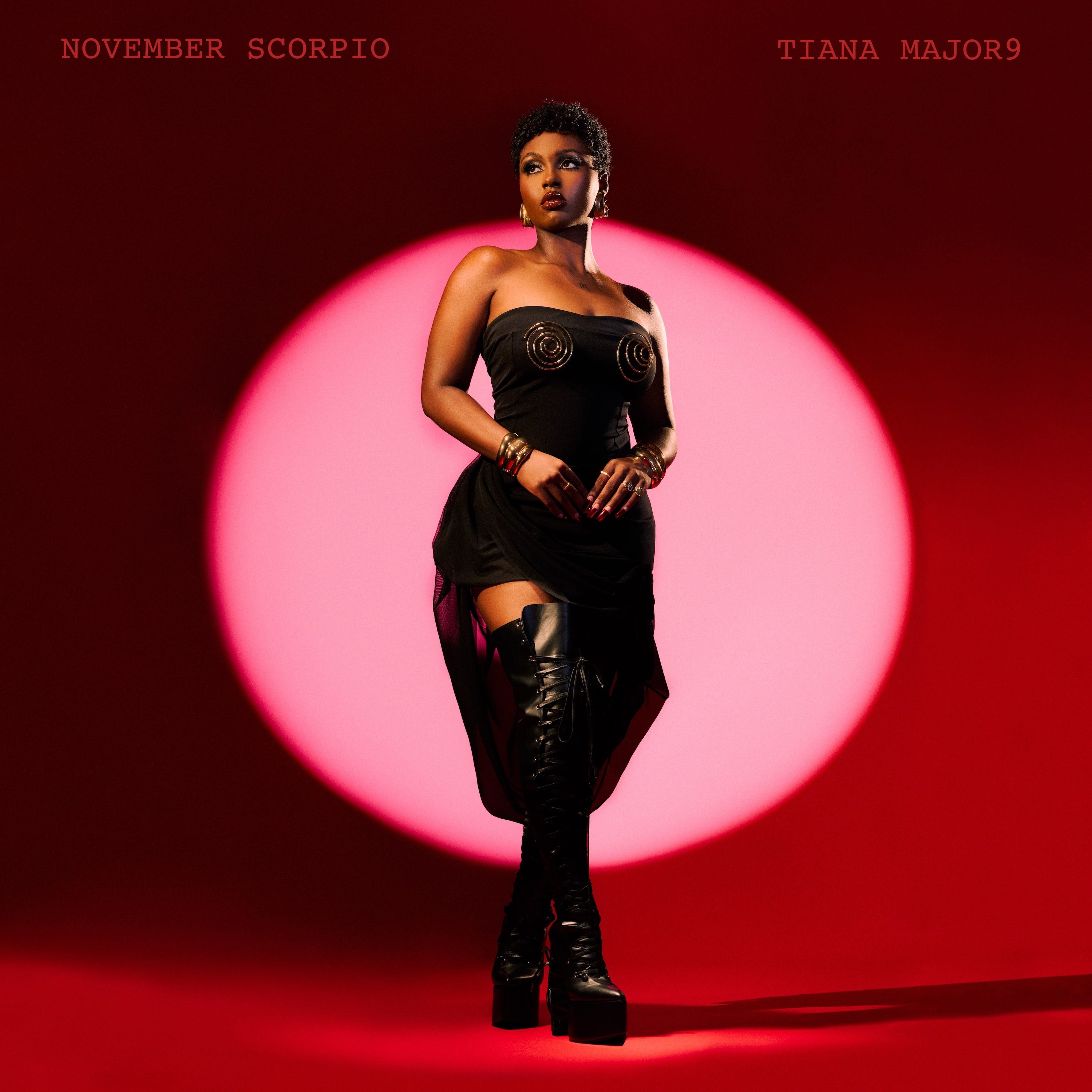
Every couple on this record is also a small business. Somebody leaves to earn, somebody stays and wonders if earning was the point, and the songs keep circling the gap between devotion and transaction without ever pretending to close it. That tension takes a different shape on almost every track. One promises a vacation as collateral for patience, then widens the deal to generational wealth, then blurts out a joke about starting a family that isn’t really a joke. Another personifies money as a lover who disappears after a single reckless night. A third clocks the exhaustion of a couple who’ve been in therapy and still can’t stop fighting. The fears pile up without canceling each other out. Tiana Major9 wants domesticity and the road, faith and profanity, partnership and the petty thrill of stealing somebody’s attention, and the album never pretends those wants are compatible.
A British singer from East London with Jamaican roots, she broke out in 2019 through “Collide,” a collaboration with EARTHGANG for the Queen & Slim soundtrack that sat on Billboard’s Adult R&B chart for half a year and earned a Grammy nomination for Best R&B Song. She released four EPs through Motown between 2019 and 2022, went independent on +1 Records, and spent two years quiet. With PRGRSHN on the boards, November Scorpio carries the pressure that silence creates. It also carries the benefit. Nobody handed her a concept or a deadline, so these concerns feel chosen rather than pitched, and what she chose to write about is how badly she wants love, money, and control, and how each one complicates the other two. On “Waikiki,” that bargain is literal. She tells a partner she’s gone “to write you songs to help me pay the bills,” dangles Honolulu as collateral, then widens the promise to “get the bag and bring my family wealth” a verse later. Right before it fades, a bridge slips in about starting a family, then says, “Yeah, I’m joking.” The retraction makes the real want visible. She means it. She’s scared she means it. And it won’t let her take it back or commit, so it just ends in the waves.
The guitar-driven “Money” personifies cash as a fickle partner who’ll “desert me” after one reckless encounter, and Tiana concedes she’s “high key possessive.” That would scan as a cute metaphor on its own, but she grounds the obsession in biography. She grew up counting “pennies round the house to make a pound to go buy basmati,” and that memory stiffens her grip on every new dollar. When she reaches for the word “cleromancy,” wanting divination to predict whether she’ll stay solvent, the joke can’t quite disguise the pit it came from. “Fiiighttt” redirects the same anxious energy toward a relationship, clocking the fatigue of a couple who can name their problems and still can’t stop rehearsing them. She calls herself “a ball of emotions” opposite someone who keeps feelings “at bay,” and the mismatch leaves no exit. “Not even therapy can change our ways” sits right between surrender and threat, and the hook hammers the stakes into something personal. She has “a few years left of my twenties” and refuses to spend them on the same quarrel. Those two tracks together map a worry that R&B rarely puts this bluntly. She’s not heartbroken or wronged. She’s afraid the math won’t work out.
The toughest writing lives on “Shook One” and “desire.” and they earn their weight through opposite strategies. The former borrows its title and samples from Mobb Deep but redirects that menace toward romantic confrontation, begging a stoic partner to say what he feels. “I can’t read your mind if you don’t communicate” is the cleanest line on the record. The anger escalates without theatrics, and when Tiana asks, “If you ain’t loving me, who the fuck are you loving?” it sounds like a woman who already cried and now just wants a straight answer. The latter goes somewhere harder to defend. She falls for somebody taken, and the loyalty collapses in one breath. “Usually I’m truly such a girl’s girl/But fuck her if she think that you’re her nigga.” The solidarity dissolves before the bar ends. She just names the want and asks forgiveness and keeps going. A more guarded debut would bury that admission in an interlude or coat it in satire. Tiana plants it near the end and lets the discomfort sit.
Then the temperature drops. On “GRACE,” Tiana wakes up, smokes a spliff, walks her dog, and tries to hold it together.
“I be a vessel, Jah just shine within
I keep the balance, but I might just tilt.”
She fakes composure and knows she’s faking, then says she’ll “fake it till I make it” as if the cliché spoken aloud might somehow become real. The track would dissolve into affirmation if it stopped there, but a voicemail arrives after the music drops out. A woman’s voice, warm and unhurried, quotes Second Corinthians 12:9 and reminds her, “you don’t have to earn rest.” That external voice is the only one on the whole record that doesn’t belong to Tiana, and it hits because every surrounding minute is so sealed, so interior. “Alone” strips away the remaining armor. No metaphors, no wordplay, just “can’t turn this house into a home” and the blunt word “stupidly” to describe her own loyalty. That’s the least poetic moment here and the most precise one.
With Yebba on “Always,” the scope widens. Tiana introduced this person to friends, built them up publicly, and now watches the wreckage. Yebba enters owning her part. “I play the judge, and the jury/I wouldn’t let you flee.” Both acknowledge they “turn into actors, performing for nobody,” and that image—the curtain down, the crowd gone, two people still reciting lines—does more in four words than most R&B breakup bridges manage. The outro narrows to the smallest possible gesture. “Pick up the phone and I put it back down.” It barely needs a melody. “Energy!” and “Lucid Dream” close things giddy and unbothered, which is the right call. The first rides flirtation without forcing depth, and its outro owns up to being “a frequent freak” who wants plain instruction. “Lucid Dream” plays sex fantasies as comedy, and the “OBE” is a punchline and as genuine escape when waking life runs too slow.
Great (★★★★☆)
Favorite Track(s): “Fiiighttt,” “GRACE,” “desire.”