

Album Review: Oda by Daniela Andrade
After fourteen years singing other people’s songs, Daniela Andrade finally recorded the conversation she’d been having with her mother all along. Oda is the proof.
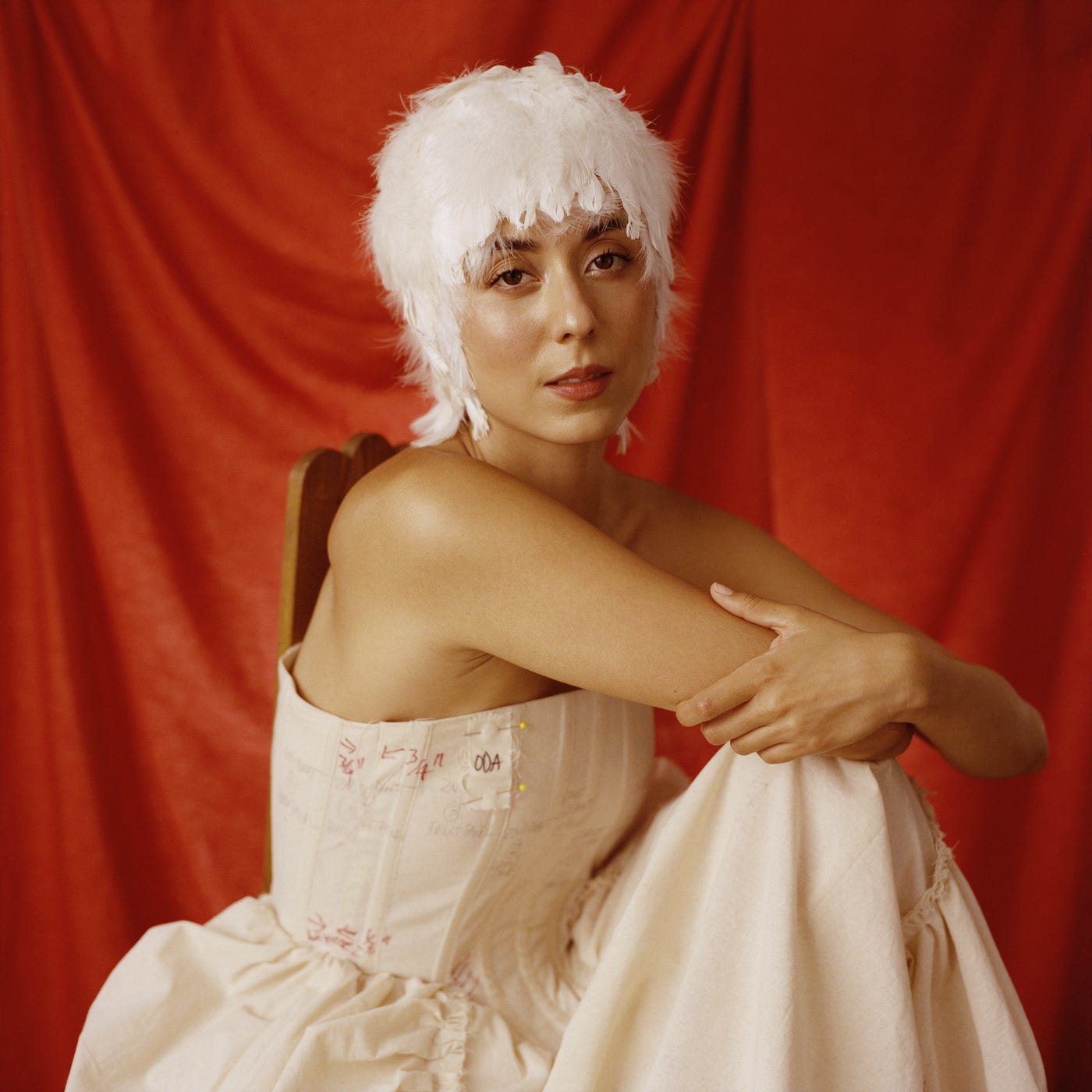
Most people who know the name know the covers. A teenager in Edmonton posting acoustic takes of Beyoncé and Nirvana in 2008, building an audience of nearly two million subscribers on YouTube before she had a single original song to show for it. A “La Vie en Rose” video with 100 million views. TV placements on Suits and The Umbrella Academy. Six years ago, Daniela Andrade released Tamale, an eight-track EP that introduced her in Spanish for the first time, singing about her parents’ immigration from Honduras and the tamales her mother sold to send money back home. Then quiet. A handful of singles and collaborations, but nothing shaped into a full statement.
Oda, her self-produced debut, took those six years to arrive. It opens with a voice memo from her mother, blessing her in Spanish. “Good morning, beautiful doll. I hope you woke up with high spirits. God bless you. Praying for your plans and dreams.” Andrade could have opened with anything. She opened with her mother’s voice before her own. That voice keeps returning. Andrade’s mother appears on three interludes spaced across the album, each one a small window cracked open between songs. On “el enojo,” she says in Spanish that when anger arrives, the body wants to leave or rest, that you don’t cultivate anger, but feelings come anyway. “ángel19” holds a childhood warning. “You have an angel, but the angel leaves if you go out to a party.” “Eso me marcó,” her mom says, but in English, it’s ‘that marked me.’
Of the three interludes, “poema” cuts closest. Andrade recounts a shower in her second apartment in Montreal, where she cried thinking about her mother, because she missed her and was furious at the same time. “Yo llevaba mucho enojo y no sabía adónde ponerlo,” she says. “I carried a lot of anger and didn’t know where to put it. There are parts of you I rejected. And with time, I’ve learned those parts are always going to be inside me.” Between those interludes, “madre” moves in Spanish through what a daughter couldn’t understand as a child, her mother’s tears, and circles it now as an adult carrying laughter and pain at once, a flower in spring that sings.
The album’s other territory is desire, and Andrade writes it as something happening in real time, in a specific room, with a specific person. “fantasmagoría,” sung entirely in Spanish, places her in a salsa club wearing a black skirt and tall boots, watching someone dance, watching the band play. No photos, she says, because this is just for the two of us. Her phone’s dead anyway. What she keeps is hers, stored in her mind: “your words, your smile, and the atmosphere.” She knows tonight will become a memory, and that knowledge is exactly why she falls in love. In the second verse, she likes when someone gives patience, hips moving like a figure eight, and they say, “girl, there’s no rush here.”
Andrade’s lone feature pairs her with Montreal producer and cellist Ouri on “beds of hay,” and it pushes further. “It was 2:30, you planted one on me,” Andrade sings, “I said why don’t you come in, why don’t you stay.” Their hands got sticky, sentences melty. “Words can be ribbons, can be little beds of hay.” She wants it in her hair, down her back. Fingertips light up the ceiling. The song stays close to the body, specific and unhurried, built on small physical details instead of euphemism.
On “i see red,” she admits to stumbling with words, to holding things in, to getting overly sensitive when something matters. Then she flips it: “I like when we get angry on a Sunday afternoon, make up real nice, tense up the room.” A voice memo in the bridge offers a piece of advice from Santiago. “Don’t go to bed without fixing the problem, because how are you going to sleep angry next to your partner?” The album turns toward people who leave and the spaces they leave behind. “steer” puts her in empty parking lots with the radio up, trying to steer clear of someone she still misses. The next verse sharpens the blade: “I feel like I met you in a past life, did you send the bullet even then?
Two-thirty-five a.m. and thoughts are spiraling on “cohete.” “Is this my prime? Am I running out of time?” Then it switches to Spanish for the chorus: “you’re like a rocket, you pass through my mind.” The person intrudes and disappears at the same speed. “777” pins loneliness to an apartment. “Tables have turned, nobody’s home, records feel different when you’re gone, if walls could talk they’d probably say nothing stays the same.” Echoes on her feet, nowhere to be.
A goodbye that refuses grief, the title track has Andrade singing in Spanish that she is an ode to kisses, to hours of conversation, to someone’s dreams she prays come true even though she’s no longer beside them. Every story has its end, she says. Even in the good times, you have to say there’s only one song left, one more ode. If it’s the last interaction, let’s dance it. The pain gives way to tenderness. She feels tender.
The album shifts between English, Spanish, and French, and those shifts aren’t decorative. Spanish carries the family conversations, the desire, the cultural memory, the warmth. When Andrade sings to her mother, she sings in Spanish. When she’s in the salsa club on “fantasmagoría,” she sings in Spanish. The title track’s declaration that she is an ode to someone’s kisses comes in Spanish too. English does different work. “steer” keeps its distance in English, and “shy” holds its words back in English, a song about the gap between feeling something and being able to say it, where she compares the delay to leaves budding from April into May, slow and seasonal. The loneliness of “777” lives in English too, flat and undramatic, just empty rooms and records that sound wrong.
French arrives only once, on the closing track “à volonté.” Andrade trembles when she goes out without a coat in a white January morning, trembles when she sees the pregnant moon like a yellow eye watching her in bed, trembles because she knows life is cruel and sweet like a flower, trembles because to love is not to have. The French chorus, à volonté, toujour, pour toi (freely, always, for you), takes the album’s final offering and places it in a third language, as if the thing she most wants to give can’t live in just one.
As a thirty-two minutes long introduction, Andrade produced it herself with co-production from Nathan Burley and Gray Rowan, who worked on Tamale seven years ago, and there’s a smallness to the recording, a closeness. This is personal work, made by a woman who spent over a decade singing other people’s words and finally committed her own anger, her own desire, her own inherited contradictions to tape. There are songs here that justify every one of those six years. Three spoken pieces plus a 29-second opening blessing is a lot of breathing room for a record this brief. But Andrade has said the voice memos are the album’s organizing principle, and she has every right to trust that instinct. The album does the rare thing of being exactly as long as it needs to be.
Great (★★★★☆)
Favorite Track(s): “shy,” “fantasmagoría” “beds of hay”