

Album Review: Of Earth & Wires by Dua Saleh
A grief album built for the dance floor, where the body keeps moving after the mind has already left the room.
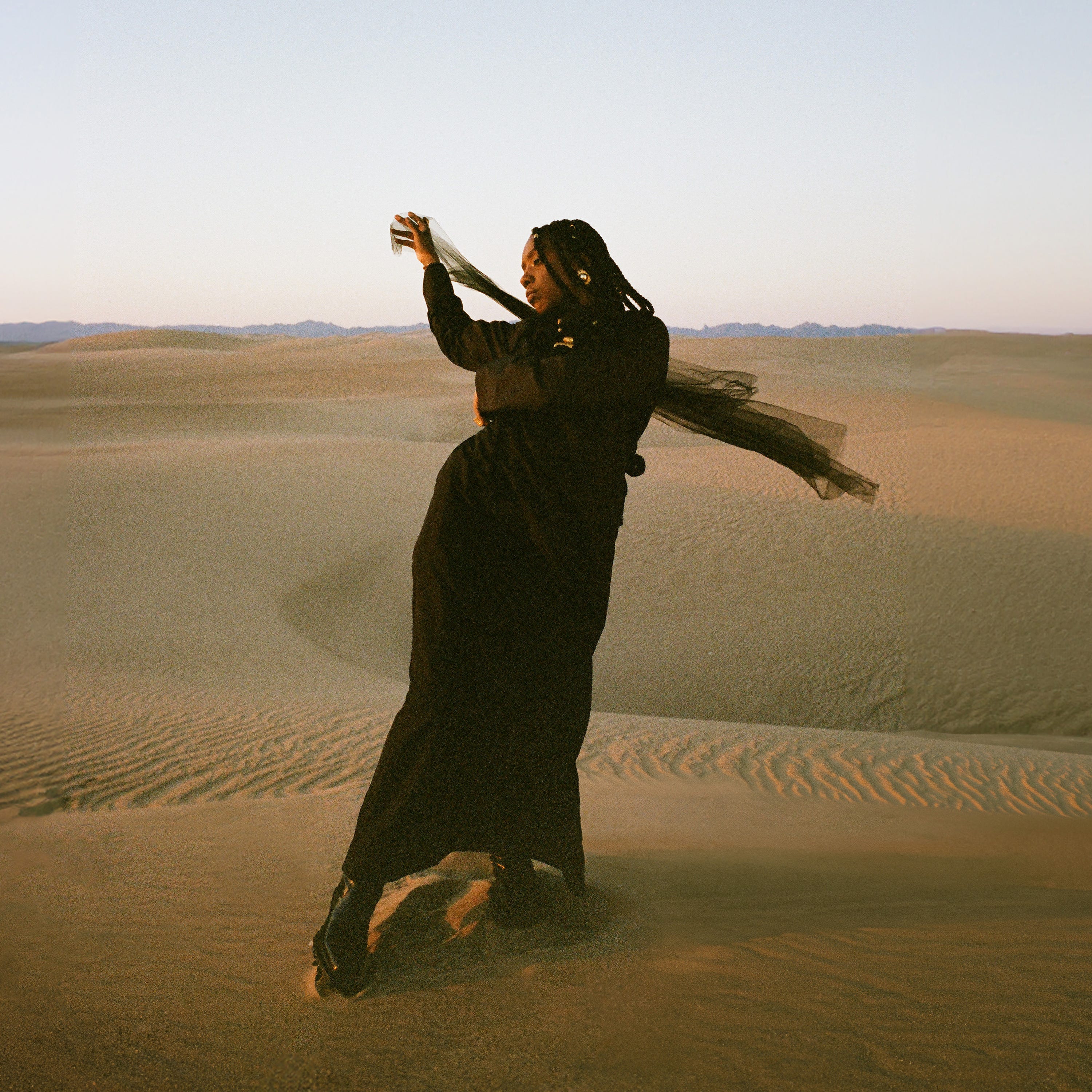
In a rented house in rural Wales, between takes for a British TV show, six songs were cut in three hours, with four minutes from the first guitar loop to the final vocal take on some of them. Billy Lemos had flown from Cedar Rapids with a laptop and a bass; the singer on the other side of the mic was mourning a grandmother back in Sudan, a country mid-collapse, reached only by phone calls that arrived at odd hours. “Flood” needed only one take. Dua Saleh’s second album was assembled in stolen afternoon hours between someone else’s scenes.
Raised across five states after fleeing Kassala as an infant, Saleh landed in Saint Paul’s Rondo neighborhood—a Black community cut in half by a highway in the 1960s, still rebuilding when they arrived. That history never turned into backstory. Their first EP, Nur, arrived in 2019 on Against Giants with Psymun producing. A co-writing credit on Travis Scott’s “MY EYES” and the debut full-length I Should Call Them on Ghostly International followed. Of Earth & Wires is the second album in eight months; the boldest proof yet that Saleh’s velocity is method, from a singer who usually finishes songs in thirty minutes but called this their most careful work.
On “Flood,” guest vocalist Justin Vernon stacks his vocals into dense choral layers behind Saleh’s talking delivery. Unlike the Vernon of i,i, whose layers existed as self-contained weather, these vocals earned their weight. Horns dry, guitar acoustic—a strange arrangement for a grief song. Still, it holds. All the moisture comes from one human voice multiplied past recognition. Saleh raps about grief growling at the Earth, about koi fish splitting into yin and yang. Vernon’s refrain (“unless you saw the water”) never turns into a hook, never gets repeated enough to become one. “Cállate” runs on an Afro-diasporic drum sequence pulled from industrial reggaeton—metallic hits punching through distorted synth stabs while Saleh’s rapid-fire delivery bounces between Spanish and English. Lemos constructs every track on the album as a single architecture without genre-switching breakdowns, and that is where that rigidity earns its keep. Strongest single on the record, and it is most physically aggressive.
“Firestorm” rides synth plucks and a driving bassline, but the vocal sits at one temperature across its runtime. Saleh asks someone to undress, come closer, look in their eyes, without shifting between any of those requests. “Speed Up” borrows Jersey club velocity and coasts on it, its chorus sticking to nothing past the song’s end. “I Do, I Do” stacks pitch-corrected harmonies into cold detachment that leaves nothing to return to on replay. Honest dead weight for the unmemorable run on the album. On “B r e a t h e,” over an electric piano groove that needed nothing else, Saleh sings about a party-hopper in mourning.
“Simply breathe?”
As “Glow” opens bright and upbeat before unraveling into glitch-pop, its final section replaces melody with broken digital noise and distorted vocal screams—the most ambitious production move on the record, made possible by Psymun’s return alongside Lemos. “Anemic” pairs Gaidaa’s smooth delivery against Saleh’s rasp over sad acoustic guitar and slow-pulsing sub-bass. “Keep Away” runs a hypnotic drum-machine loop while Saleh raps about wanting solitude they cannot maintain. Vernon returns on all three, where his voice is pitched and submerged beneath Lemos’ production. Never foregrounded. “Glow” is among the year’s strongest R&B productions; “Keep Away” never quite justifies its loop’s claustrophobia.
Between the debut and Of Earth & Wires sits eight months and an entire register shift. Saleh moved from Saint Paul to LA, lost family members to the Sudanese war, lost closeness to siblings and a mother whose voice they worried they were forgetting. Psymun, who produced that 2017 first take in a home studio in Minneapolis, returns on “Glow”—eight years separate that session from this Ghostly International release. A quiet record, blunt about what it left out. The first album needed a narrative arc to justify its ambition, and this one, unlike anything else released on Ghostly in recent years, runs on physical pressure alone.
Great (★★★★☆)
Favorite Track(s): “Flood,” “Cállate,” “Glow”