

Album Review: Once In a Red Moon by Red Cafe
A 49-year-old Brooklyn rapper puts out his own album on his own dime, twenty years after his debut was first scheduled to arrive. The features sit alongside Benny the Butcher, Max B, and more.
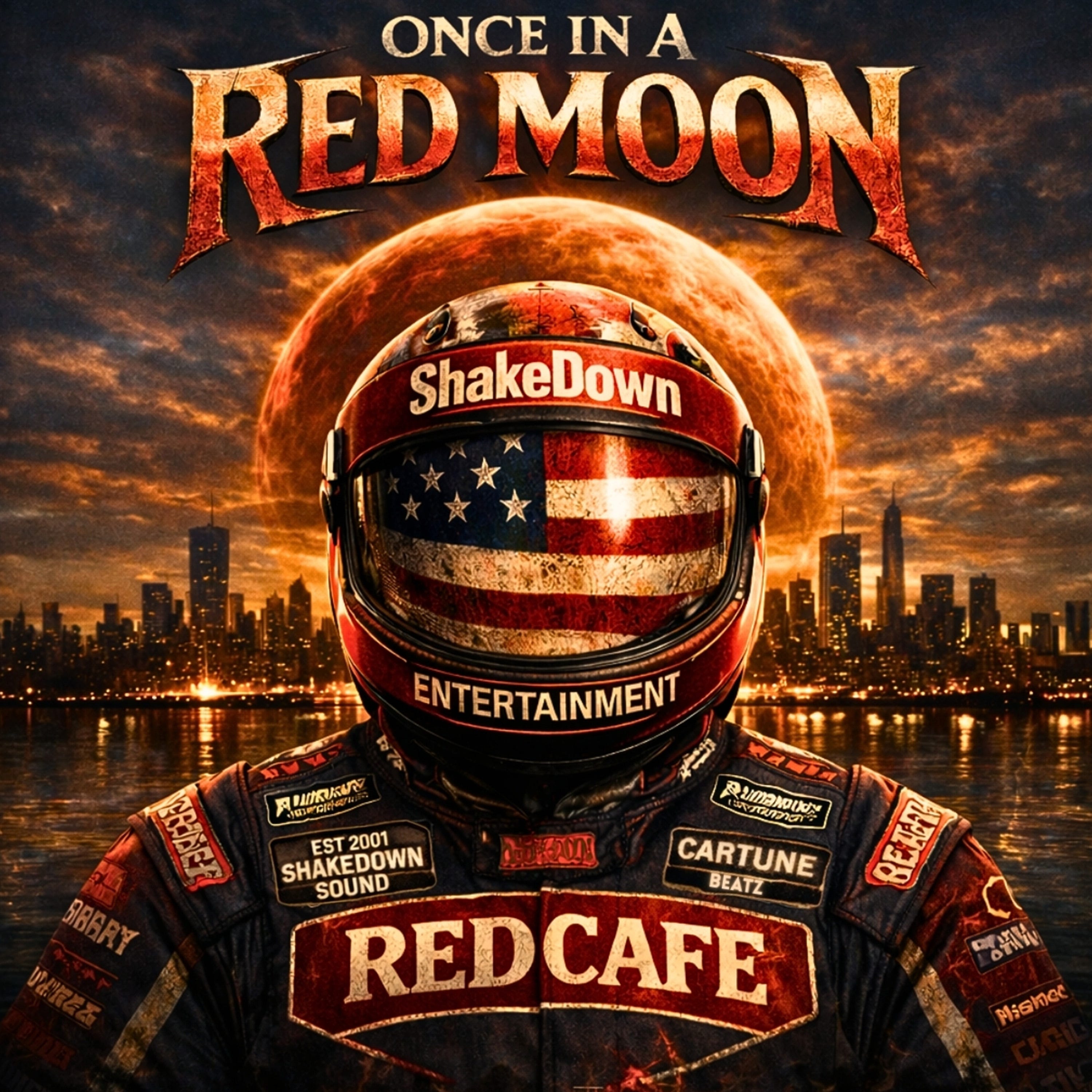
In English, “once in a blue moon” reaches back to the 16th century and points at a thing that almost never happens. Jermaine Alfred Denny was born in Guyana in 1976 and raised in Flatbush from age six. He took his stage name from his father, whose nickname was Red; the words were stamped on bags of Denny’s drug product before they were printed on any flyer. He did four years in a New York state prison beginning in 1992, when he was fifteen. After his release, he signed to Violator, Arista, Capitol, Konvict Muzik, and Bad Boy across two decades, with a major-label debut called The Shakedown that got scheduled for 2012, got rescheduled for 2013, then got shelved. He has composed for, produced for, or ghostwritten for Diddy, French Montana, J-Lo, Rick Ross, Future, Chris Brown, Busta Rhymes, and E-40. He played the rap-battle opponent in the Notorious B.I.G. biopic, reading the actual lines the actual opponent delivered against Christopher Wallace in a real Brooklyn battle in the 1990s. Once In a Red Moon Vol. 1 came out this week on his own Shakedown Entertainment, with every beat produced by Cartune Beatz.
Cartune’s beats are simple late-‘90s East Coast architectures, built on chopped soul-sample horns, knotty bass figures, thudding drum patterns, and almost no melodic ornament. Kicks and hi-hats land where you expect them. There are no beat switches, no TikTok-engineered drops. Red Cafe raps deadpan punchlines over them for ten tracks.
One of two solo cuts on the record, “Private Room @ 2AM” opens with the hook:
“Big ice, champagne, Bottega Veneta, now I’m suitable
Slide to STK and order up the usual
My twin, she love me down, she tell me all my scars is beautiful
I’m sick of the loss, sick of the snitches, and sick of goin’ to funerals.”
The first verse opens on a casino trip (“Bet the chips on red, now it’s all or nothing”), moves through the Patek-and-Rollie combo (“it’s a fuckin’ menage”), lands on “ball in the street more than I ball in the park.” He identifies himself, spelling each letter: “I’m a D-E-A-L-E-R.” The second verse pivots inward. He raps now about burning bridges, fine dining with fine women, and his father’s funeral. “Pops’ funeral, I said I wouldn’t, but I cried,” he raps, then follows it with, “Every time they left me for dead, I came alive.” Then: “I still wash my AP in champagne/I’m in them offices, but some things I can’t change.”
Benny the Butcher turns up on “TSA Pre-Check” with the Royal Oak AP soaking wet and the line, “I told my lawyer I’m too rich for a crime cell.” His verse closes, “Sold so many bricks, I hope I’m getting into Heaven. Pray for me.” On “Redrum,” ElCamino moves from a whip he hasn’t driven yet to “And if you gettin’ money, then give your mama somethin’, nigga.” RJ Payne opens “Payne Cafe” with “I seen my mother die, nothing was the same that day.” Boldy James on “You Lucky” namechecks the Peter Pan bus line drug runners once rode between cities (”Came up off the Peter Pan like I’m Captain Hook”) and drops “I’m so Detroit, type to park the Rolls on the coursework.” So Rich’s verse on “Water & Flour” walks through his first smiffin at fifteen from Benz, his first gram from Flatline, the partner whose name was on the paperwork while he was inside. Max B’s verse on “Wish Me Well” ends with himself and Rozay smoking “up in the big house.”
The second of two solo cuts, “Pray for Me,” opens with:
“Pray for me, pray for me, that I make it home safe
Pray for me, pray for me, that I never catch another case.”
Red Cafe spells himself out again on the verse, “Kinda hard being R-E-D C-A-F-E from the SD.” He mentions an ER visit his chain sent him on (“said my chain too heavy”) and lists the films he came up on—Shottas, Money and Violence, Belly. The verse closes, “Me, my blick, and my bitch, all we got is us.”
When he raps “I could whip it to a cookie or a pancake” on “Once In a Red Moon Pt. I,” the room he is remembering is a real Brooklyn stove in the late 1980s. When he raps “My kitchen counter touch more cocaine than Rick James” on “Payne Cafe,” he is referring to an apartment he lived in before Violator signed him. On “Redrum” he raps:
“Back on Flatbush Ave, I had the cheap rocks
Pandemic season, we had the tree spot
We got it fifteen-five, that’s the sweet spot.”
The bars name a specific block, a price point, and a year. Everyone on the guest list brings the same kind of paperwork. On the album’s closing song, Red Cafe raps over a Cartune beat cut from the same template as every other beat on the record. His hook repeats “Anybody can get it” eight times, and his verse runs through branzino at Wynn, a penthouse at the Aria, McQueen on his feet, a Jersey move, and the line, “I’m a black IP, still I move the Fergie.” Cartune’s uniformity across ten beats puts the differential between songs almost entirely on Red Café, and on the back end of the record he raps in brand names.
Shakedown Entertainment, the label that put the album out, carries over the title of the major-label debut Bad Boy scheduled and cancelled twice. The Guyanese jewels Red Cafe shouts out on track one are the jewels his father wore. At 49, after two decades of ghostwriting hit singles other people signed their own version of, Red Café raps on “Private Room @ 2AM”: “I did it my way, middle finger to the critics.”
Solid (★★★½☆)
Favorite Tracks: “Private Room @ 2AM,” “Water & Flour,” “Pray for Me”