

Album Review: Outsider by Tiwayo
Tiwayo disappeared, stayed gone, and wrote an album that calls itself an outsider’s LP without a trace of irony.
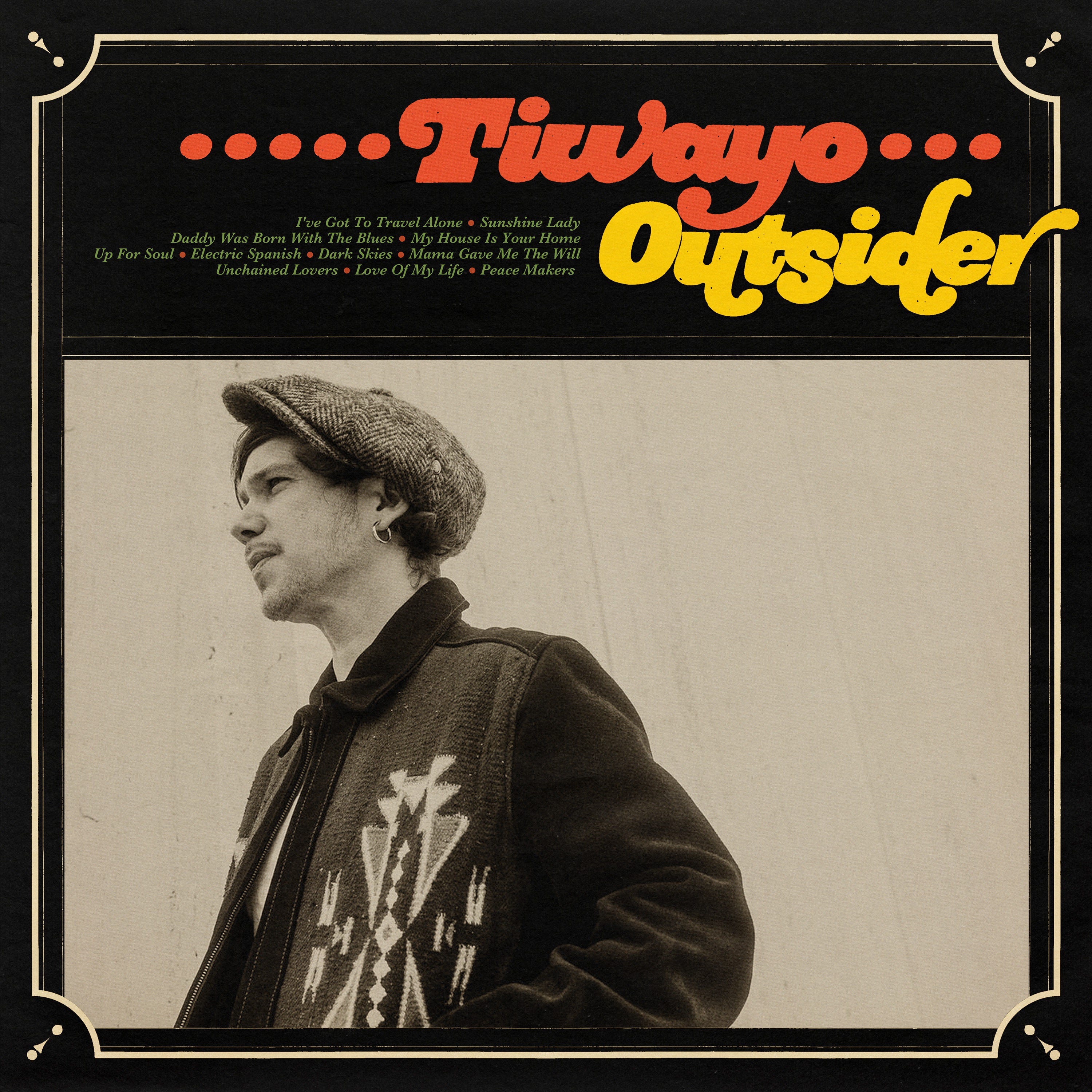
A singer most of the American audience has not placed yet put out a new record this spring on Record Kicks, the Milan independent whose catalog tilts toward soul and funk LPs made by small working groups. Tiwayo came up busking, signed to Blue Note for two earlier full-lengths, toured as a support act, then went quiet for long enough that those records stopped being discussed. Adrián Quesada heard the demos and reached out, met him at Les Eurockéennes in eastern France, and brought him to Electric Deluxe in Austin to cut Outsider. Quesada produced every track, played guitar on every track, and the rhythm players behind him never leave the room: Jay Mumford on drums, Terin Moswen Ector on bass and congas, Joshy Soul at the keys, Alexis Buffum bowing strings, Doyle Bramhall II plugging in as a second guitar on “Daddy Was Born with the Blues” and “Electric Spanish,” Kendra Morris walking in once to sing a duet. The personnel on the first track is the personnel on the eleventh, and a listener can hear that kind of steadiness in a room before anybody opens their mouth.
On the song for his late father, Tiwayo will not explain the death. He tells you the man was born in a beautiful city he does not name, that the city was a land of many dreams, that his father was a lonely child who met jazz at school and stopped being so lonely after. “He was born with a feeling,” Tiwayo writes, “an extraordinary feeling that also weighs heavy sometimes,” and the line about the heaviness is doing more than the line that sets it up. Doyle Bramhall II’s guitar comes in under Alexis Buffum’s strings, and a plain four-line biography arrives at the chorus.
“Oh, yes, he was born with the blues
Just heard the news that he didn’t get two lives to choose
Daddy was born with the blues.”
What that third line contains is the song. Tiwayo is writing a eulogy for a father whose only tragedy, in the song’s telling, is that one life was not enough to hold everything he was, and he does not expand on it. He arrives at “He had two beautiful sons/Many stories to tell/And for what he started with/He did pretty well,” and leaves the arithmetic alone. Twice more the chorus comes around, and the song ends without naming the city, the cause, the year, or what anyone said at the funeral.
But later on, Tiwayo writes his way into a double identity claim that looks, on its face, like a guitar joke. In “Electric Spanish” he goes out into the streets and cannot find anybody to talk to. He is lost in the country around him. He gets as high as the day will let him and still cannot reach anybody. People ask him where he finds any joy at all, and his answer is the song’s title. “I say I’m electric Spanish, electric French/If you’re looking for trouble, trouble, Lord knows I can be your man.” Gibson’s ES guitar is the obvious pun, and it is out in the open. What the song is actually about is the nationality claim. Tiwayo was born in Paris, raised on American music, made the album inside a Texas studio, and here he names himself into two countries he is not from and a third he is not in. Doyle Bramhall II plays guitar on this one too, underneath a verse where Tiwayo sees “tension and people with bad intentions” and wishes somebody would tell them “life is not for hate but joy.”
Tiwayo calls himself a peacemaker twice. Once on “Up for Soul,” where he is broke and in debt (“I’ve got debts, baby, a little luck could do me well/But fight for blood ain’t my thing, I’m a peacemaker, music is my thing”), and once on the album’s closing number, where he is driving fast through a city and trying to talk himself down. He opens his door to a stranger on “My House Is Your Home” and tells them “nobody defines who you are nor who you will love.” He says “Life is not for hate but joy” on “Electric Spanish.” He says “There’s no reason to be unkind” later. These are the words that read as naive or corny on a page and read differently coming out of the mouth of a singer who is not winking. Tiwayo is not winking. Whether the plainness converts depends on how much of 2026’s moral embarrassment a listener is willing to let go of for the length of the LP.
Where the plainness gets harder to defend is the love songs. His duet with Kendra Morris on “Unchained Lovers” has no obstacle in it. Tiwayo and Morris name what they are to each other across a chorus that is just the title phrase, over a verse where the love blooms as a field of flowers does, over another one where the connection is smooth as water under the trees. “Love of My Life” gives his wife the “sun and my rock and my sky” and a memory of the dress she wore under the Memphis sun. Every pop lyric has been reaching for those same words since pop songs were written. The group takes it from there. Mumford drags the ballad backwards at his kit, and Joshy Soul opens a room at the keys for Quesada’s guitar to walk through. What the lyrics say is mostly that Tiwayo is happy and intends to stay that way. Outsider is not trying to invent new words for the interior of a long relationship. It is reporting that the interior is fine.
Both of his parents are on the album; the father is gone and the mother is not. “Daddy Was Born with the Blues” sits in the third slot and “Mama Give Me the Will” sits in the ninth, six songs later, and the sequence never flags the symmetry. The song for his mother is a list of things she handed down, and the list is the song:
“Mama gave me the will to be the man I wanted to be
Mama gave me the will to sing like in Memphis, Tennessee
She gave me the will to stay free like the birds and bees.”
Memphis shows up again on “Love of My Life,” where his wife wears a dress under the Memphis sun. I do not think Tiwayo is asking anyone to piece together what the city means across the songs. I think he has been there, he learned something there, and when he writes about the people who made him the singer he is and the woman he is still with, Memphis is the place name his memory reaches for. The album never announces the rhyme. It lets both songs happen and moves on.
The features-and-rotations model of contemporary R&B and rap has trained a generation of listeners to hear an album as a set of collaborations the artist stitched together, and Outsider does the reverse. Quesada produced every song, the same four or five players appear on every song, and Will Grantham engineered every song. Tiwayo was in a room with a working group for what was almost certainly a short stretch of consecutive days, and what came out is an LP a listener can hear all the way through without losing track of whose voice it is. On “Dark Skies” Tiwayo asks an unnamed second person to be near him before the sun goes down, and that is the whole ask. He is in his thirties, has been alone for a long stretch, met a guitarist in a field in eastern France, and wound up in Austin cutting an album about being a peacemaker and an outsider and a son and a husband who still loves the woman he married.
Great (★★★★☆)
Favorite Track(s): “Daddy Was Born with the Blues,” “Electric Spanish,” “Mama Give Me the Will”