

Album Review: Overture by Glenn Lewis
Love shows up priced, doubted, and half-regretted across Overture, voiced as often from a woman’s side as Glenn Lewis’s own. It is his clearest-eyed record.
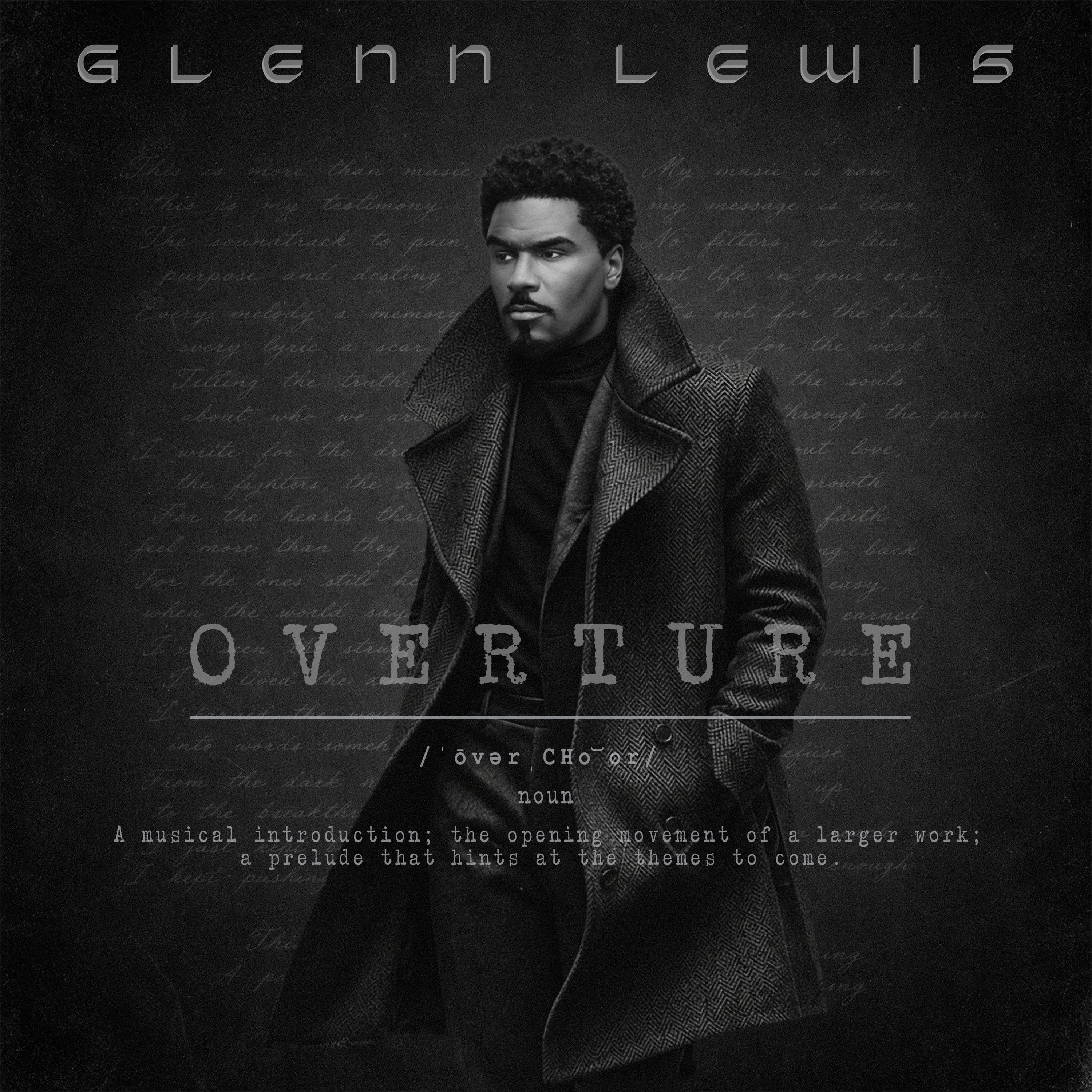
One song tells the tale of a con artist who wins hearts as effortlessly as passwords and PINs. Another chronicles the tale of a friend dumped and then ghosted, only to resurface like it was nothing. A third, however, borrows the sing-song of the hook, of a woman responding to a toast to new beginnings with a sly query into self-interest. Unlike so many love songs striving for surety, these offer space to question the costs and to ponder the demands of those previously broken hearts. Welcome to the return of Glenn Lewis. The Toronto soul singer went silent years ago but re-emerges with Overture, in which he wrestles more with love than celebrates it.
On “Love Ain’t Free,” a toast to new beginnings is met with a counteroffer: “She said love ain’t free/What you gon’ do for me? Let me see.” He doesn’t back down. “Got them own funds, ain’t tryna raise someone else’s son,” he sings, angling for “Matching expensive taste, crypto to pesos.” This is the kind of love that comes with a term sheet, everyone having read it carefully. Over an interpolation of Patrice Rushen’s “Where There Is Love?”, doubts linger even after the negotiation on “What Does Love Mean,” in which the chorus is simply the title: “What does love mean to you?,” a question he is also struggling to answer. In the middle of the track, he begins to dismiss the whole concept, concluding, “Vows only something said/It’s really all in your head/Love’s only ‘til the next one”—and delivers that last bit flat, without even a hint of self-pity.
The singer’s acquaintance Ruth is a connoisseur of “Designer things, them finer things,” and has a unique approach to acquiring them. “A warm body just to pass the time,” she uses men as pawns, but also plays deeper games. “Your passwords and pins without you knowing her real name,” she keeps “Intel and dossiers all on her next victim,” jetting between Paris and Geneva through the winter and working summers. “Black her favorite color, legs long like a funeral/Tailor-cut and fit, heels nightmare beautiful,” Glenn paints a striking portrait, all glam and avarice. For much of the song “Ruthless,” which resembles a heist movie with its constant movement and acquisition, he is painting a picture of progress. When Ruth has collected all the trappings of her desire, she finds herself alone off the coast of Belize and wondering whether love is in the cards for her at all. His observation, quiet and somewhat tragic, concludes with: “To protect herself, she hid behind the pain and the hate/But all she ever wanted was someone to make her feel safe.” There is no absolution here, no neat redemption: she is left suspended in a space of repeated, unfulfilled longing: “Maybe this time that love would find her/Maybe she’ll open up/Maybe she’ll learn to trust someone,” a refrain that goes on and on while nothing changes.
A woman sleeps with a man whom she is intending to leave, dresses up, spins him a tale of fabricated phone calls and errands, and kisses him goodbye, locking the door behind her before she can be sure he’s out of the building. “Sometimes you wonder if alone’s really the same as being free,” Glenn sings, writing all of “Jaded” from her point of view in the second person, and the chorus puts a stamp on the narrative before she’s given the chance: “You know that feelings fade and people lie, so why try?/Already know the outcome/This shit got you jaded.” Soon after, she meets someone on vacation and learns he’s from her neighborhood, lets him plan to track her down, then sees him across the aisles of a supermarket back home and makes her getaway before he can look up. “Ain’t this all the makings of what they say fate’s s’posed to be?” she muses before walking away anyway. On “Past Tense,” he’s the friend in a woman’s ear, convincing her she’s the one to blame for holding on to a man who’s already slipping away: “At this point, you playing yourself/Now it’s on you.” He’s saying it plainly, the way a friend does once the trainwreck has been playing out in front of them for a while.
On “Waiting,” he put all of himself into a relationship, was told being easy was boring, and now the other party has progressed to the point that “Your girl been texting me.” What he asks is embarrassingly little: “Won’t you say something, anything?/Instead of me waiting, waiting, waiting.” Towards the song’s end, he decides he was never the problem: “Truth is you ain’t stopped to free the man in me.” The flip side of that conflict on “Say You Will” pressures someone into committing. This person wants to keep things friendly for now: “Just stay friends,” they say. Glenn has already made up his mind: “I gotta have you.” Still, the bridge undoes all that confidence: “What if we drift?/What if we don’t make it and we grow apart?” He has no answer. He’s only still begging for a yes.
Glenn’s own father was a “Rolling Stone, he was sure as they come,” mostly gone from his childhood, forcing the boy to “Learn life and all on my own.” Now that he has a kid himself, he’s trying to reverse the curse on “Father to Son”: “Change the damage that’s done with love from father to son.” He isn’t going to hate his absentee father. “No, I don’t blame you,” he sings, calling the man “Just a product of a world that said it hated you,” and passing the buck onto the divine in the bridge: “Only God could once I put it all in His hands.” He goes in that same direction in “Where Life Begins,” settling on something slightly simpler, a straightforward uplift, but it doesn’t even dig through the surface: “What seems like the end is where life begins, sometimes.” It sits next to the father song like a birthday card.
His pen is much sylphlike than his voice, which keeps on overcompensating for it; Glenn never grasps for a money note, instead playing with placement and phrasing as a way of reaching: “Impressions,” the LP’s lightest track and one already in most people’s ears if you’re an R&B head, is done with a synth, drums, and trumpet and he sticks with the groove instead of riding over the top, chasing clarification from a fickle object of desire: “Don’t leave me guessin’/Lookin’ in all/The wrong direction.” “G.Y.A.M.L. (My Love)” has a richer texture and instrumentation by Seige Monstracity (who produced three songs) and a less guarded tone; he can finally drop the cool, with lines like “Crazy seeing ya” to open it and by the time the hook hits he’s over the circling: “Loving for me you like medicine,” he croons, then, “I’m giving you all my love,” with no qualification. “So Many Stars” is even simpler, relying heavily on the vocal; it’s just Glenn to his most relaxed playing the top line against an evenly laid groove, giving him the space to stretch it out—carefully, with no bursts of excessive ad-libbing. It starts after a blink of an instrumental from Joe Jackson that makes the listener blink too-the song goes right to him.
With “Dance for Me,” it consists almost entirely of a plea: “Dance for me, girl/When you do nothing else exists.” The second verse sheds the mood for something approaching an assessment: “Legs in them heels like a thoroughbred walk mean.” “Say What You Want” starts off as if it might really consider her: “They say you ain’t the same one/Since the day I first met ya” followed by “Do anybody see her?” But it ends up back at where they always end up: “Our bodies left doing the talking.” On all these songs, the voice is steadier than the pen; he manages to make something out of a number of dead lines, and everywhere the songs give him something to hold.
“Tomorrow will be here before you know it,” he sings on “Last Goodbye.” “And what is new will soon to rust and turn to dust.” He has spent one song after another measuring the value of love and then doubting that value, but he’s landed somewhere he sounds certain about, with his most resonant phrase: No one is ever truly known by another. “Honesty from tears and facing our fears,” he intones, “That no one truly knows us before the last goodbye.” It’s the closet the skeptic comes to an avowal of faith, and the stretch holds. He never actually settles on a number; for the closest he’ll get to an appraisal, what a known person might be to another, he looks to that pre-show glimmer, to what a life might be if it could be confirmed before the lights went out.
Great (★★★★☆)
Favorite Track(s): “Jaded,” “Ruthless,” “What Does Love Mean”