

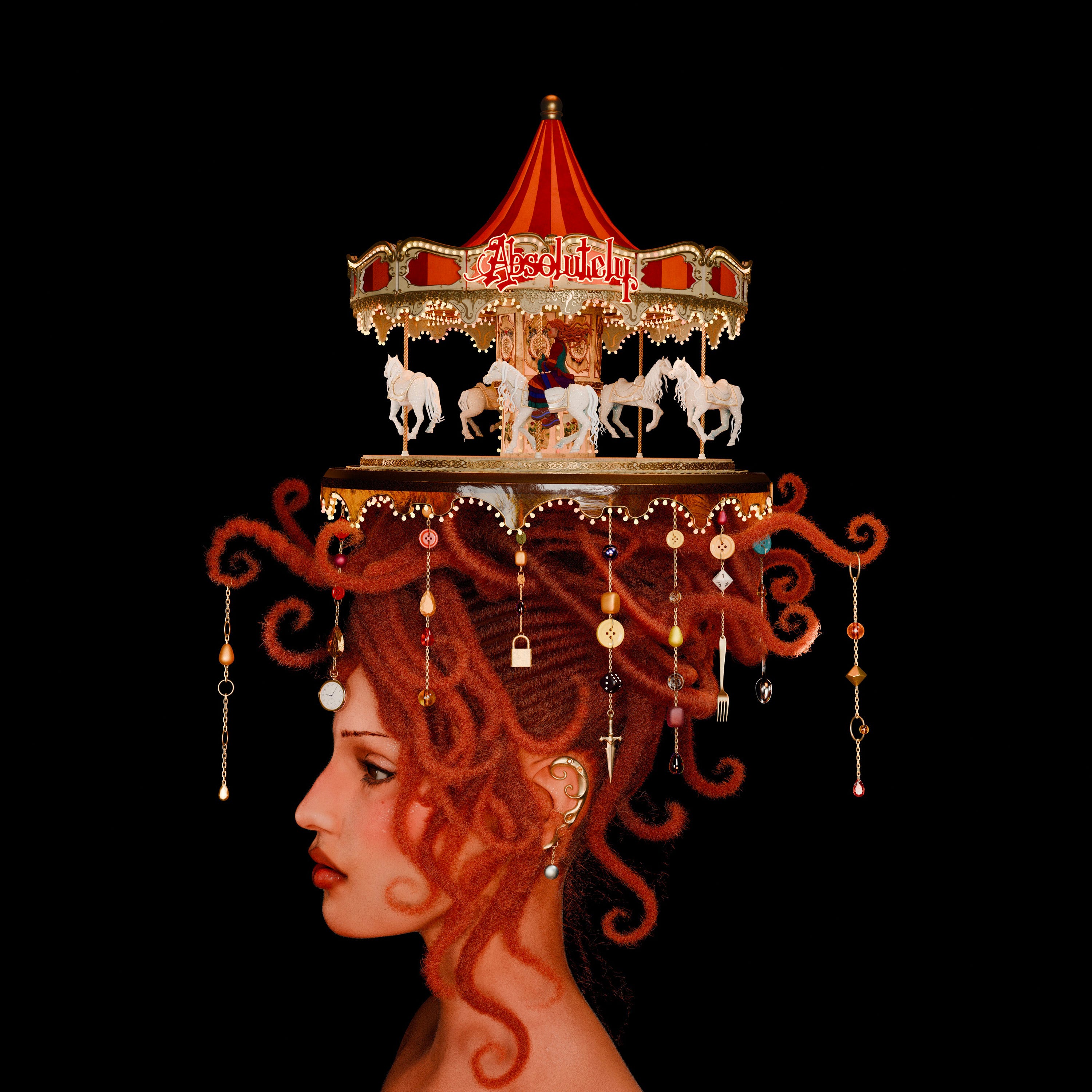
There’s a recurring figure on this record, a woman who wants someone so badly she starts describing the wanting in weather. Rain behind her eyes, clouds in her thinking, tornadoes ripping a lover out of reach. She tears the furniture off the walls for relief and then stands in the wreckage, feeling, for the first time in months, as if she can breathe. She begs an elevator to break through the ceiling. She addresses glitter like a friend she’s outgrown. She writes a love song to a person who hasn’t been born yet. All of this belongs to Absolutely, a London singer-songwriter (yes, RAYE’s sister) whose 2023 debut CEREBRUM processed every feeling through cognition, worrying about worry until the thoughts consumed themselves. Paracosm, her second album that was mostly produced with Danja, Deputy, and others, abandons the skull for the chest cavity, the throat, the hands pressed flat against a wall. The fears haven’t changed, but the organ receiving them has.
On “Natural Disaster,” Absolutely begs a lover to stay below zero, keep two hands on the wall, and not get caught in the wind. She commits so thoroughly to storm language that it stops registering as metaphor. Her eyes rain, her mind clouds, tornadoes rip a lover out of reach. The bridge narrows to a single repeated instruction, “Don’t let go,” while the melody climbs until her voice thins to almost nothing. Two songs later, “Nowhere to Hide” takes that same overwhelm and redirects it inward. She tears everything off the tables, rips things from the walls, and then confesses something that cuts past any chorus: “Look at the mess I made, but it felt so good, just to let my hair down and not give a fuck how it looked, how I used to do when I was a child.” Adulthood taught her to care about the mess. Childhood was the last time relief arrived free of charge. The demolition, on this album, is never dramatic for its own sake. It’s the only reset she trusts.
Absolutely has an unusual habit for a pop songwriter. She builds songs out of rooms. “No Furniture” names every missing object in an empty apartment (four walls, a chair, a chandelier) and replaces each one with a lover’s body. “Your body still feels like home” is generous enough, but the bridge swerves into genuinely strange territory. “Decorate my ventricular” asks a person to furnish the chambers of her heart the way you’d hang curtains in a bare living room, and she delivers it with enough plainspoken conviction that you almost miss how odd it is. “Elevator” shifts the axis vertical, its entire pulse organized around the sensation of being lifted, and its pre-chorus confesses what she actually wants from the person doing the lifting: “I want you to try and fight the ceiling so the sky is where I go.” She’s asking someone to punch a hole in the roof of her life. Absurd, and completely sincere. Then “No Audience” strips everything to a theater with nobody in it. “Empty seats in the theater, nobody watching, wouldn’t that be freer?” is the album’s quietest radical question. Every other song here aches for a witness, and this one wonders what happens if the witness walks out.
The three songs occupying the album’s midsection share so much melodic and lyrical DNA that they start to blur. “Painting by Numbers” keeps asking, “Is this real life?” A woman so unused to happiness she can’t stop checking whether she invented it. She sings “I’ve waited my whole damn life for this feeling” like saying it aloud will jinx the whole thing. “Simple Things” asks how ocean waves know to reach for sand, how wind moves every leaf without making a sound, how a bird that knows the whole sky still wants to land, and answers all of it with six plain words: “When I met you, it was proof.” “Helium” marries a fear of heights to a compulsion to keep climbing: “Scared, I got a fear of heights but I wanna go higher.” Each song is pleasant on its own terms, and Absolutely’s delivery on all three sounds genuinely rattled by her own luck. But the shared wonderstruck posture, the dazed gratitude, the upward-tilting melodies bleed together across thirty minutes until the distinction between them starts to evaporate. The album needed at least one of these three to push harder or arrive at a different conclusion.
“I can’t let you fuck up my life twice.” That line, buried in the chorus of “Trojan Horse,” carries all the weight the wonder songs leave on the table. The word “twice” does the work—it admits the first time already happened, that she’s guarding a door someone already walked through. The song opens on a body that feels foreign, an army in the mind, blueprints she drew for rebuilding that she couldn’t follow. Then the metaphor shifts from civil war to invasion: “Somehow you got inside just like a Trojan Horse, and now you’re taking up the space in my bed.” Ancient military trick repurposed for the mundane shock of someone sleeping next to you again. “You did it so easy, it’s like you do this professionally” carries admiration and accusation in the same breath and refuses to resolve into either. No other song here allows anger and desire to occupy the same room this openly, and no other song presses this hard on a single relationship. The writing earns every second it asks for.
By now, Absolutely starts shedding things. “I Just Don’t Know You Yet” addresses someone who doesn’t exist yet, a person she can feel crying from wherever they lay their head, sent from God to teach her how to love again because she thinks she forgot. The boldest admission is the forgetting itself. “I’ve fallen for illusions, misled by confusion, I just couldn’t understand why I’d be pushed aside, lost my dignity and pride, I’ve fallen for a counterfeit” compresses a full autobiography into two bars, and the word “counterfeit” stings because it means she believed the fake was real. “Goodbye Glitter” takes the shedding further, addressing glitter directly, like a departing friend. “I found some stardust and it’s better than anything I’ve ever known.” She’s choosing real light over reflections, the object over the shine it throws. “Diamonds are forever but when the sky falls even they turn into dust” sounds simple until you sit with its arithmetic. Even the hardest substance answers to gravity, even permanence is conditional. The bridge, “What doesn’t stay eternally, they fall away, and I fall asleep, these earthly things are not mine to keep,” has the weight of someone writing a will for the version of herself she’s about to leave behind.
A paracosm is a detailed imaginary world maintained over a long period of time. The title track, the sparsest song here, takes that definition and collapses it. Two verses, a bridge, no real chorus beyond wordless melody. “It’s such a big world, sometimes I feel small, like I’m in a castle, lost in the halls.” The second verse shrinks the speaker further: “Like I’m a child and everyone’s tall, the people are walking, I’m learning to crawl.” And the bridge concedes what the rest of the album has been circling: “Maybe some things are not meant to change, this life makes less sense as I age, the best pieces of me they remain just a little bit strange.” Then the outro, barely sung: “It’s not my home.” The invented world the album is named after turns out to be the one she’s already standing in. Real life is the paracosm. The fantasy was believing there was somewhere else to go.
Great (★★★★☆)
Favorite Track(s): Nowhere to Hide, Trojan Horse, Goodbye Glitter