

Album Review: Play With Something Safe by Rosco P Coldchain & Nicholas Craven
After years in a cell, the North Philly rapper reunites raps over Nicholas Craven’s soul loops and recalls his life in the kind of detail that only survives if you've had nothing to do but remember.
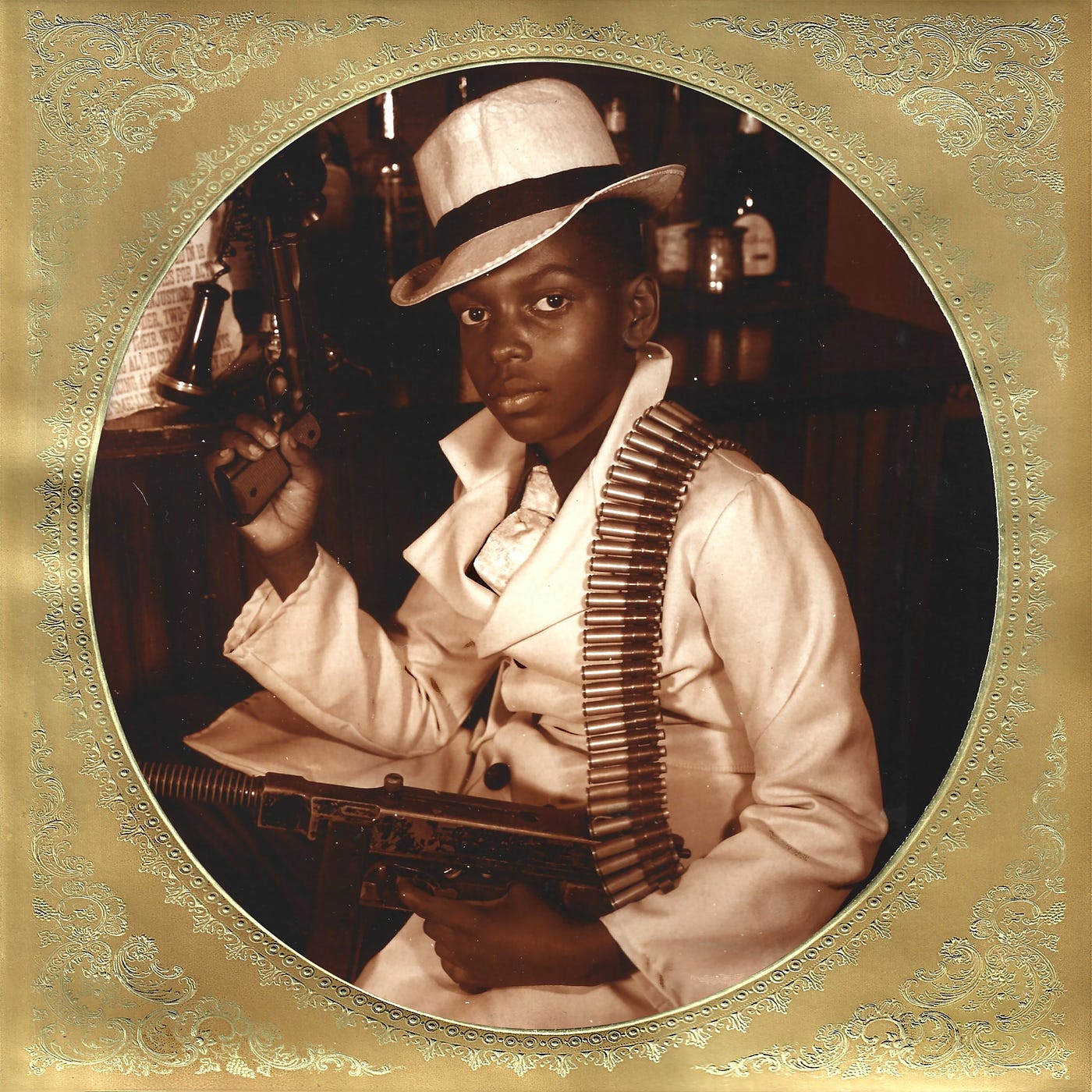
On 18th and Oxford in North Philadelphia, sometime around 2001, Rosco P Coldchain, named after a gun and Boss Hogg’s sidekick, walked up to Pharrell Williams at a Philly’s Most Wanted video shoot, name-dropped a local MC, rolled a blunt, and started rapping. Pharrell signed him to Star Trak. Two verses on the Clipse’s Lord Willin’ followed, “Cot Damn” and “I’m Not You,” and then a third on Hell Hath No Fury’s “Chinese New Year.” A debut album with Timbaland, Kanye West, Alchemist, and DJ Premier production sat finished and ready. Then Arista Records folded and Star Trak’s distribution collapsed with it. His Hazardous Life died in the building. A few years later, he was arrested in connection with a fatal shooting and sentenced to prison. He did 14 years. He buried his uncle, his best friend, the love of his life, and his younger brother Bird while he was inside. DJ Premier was the one industry contact who stayed in touch.
Nicholas Craven produced all ten tracks. Craven is a Montreal digger who learned to sample at thirteen from a friend’s older brother and built his name on the same drumless soul-loop style that runs through the Boldy James and Roc Marciano catalogs, and here the single-producer setup means the loops never spike or dip. That steadiness gives Rosco room to talk without competing against beat switches or guest-producer mood swings. The samples are warm and slow, the kind of dusty flips that sit underneath long stories without crowding them.
Most of this album faces forward, but “Prayer Group” faces backward, opening on a Power Wheel, Oshkosh sneakers, Nike Cortez. His father hit the pipe during the crack epidemic, and his mother couldn’t deal with it. A Norman Connors vinyl spins on the turntable; at ten years old he understood the message, that someday he’d kiss a pretty girl and fly off in a starship. He describes a man in a Troop jacket and Lee jeans counting money on the block, Gucci sneakers and diamond rings on every finger, and lying in bed next to his sleeping mother wondering if he’d be able to sell what that man sold. Kids at school call him Pookie, Pork Chop, Saddam Hussein. He drops out in ninth grade. He’s tired of powder milk, welfare cheese, boiling water on the kerosene heater. Watching his mother starve was eating him up. He ran away from home, put on his LA Gears, and copped a buck-thirty pack from Brunroni at 17th and Ingersoll, owed a hundred back. Then he asks how many pairs of Jordans he can buy. None of these details feel arranged for a verse. They feel recalled, tested against fading accuracy, put down in the order they actually happened.
Something similar runs through “Hold My Hand,” but it works differently. A mother’s voice at a crosswalk: “Look both ways before you cross the street, hold my hand.” Rosco buries that hook inside two verses about normalized killing. Brain matter on his Louis wouldn’t cost him a wink of sleep. He shouts out the widow of a baby daddy who promised to ball like Wake Forest, daughter too young to know what her dad’s in a casket for. And in the second verse, he’s buying an outfit for his boy’s closed casket, the bullet hole in his head too big. The epitaph reads “goon gone, I lived hard, died young, I did my thing.” A man leaking on a stretcher rambles about whether he’d do it all again. Rosco writes about death the way a paramedic might describe a Tuesday shift, past the point where shock registers as useful information.
The title track reunites Rosco with Ab Liva and Jimmie D, both of them Star Trak and Re-Up Gang affiliates who share his lineage with the Clipse. Jimmie D raps about scraping pots, the school of hard knocks as alma mater. Ab Liva describes filing the numbers off his gun “like a pimp’s nails,” hand on his trigger at seventeen while his pops stayed in the Blumberg high-rises. This was “Clue tapes in the barn with blue tops and brown Dickies and beef and broccoli Timbs.” Bruiser Wolf shows up on “Die Slow” and accepts himself as a manic depressant who probably should’ve told Andrew before he invested, his development arrested, desperate, desolate, the margin for error very thin. But every guest on this album talks as if they grew up in the same room, separated by geography but bound to the same arithmetic of risk and loss.
Rosco is most direct about prison on “Boogie Nights.” He admits he cared what people said about him, stayed in North Philly when he should’ve left, and that nobody warned him to go. Misery loves company. Pride plus arrogance equals jail time. In the mountains, racist hillbilly COs dictated when he ate, slept, and shit, but he’d lived in conditions worse. He asks if people have forgotten how he had Skateboard P on a skateboard on 18th and Oxford doing ollies. The song stretches across three verses and ends by asking whether pain brings joy only if you survive it. It’s the loosest, most sprawling track on the album, the one where he sounds as if he’s been rehearsing these arguments with himself for a decade and finally has a microphone.
The flow itself hasn’t changed much from the 2 Raw for the Streets cyphers, where his cadence lurched and stalled on purpose, almost spoken-word in how it refused to sit on the beat cleanly. On “Frankenstein,” he calls the style by name, “Frankenstein flow,” and raps about smacking a man as if he were a bongo and smoking a disrespectful man “like some fronto,” his last plug Alfonso reminding him of Benny Blanco, a little too ambitious. On “The Future,” he compares his own storytelling to Charles Dickens (his comparison, not mine) and hits a man with a McDonald’s, calling him a clown, Ronald. The punchlines are jagged and dad-joke adjacent, funny in a way that doesn’t ask permission. He raps the way he talks, and the talking happens to include cement mixers full of cocaine, Smith & Wessons, and Russian roulette with an automatic gun.
Vince Staples named his mixtape series Shyne Coldchain after this man. Premier kept calling the jail. When Rosco came home in 2023, he started recording immediately, Sin City, Last Night Should Have Never Happened, Living on Borrowed Time, singles with Statik Selektah. Play With Something Safe is the first of those records that sounds settled rather than rushed. On “Prayer Group,” after the second verse, after the Jordans question, we hear an L.T.D. song that we could all learn to live, learn to give, and have togetherness. His grandmother shared blood with David Porter of Stax Records.
Great (★★★★☆)
Favorite Track(s): “Prayer Group,” “Hold My Hand,” “Play With Something Safe”