

Album Review: Push & Paint by Bruiser Wolf & Sheefy McFly
Detroit’s funniest drug rapper and a painter who moonlights as a producer spend less than thirty minutes proving that wordplay can substitute for depth. They’re not wrong.
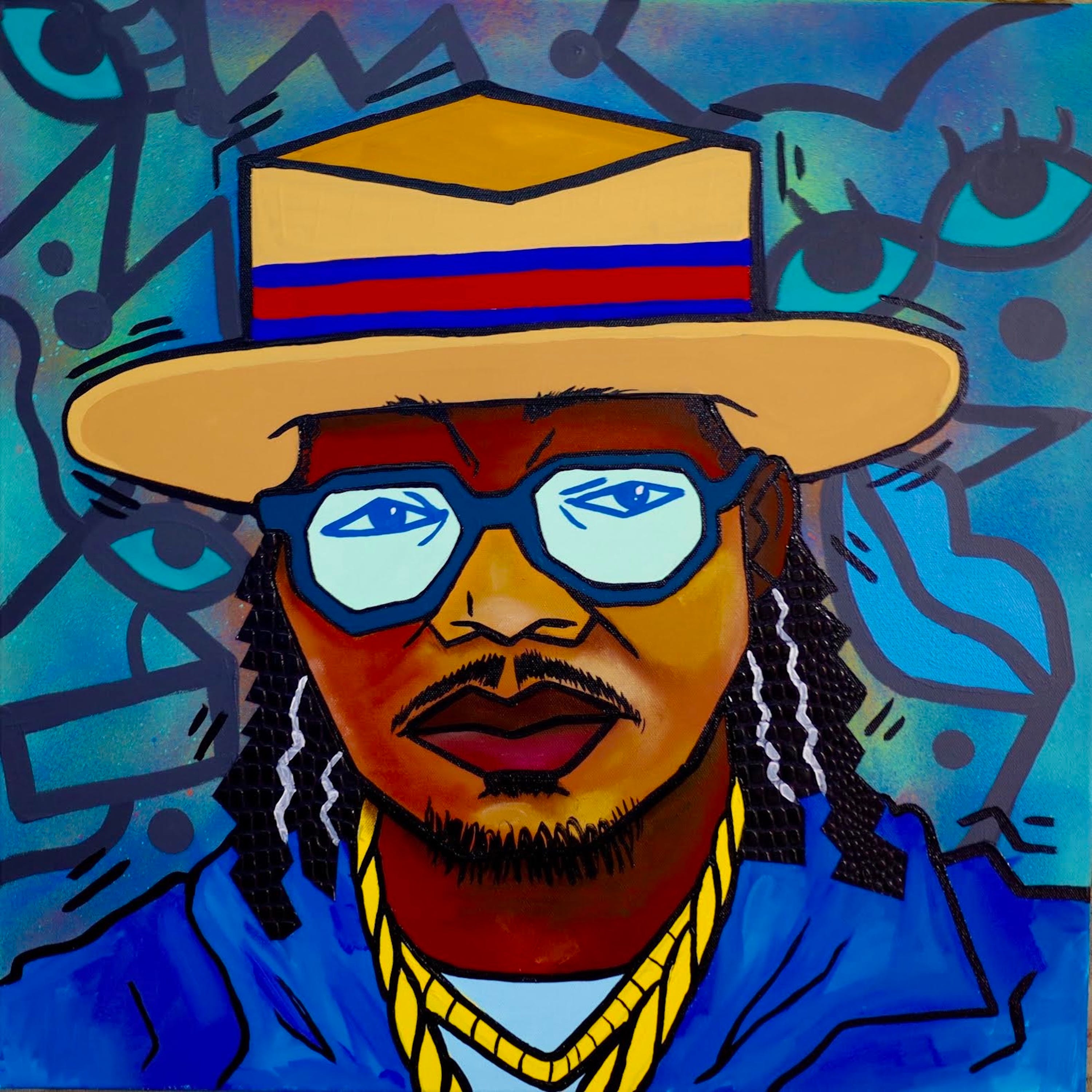
Most rappers who rely on wordplay burn through their best material in two or three songs and spend the rest of an album recycling. Bruiser Wolf, the 43-year-old Detroit east-sider who came up through Danny Brown’s Bruiser Brigade, has been dodging that problem since his 2021 debut Dope Game Stupid. His punchlines sound involuntary, like he couldn’t tell a straight story if he tried. Sentences don’t build toward a payoff so much as skid into one, and the joke clicks a beat after the bar has already passed. On Push & Paint, his collaboration with Sheefy McFly, a painter, muralist, and DJ whose Neo-Expressionist canvases have shown from Detroit to Bosnia, that instinct finds a producer willing to stay out of the way. Sheefy’s beats are spare and bass-heavy, functional in the best sense, and the whole record puts its weight on what Bruiser Wolf’s mouth is doing.
And his mouth is doing a lot. On “Ask Yourself,” he describes a woman as “always dressed to kill, natural causes,” which is the kind of line that stops you mid-step—the logic bends just enough to be funny without collapsing. On “Hater Not an Opp,” he connects a bounty to economics:
“Price on your head, that’s the cost of living.”
On “Ole Girl,” cocaine becomes a wife, a romantic partner, and an inheritance all at once, and he says he loves the white girl so much he put her in his will, and if you hustle, they’ll hate you because you married that white girl and your kids aren’t biracial. The punchlines move sideways. He jumps between meanings the way a bilingual person might switch mid-sentence, and the humor comes from how casually he sticks the landing.
The sharpest storytelling on the album belongs to Payroll Giovanni, whose guest verse on “Hater Not an Opp” could stand alone as a short film. He starts from a half track and a bad batch, no cash stack, and walks the whole thing forward, cooking crack, counting money, serving junkies, watching for undercovers. His father hid a platinum chain in the kitty litter when he heard the raid van coming. Neighbors watched as the family got cleaned out. He didn’t want to see an ounce again until he went broke and saw the rock. Payroll just tells it, and the specificity of that kitty-litter detail, that one weird domestic moment during a federal raid, gives the spot more gravity than any of Bruiser Wolf’s clever turns. It’s the one passage on the album where the drug-trade talk stops being funny and becomes something a person actually lived through.
Women on Push & Paint are currency, spectacle, cocaine, and bills—sometimes all four in the same track. “Common Goal” says it plain in the hook by getting rich and fucking lots of hoes. “Toxic” is a shouting match between a man and a woman where both sides sound equally terrible, the hook a call-and-response of “Fuck you, nigga/Nah, fuck you, bitch.” On “She a Bill,” Bruiser Wolf spends three verses turning a woman into a financial instrument. She fits the bill like a wallet, her due date is approaching, cash credit or debit are the only three choices. “Ole Girl” makes cocaine the love interest, and “Ask Yourself” asks a woman with her own home and walk-in closets whether she can handle a man who won’t put his name on a lease and disappears for weeks. These songs are talking the way they talk, and whether that bothers you has everything to do with what you came to a Bruiser Wolf record expecting.
Every feature on Push & Paint brings a different speed. BabyTron on “Why They Play Me?” matches Bruiser Wolf’s lateral punchline style but cranks the absurdity higher. He admits he skipped arm day but still rocks the beater because it’s Chrome Hearts, and who’s going to say anything? “Toxic” lets Sada Baby be Sada Baby, all chaos, spinning spokes on the Lamborghini that look like an oldie, getting toxic off the dribble. P-Lo, the lone Bay Area representative, flips the “Ole Girl” hook into a warm, flirtatious California turn, all vintage and retro, throw it back like four flats on a Cadillac. On “Ask Yourself,” G.T. goes full flex with fur Gators in the closet and a Rolls Royce with a driver. Sheefy McFly himself only raps once, taking the third verse on “She a Bill,” and his bars are the plainest on the album. Fucked your baby mama, needs bread and dough, calls himself a baker. He’s a better producer than rapper, and one verse is the right amount.
The hook (“You a quick cummer, that’s a bummer/I don’t call hoes, I ain’t good with numbers”) runs six times with almost no rapping underneath it on “Numbers.” In 28 minutes, one hollow uptempo track is a small tax, but it stalls the momentum between the rowdier cuts that surround it. “Wannabees” picks things back up with Bruiser Wolf at his most playful, bragging that he was talking about buds before Colorado legalized anything, calling Chicago the only other person ill he knows because it’s the Windy City, and noting that the semi costs a pretty penny. The wordplay there is looser, goofier, and less precise than his best work, but the fun is obvious. And on “Why They Play Me?,” he drops one of the album’s stickiest images—ten degrees, serving fiends, wiping his nose with his sleeves, washing down sleep-for-dinner with spit to energize his grit. That last bar is the closest Push & Paint gets to saying something that isn’t a joke, and it flickers by in a second before the next punchline swallows it.
Solid (★★★½☆)
Favorite Track(s): “Hater Not an Opp,” “Ole Girl,” “Why They Play Me?”