

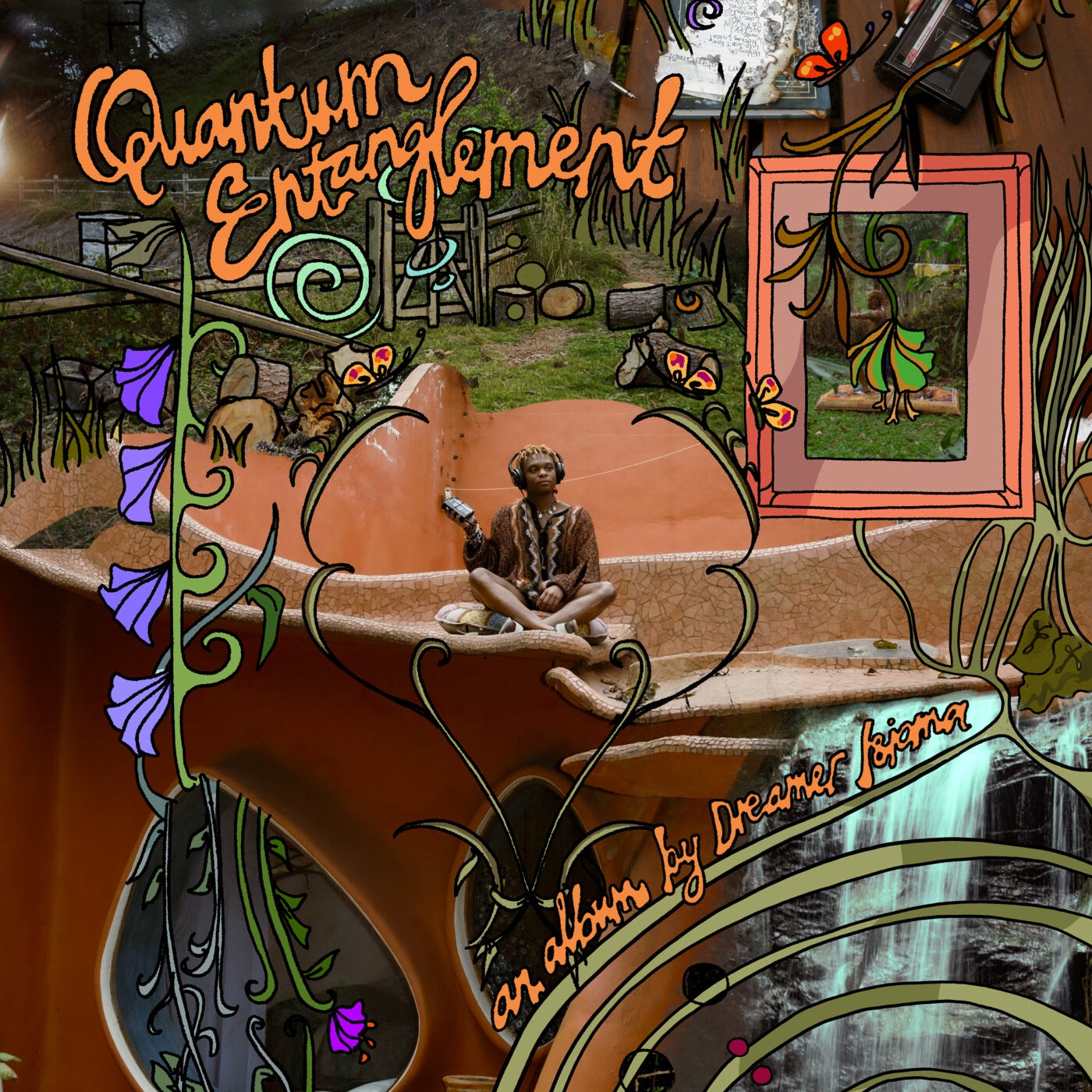
Album Review: Quantum Entanglement by Dreamer Isioma
Dreamer Isioma sings about jumping off the world and begging to be loved in the same breath. Quantum Entanglement turns self-destruction into devotion.
This album and this review reference suicide and self-harm. If you or someone you know is struggling, the 988 Suicide & Crisis Lifeline offers free, confidential, 24/7 support. Call or text 988, or chat at 988lifeline.org.
Quantum immortality is an argument both crueler and more reassuring. Because consciousness has no way of imagining its own disappearance, it seems it never ends, and it is assumed that somehow, some version of you continues on in another universe, no matter what happens to this body. A few years ago, in a slump, Dreamer Isioma, a Nigerian-American singer and producer raised between Lagos and Chicago, found the argument and says during a Bandcamp interview in 2022 that in some cases it had anchored them when survival was an option more willingly than a necessity. It is this same love for all things universe that provides the title to Quantum Entanglement and the justification to Isioma’s choice to survive.
In “Holding On,” we are initially asked not to be left alone with our worst thoughts before the music breaks apart and all that is left are the words, “At the top, I might just jump off the world/But I’m holding... On for you.” The chorus blows up the problem into the destruction of your own heart and the desire to stop time so that this will go away before I feel it too. And then all of a sudden the song makes a turn and completely abandons everything: “Stop fucking with me/Just dance.” The entire jump from suicide note to club anthem is about three seconds. It concludes with the abandoning of everything except holding onto the grip of one other person: “Baby, hold on/Hold on to me.”
“We’re all gonna die one day, and that is okay” is the closing statement of “Smile,” the song that is already building towards this pronouncement in everything it sings, attempting to make the threat good news. To earn the statement, the song has been ticking through the significant events of Isioma’s life in a dead tone, from the house on the hills to the contract not signed, until the words come out as a simple direction that they should grin at a funeral: “When I die, don’t you cry for me/Baby, smile, it’s a celebration.” “Nothing Is Real” makes the same maneuver with a similarly bad feeling. It’s an almost overt tell from the jump: “When I’m having the time of my life, I want to die so bad,” and the chorus uses unreality to allow for permission slip in the follow-up: “Nothing is real/I can do whatever I want to/And I can feel how I feel.” By the second verse, the rule is spoken aloud: “You can’t be happy without sad,” and what follows is an invitation to “Let’s get wild” that becomes something the singer might do to himself.
The frustration with life comes out most violently on “Life Isn’t Fair.” Isioma grabs the loud persona, money and status come first, “Six figs on me, that’s a loss/Seven figs on me, I’m a boss,” and then claims, “a fucking icon, you could put me on a cross.” It lasts about a line. A few lines later in the same verse, it’s already “Love pushes me to the edge/Thinking that I’m better off dead,” and the hook can’t help but keep itself out of trouble, “I shouldn’t even care, but I do.” On “On My Grind,” the wound is more interesting. They wants the injury: “I want somebody who hurts me,” then “Breaking hearts to make my heart break,” before begging, “Please, please, please/Love me.” Vayda answers from across the room, tired, “Wasted years on love that never came through,” roaring in the car and yelling at no one; “Is he really proud of me?” Between the jokes, the flirty flirtation of “Boo Thang” also brings the confession: “I wanna love myself, but loving me is hard.”
“All I Need” has three different artists say “That’s all I need,” and its meaning shifts with each. Isioma’s verse is the search: “South side, north side, west side, out east/No matter where you at…” Perry Maysun then takes it to the saddest spot of the song, “In the hills sobbing, plagued with indecision,” willing to “Burn it all down and bathe in the ashes,” before reducing the need to one image: “All I need is to burn forever like candles on the corner stairs.” detahjae has the phrase last and has built an image of domestic bliss; “All I need is you and babies.” He will do road trips and be irrevocably ruined by love. It is only after this happy ending that the verse can acknowledge “the gunshots on the outskirts of the night.”
Contempt seems to be the biggest driving force behind “Believer.” Isioma sets up the tension in the very first line, “She’s a god, and I’m a demon,” and then walks away when she brings up an unrealized wish; “I told her that I’m not a believer... I’ll fuck then leave her.” They move on to a more direct attack; “Bitch, go to Hell/Bitch, go and die,” before admitting the deeper problem; “Let’s not pretend like you ain’t do me wrong over and over again.”
“If you even consider leaving, I’ma rip a knife through my heart and stop breathing”—one friend’s voice slides through the middle of “I Try So Hard” and immediately alters the weather. The verse is taut and wounded, threatening to hurt themself and warping one moment. The phone rings, asking not to let things they can’t control break them, to just have faith. It responds, as the next verse does—like therapy, talking to itself, “Inhale, exhale, baby, meditate... Don’t hide from your feelings, let ‘em ride.” It fails. The calm is breaking apart, “I almost died trying to find all that I am... I lost the plan,” and he hides in what’s left: “Swag, swag, swag.” Quieted, that same gesture finds itself in “Pressure,” the shortest track, a single, held breath, giving someone else the wheel, “I would give you full control,” and asks what’s hiding underneath it all: “Why do I feel safer when you’re near?” The calm is elusive; it never comes, and the songs can only reach for it.
Isioma’s central idea of love existing across space between two points can finally be sung out in “Love Me”: “Between every star there is space and no matter how far we are, we’re entangled by love.” Sung so baldly, it’s the closest the galactic chatter ever comes to saying something directly, and the song immediately starts to dismantle the sentiment. The chorus breaks down the want into the base element of survival: “Love me/Do you really love me?/How can you say you love me?/I don’t even love me” sums up the problem with three simple, four-line questions, begging for something outside yourself to provide you with a feeling that you cannot generate from within. The loophole that promised that some version of you would survive the separation begins to shrink on “Love Me” and becomes nothing so vast and nothing so simple, only that you still ask for something.
Great (★★★★☆)
Favorite Track(s): “Holding On,” “All I Need,” “I Try So Hard”