

Album Review: Resonance Frequency by Homeboy Sandman & Jack Splash
Ten albums in, the Queens rapper riffs on food, phones, and the people who can’t put either down, and the jokes do the arguing for him.
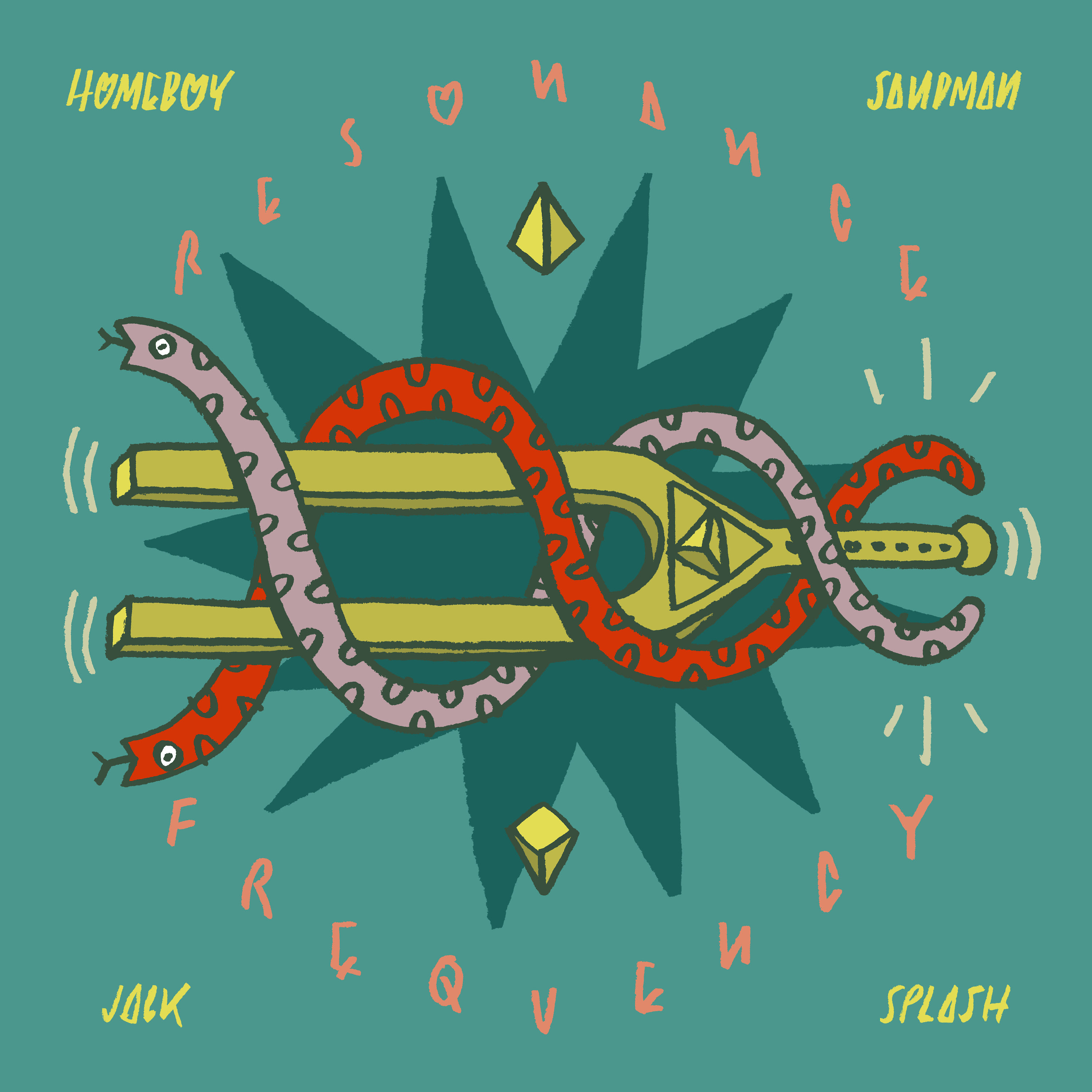
During his time from 2008 to 2018, Homeboy Sandman was quite prolific, releasing six albums. After these, he released four more albums from 2019 to 2022. Sandman’s music often has themes of consumption, spending, and distribution of goods, as seen in the songs that he has released. Jack Splash is the producer for Sandman’s album Resonance Frequency, and the pair make for an excellent team, combining both live instruments and classic hip-hop aspects of music.
Sandman wrote the song “TWENTYFOURSEVEN” as a reaction to those individuals who referred to him as “strange” in reference to his own childhood habits. For instance, while his childhood friends played video games, Sandman was either reading or performing mathematical computations. Sandman has an interest in the amount of money that rappers like him receive for their music, as expressed in the same song. He claims that while other rappers might pursue that money, he has no need for it, and states that “Even for the mill’, ain’t no run-of-the-miller/Figures, it ain’t never Miller time.” In his “Arrow” song, he describes himself as a “small fry turned Big Sam” in reference to Ryan Gosling in the video game movie “Fall Guy.” Sandman also uses this song to refer to himself in relation to the scarecrow from The Wizard of Oz, describing himself as seeking knowledge in the way that the scarecrow does.
Sandman utilizes “Signal” to describe how many rappers can fit into a clown car, complains about the difficulty with which his telephone works, and about the odd links that his friends forward to him. He also writes of himself as being out on the town “Saturday night, the only sober man on Ludlow.” Within the same song, he also talks about keeping a live cat within a box, and about being caught in a library. Masta Ace, a super underrated MC, tells his history as a rapper. He refers to the times when he would catch gypsy taxis before the rise of Uber, and he was taken for a Southern Californian at the age of twenty-four. He believes that his life experiences as a young, Black, and intelligent individual should have been recognized with a Grammy Award. Towards the end of “Signal,” Sandman returns to writing about those individuals who are not humble with their displays of knowledge. He writes, “Who actually thought that wisdom was news?”
Sandman uses “Weed Stores Everywhere” to present his views on food, medicine, and the way in which the news is reported. In this song, he also describes the costs associated with those views. For instance, he thanks God for having the choice of what he eats and the way that he chooses to report the news. He then writes that “I’m grateful for the choice, seems not everybody has them/And that creates a chasm between me and my own friends.” Sandman writes that many of his friends bet that he is a lot of fun at parties, and he responds that they have no idea what a party is. Sandman questions the identity of those who claim to be soldiers when they struggle to stay sober on “Gas,” and claims that those who consider themselves to be Rome when addicted to their phones will question their minds if they ever have time to think. He then answers this question for himself by stating that those individuals can acquire anything that they want in their minds, and yet they will never truly have anywhere that they desire to go.
Sandman reflects upon a series of different experiences. These include seeing mixed crowds of people, declining to star in a school play, engaging in drag racing, and teaching young children. On “Uh Uh,” none of these experiences are linked together in any significant way within his verse. “Yeah Yeah” provides a young woman with advice regarding maintaining her virginity and testing the waters in new situations. However, Sandman also writes in this same song about his friend who is battling his own civil war when he views Doritos in the corner store. In his song “A1,” the chorus is filled with four instances of the question “What?”, and his verse on this song briefly mentions his high school recital in which students were playing the recorder.
In the triumphant “World On Fire,” CeeLo Green sings of the world being on fire (duh) and of there being nowhere to escape from it. Sandman’s verse in this song is filled with imagery of protecting his garden from attack by the forces of the universe, and inviting those who wish to live in a fantasy world to become his family. Sandman presents puddles as bubble baths, and black clouds as hovercrafts. In his song “Inner Realm,” Sandman writes that those who are hearing his song are always looking for something else to pay attention to besides themselves, and claims that this is what blinds them. Additionally, in this song, Sandman also directs a message to his peers in the hip hop community, writing, “Every rapper wanna be a movie star till somebody true decide to throw you from a moving car.” Sandman concludes his song “Inner Realm” by shaking people up, waking people up, and asking if humanity has truly evolved over time, or if all of humanity is simply a vision in his mind.
He details on “Natural Hue” about how those who skipped class always had dates to the school’s social events, while Sandman would show up on half days for those events. Sandman feels that those years were not wasted, and only considers himself to have made a mistake in writing this song if he were to break his own rules for his music. Additionally, he feels that nobody should be discussed in front of him unless the person is himself, in which case he wants to hear their version of the truth. Sandman claims that he has never met a snake that wasn’t sweet. Additionally, Sandman writes about walking through city avenues while listening to classical music, waiting for his foot to recover from his night of walking.
As for “Take Time,” Sandman writes that he is a “page turner” rather than a “wage earner.” Furthermore, he extends his verse into reflections upon visiting Sweden, his pack goat, and the breaking of the night. This song is the longest song on the album, and it does not contain a chorus. Additionally, “Take Time” is a reflection of Sandman’s thoughts and opinions regarding his own life experiences, and is one of the easiest songs on the album to sit with.
Great (★★★★☆)
Favorite Track(s): “Signal,” “Natural Hue,” “Gas”