

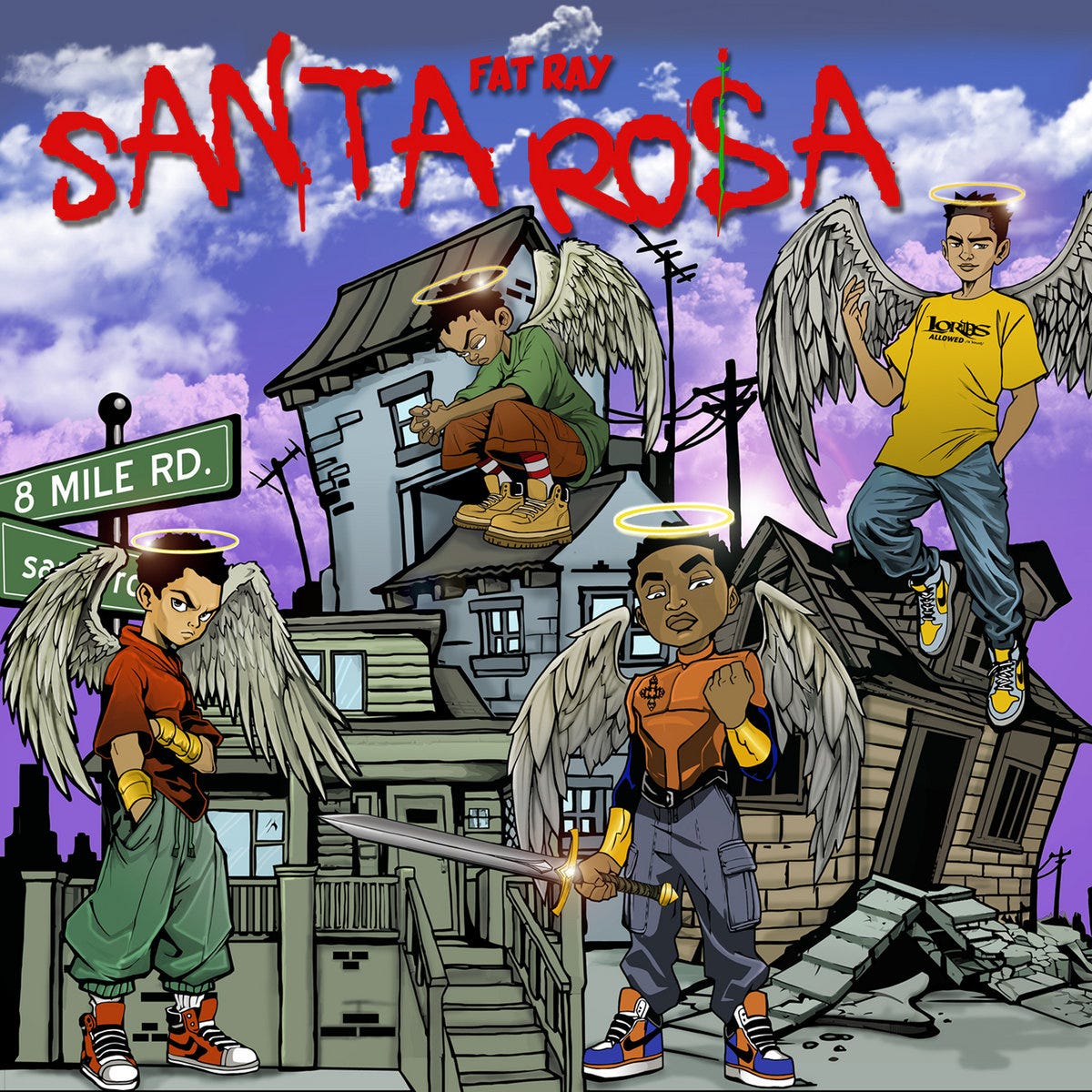
Danny Brown converted his loose collective of Detroit rappers into a proper label at the start of 2021, and Bruiser Brigade Records has been feeding the underground on a schedule ever since. Raphy, the in-house producer Brown once compared to a young RZA for his ability to tailor beats to each MC’s voice, has scored nearly every solo release on the roster, including Bruiser Wolf’s Dope Game Stupid and the group compilation TV62.
The rapper who’s logged the most time with Raphy is a west-side Cass Tech graduate named Fat Ray. He started as one-third of the production trio B.R. Gunna alongside Black Milk and Young RJ, watched Proof run battles at the Hip-Hop Shop through the window before he was old enough to grab the mic, and went solo with an entirely Black Milk-produced debut in 2008 before disappearing for a full decade. Santa Barbara, his first Bruiser Brigade album, dropped in February 2021, twelve tracks, almost all Raphy beats, under thirty minutes. Santa Rosa is the sequel, same rapper-producer pairing, same compact frame, and five years later Fat Ray is the type of rapper who spent every one of those years stacking ammunition.
First thing you hear is Fat Ray yelling at his own reflection. On “Rap City in the Basement,” he wakes up staring at a loaded gun, his mom screaming from upstairs, and starts cursing the man in the mirror for being broke, fat, and lazy. “How you got us living in the basement?/Nigga, we supposed to be on Melrose.” He tells himself to put soap and water on his shell toes, asks himself what he’s looking at the scale for, then flips halfway through the verse and decides he’s “Ray Hova” from here on out. He will insult himself in one bar and crown himself in the next, and both come from the same place. “Good Sense” has him admitting he told his ex to go be great and still hasn’t lost weight, then pulling up on the block “like a doctor” with a hundred-round clip two verses later. “K-Dot Pool” spends its single extended verse bouncing between gun-bark generalship and a plea to younger kids, asking why they’re selling blues, hanging with people waiting to tell on them, urging them to break the chain before the same thing happens to them. Fat Ray knows he’s part of the cycle and can’t pretend otherwise.
billy woods shows up on “Change Us” and drops what might be the best guest spot on any Bruiser Brigade release. Fat Ray’s turn ahead of it is his most exposed moment on the album, praying God forgives him for crimes committed, saying he feels empty, saying losing loved ones made the planet lie down with them. Then woods walks in with a Pontiac fishtailing on black ice and rigor mortis waiting on him but moving too slow. “They say nothing grow in the winter, but they wrong/It’s wild, bitter, but it do grow.“ It’s a completely different energy from Fat Ray’s verse, colder and stranger, and Raphy’s beat gives them both enough space without the track splitting in half.
On “Fast Freddy,” Black Thought skips the preface and editor’s notes (his words) and matches Fat Ray punch for punch across a beat that could have run on Rawkus in 2001. Fat Ray holds up. He actually holds up. “Landed on LaGuardia with a mic and a briefcase/Rapid cut the beat on then the speaker disintegrated”—two full sets of sixteens at that pace, every couplet swinging. Marv Won, who came up at Lush Lounge’s Wednesday open mic nights alongside Proof and D12, brings his battle-rap fluency to “High Score” with a Kevin Federline-to-Britney punchline and a quick disclaimer that his paperwork is good and he’s never been with Diddy.
Raphy’s loops keep the whole album tethered. The samples are chopped tight, built around soul and funk fragments that knock without needing anything beyond drums, a bass pocket, and whatever vocal phrase he’s flipping. The title track has the feel Fat Ray says it does, Soul II Soul, and he goes over it talking about masterminds at the round table, Dracos a long way from muskets, and finishing first while the rap game had to jump him.
Don’t cross your plug on “Big Worm”—Fat Ray calls himself Sugar Ray, counts multiple plays until the bag left, and shoots for thirty like Steph Curry. On “Lockdown,” fiends cop even when the price of the stock drops and a rapper murders beats so his people can eat. None of these songs moralize about anything. The drug sales, the gun shells, the dope fiends spending their last for a twenty—Fat Ray says what happened and keeps going. On “Plates,” he demands his cut from Brooklyn to Miami to Chicago, references pawning a Jacob watch when times got tough, and wraps it in a hook so blunt it might as well be an invoice.
Fat Ray asks, on the album’s penultimate track, why he’d beg a label to buy him when Kane is still able to rap. Big Daddy Kane, and he means it—an MC in his forties who’s been putting out his own music since 2008 sees no reason to change now. He says he can’t let them Spotify him, can’t let them crucify him, can’t let them samurai him, stacking the rhyme scheme while Monica Blaire sings around a Motown interpolation about a heart made of steel. Between songs, the spoken clips talk about freeing themselves from negative cycles, from being treated wrong. Then “Scudded” kicks in, and suddenly it’s a kid in old-school Marni running through the city, ten bricks on consignment, trying to make it off timing in a fucked-up environment. The whole thing closes with someone saying their struggle sounds violent and gangsta and they can’t help that, that’s their struggle, they’re trying to get out of it. Give that brother the mic.
Great (★★★★☆)
Favorite Track(s): “Fast Freddy,” “Santa Rosa,” “Change Us”
