

Album Review: Saturday Night / Sunday Morning by PJ Morton
His father, a bishop, raised him to keep the club and the church apart. Both halves end up asking who shows up for the man who always shows up.
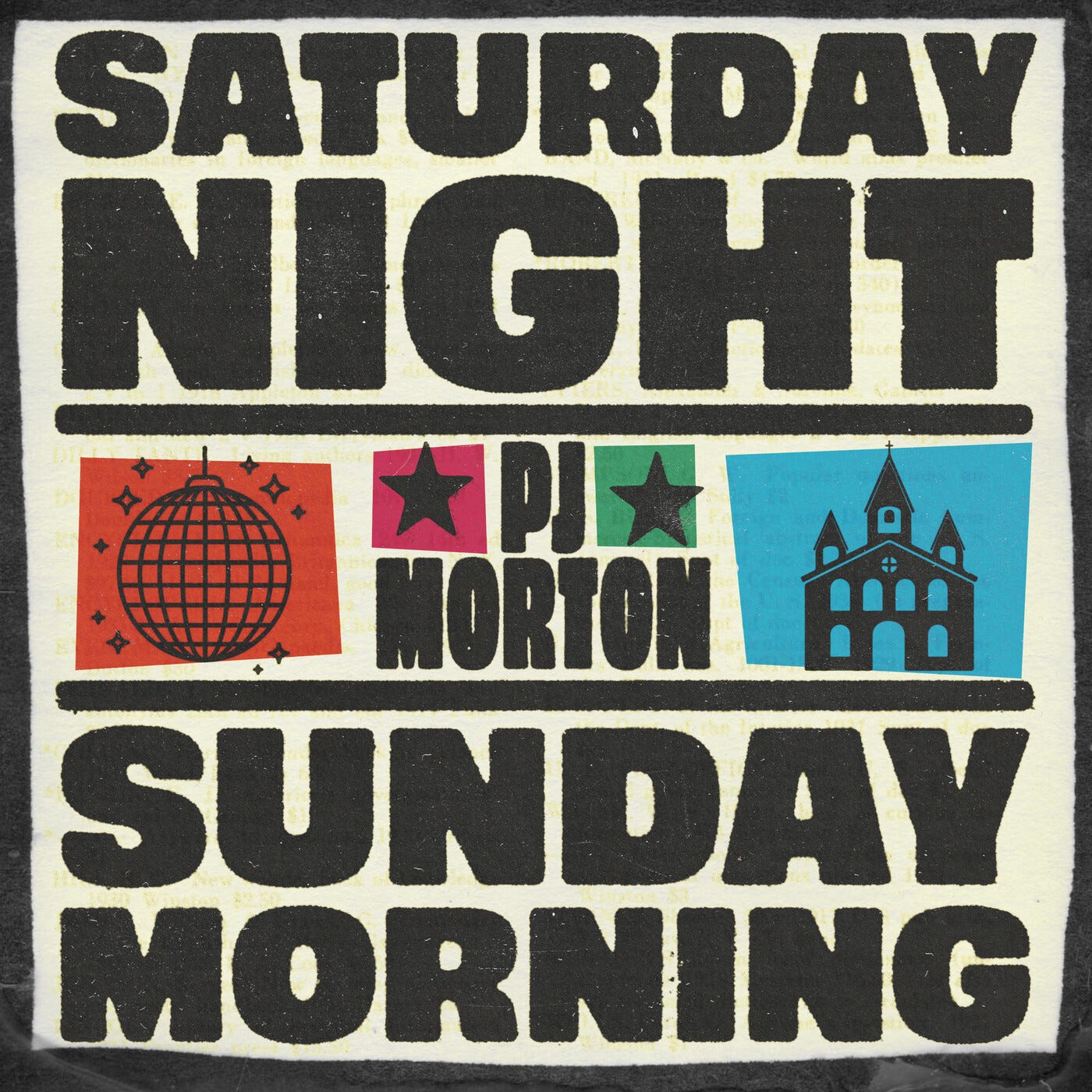
Anyone raised in the Black church has learned the calendar very early. The night before is for the world—the party, the man you hope will take you home, the self that doesn’t enter the sanctuary. The morning after is for repentance. Bishop Paul S. Morton’s son, PJ Morton, learned that split before much else in New Orleans, and has operated in both worlds for years, playing keys with Maroon 5 on the pop scene and recording soul with his own band on his own label. He named this double-LP after his 2024 memoir, building it on that dichotomy, nine R&B songs for grown folks on one, nine gospel songs for the spirit on the other, the secular and the sacred put in different rooms he walks freely between.
On “Mutual,” Morton isn’t even pursuing someone. He is soothing his partner into understanding that the gamble runs two ways—“Whatever you’re feelin’, I’m feelin’ the same way” and “Nothing you say is too far-fetched ‘cause we’re on the same page.” With bass from Thaddeus Tribbett and trumpet from Keyon Harrold, the song remains understated, and that simplicity is its selling point; Morton’s default is clarity over spectacle. This impulse hurts him on “Don’t Give Up On Us,” where that straightforward sincerity sags. He calls her his air and vows to be a better man; he believes “This trouble won’t last always” with a miniature brass section and Zahria Sims on sax, pumping life into a line that lacks its own force. He does best when he’s already won the argument, not when he’s trying to preserve it.
His mom told him to keep his business out of the street; he croons on “Used to Be,” and he attempted this, with no success: Everybody’s ear is her ear now, and nothing will get through. He goes so far as to call that a kind of faith: “Our love used to be our religion,” then asks where two people go when the congregation has dispersed, Mike Esneault’s strings reaffirming the question without providing an answer. This is where Morton shines, in that place where he can poke at a wound as opposed to begging for love. “Mess” is that wound, the thing he cannot put aside; “Yes, I must confess that I’m a mess” with trumpet from Keyon Harrold. Both guests show up at the gospel side of this building. Rukhsana Merrise offers her voice to “Autopsy,” the bleakest song in the soul half, where Morton delivers cause of death like a coroner: “When you read the autopsy of us, you’ll clearly see the cause of death was love/We tried our best, but our best wasn’t enough.”
Morton won’t open the door for somebody on “Sell My Soul” singing, “You try to come at my weakest/You try to come when I’m down/But as long as I am breathing, the sun can come back around.” Whoever is on the line wants control, and the answer Morton is giving is no, bolstered by Chris Payton’s guitar and a Harrold horn line that gives the tune a live room heat that the ballads manage to keep colder. He’d take the long road; he’d take sanity, rather than the offer; there is nobody to win back here, so his stance lacks any shame. “Listened to You” aims for the same self-possession and can’t quite grasp it. The grown man rebukes his own youth and all who ever told him that his dreams were too big, framing their critiques as “Projection of their limits on you.” It’s the only song on the soul side with no person to whom it is sung directly, only to a memory and a morality, and the assurance rings a little hollow with no direct recipient to believe in it.
The most vulnerable on the soul side belongs to the man who is always picking up after everyone else. “Protect My Heart” is sung by the friend on call, who vows, “I’ll always be your Superman without a moment to spare,” but then immediately questions himself: “I know Superman is not supposed to cry, but I’m wondering who will protect my heart?” He quickly assures everyone he is not complaining and is otherwise content with his life; all he asks is for her to show up when it’s her turn, the way he always does. Esneault’s strings are a comfortable bed for the worry. “Can We Try Love Again” points the same request outward to everyone: the starting detail of Morton looking through a comments section where “It was so much easier to find hate” opens to broad pronouncements, one frightened heart transforming into “Love is all that really matters” and “We need it now more than ever.” The farther he expands his audience, the less he is really talking to anybody in it.
On “Could’ve Been Me,” Morton is completely submerged, “I was drowning down so far, deep in sin,” until someone reaches him “In the nick of time,” and the other songs surrounding the moment offer a similar near-escape: “I dodged a bullet coming my way/I heard your voice telling me to move, glad I didn’t stay.” He’s always sure to acknowledge he didn’t deserve to be saved: “Mercy” is built around this, “I fell so many times, but You still think I’m worth it,” “I couldn’t earn Your love even if I tried,” affirmed by Thaddeus Tribbett’s bass, making the thanks sound closer to praise than to confession. When he sings “You keep showing up for me,” it feels like the answer to the lonely Superman from two rooms over; it is clearly the same man standing in both spaces. “Feeling Free” is entirely the consequence of his dependence on another: “Without you I am nothing/But with you I can’t fail,” the attempt to fly on his own, only to realize he needs someone else.
But now and then, a question pops up: “But then, something always gets in my head,” Morton states on “Always On Time,” in the middle of thanking a God who “never failed me yet.” He even prays to be forgiven for not being where he needs to be, something that feels stranger and more true to put in a gospel than confidence does. The most thoroughly written gospel track here, “Close Enough,” draws on the story of the woman who pushes her way through the crowd in the gospels just to touch the edge of Christ’s cloak. Morton is willing to gamble the highest stakes on the smallest possible amount of belief: “Even if my faith is of a mustard seed, that is all I need.” The strings that ached under the love songs of the soul set turn in here, taking the urgency down to a near-standstill, and finding a more particular kind of ache. It is possible for her to push through a crowd and simply touch a bit of cloth and have it be enough for her.
“Bless His Name” is completely its refrain, “He is so wonderful/He is so marvelous,” with very little surrounding it—it’s the only track on the gospel side with which Morton seems satisfied to simply vamps. “Yesterday Today Forevermore” is much more steadfast and holy, praising a God who stays when “Others may leave you, deceive you”; it’s the least surprising song here, a simple benediction that demands of him very little. On “Not Alone,” Morton directly addresses the person he watches give way under pressure: “You’re trying to believe, but you just don’t know how much more you can take.” “Waiting for You” goes even further: letting him deliver a word from God to a former faithful, he assumes he’s gone too far to ever go back. He promises him that no amount of sin can possibly be enough to sever his love. The same man who wanted his heart kept safe throughout the love songs is suddenly offering up himself to hold onto a hand he swears will not slip through his fingers.
Great (★★★★☆)
Favorite Track(s): “Protect My Heart,” “Autopsy,” Close Enough.”