

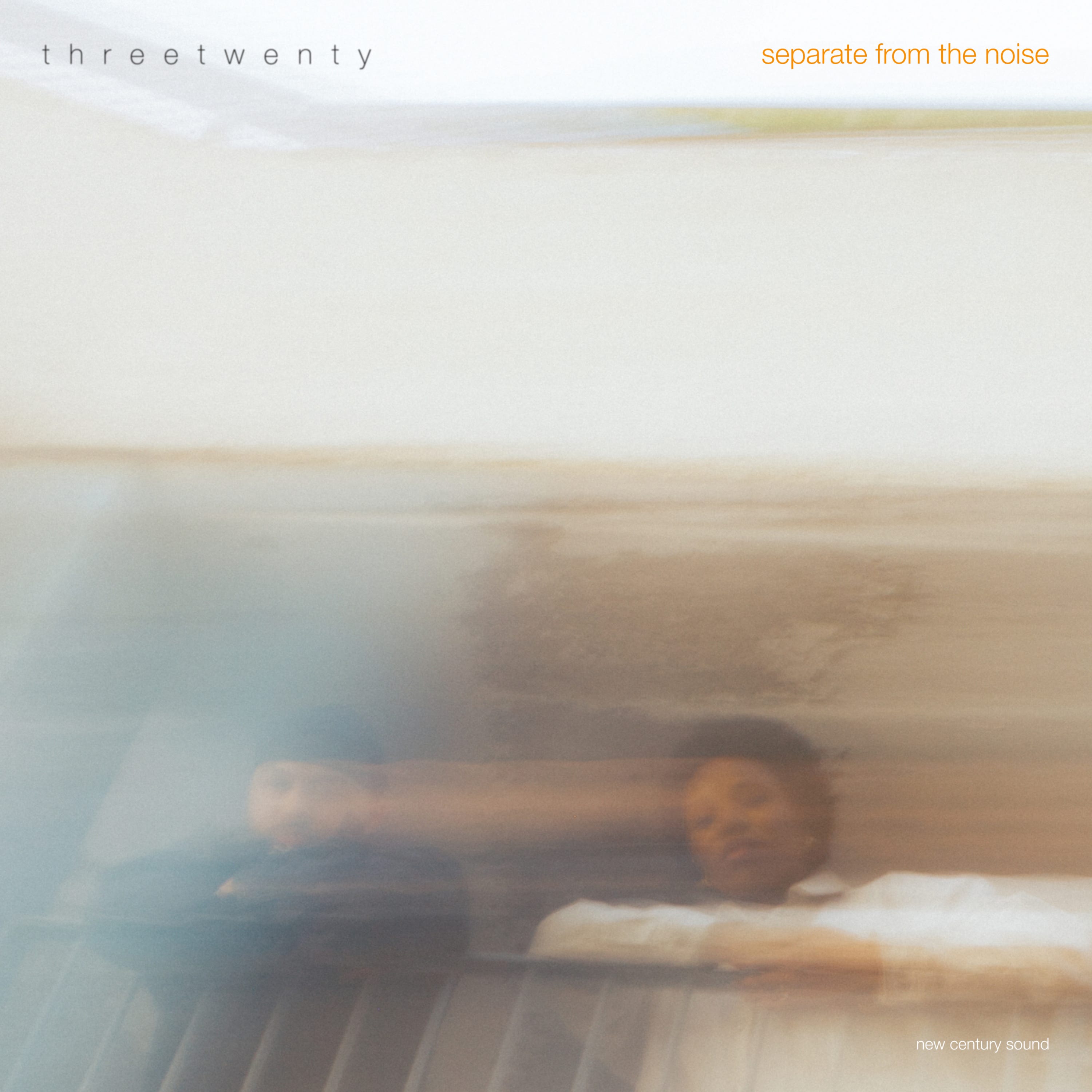
We have a new duo on the horizon that made waves early last year. Ivana Nwokike left VanJess after her father died and her faith shifted. Her husband Filip Hunter, a Swedish producer who’d worked Stockholm hip-hop, was already in the picture. They’d met on March 20, 2018, hence the name threetwenty, and Ephesians 3:20, the scripture about abundance beyond what you ask or imagine. But Separate from the Noise doesn’t sound like abundance. It sounds like asking. The album’s vocabulary circles the same handful of words (peace, light, wait, grow, pray), and time keeps “fleeing.” Days “go insane.” Someone needs direction, needs patience, needs to stop being “nice” and start being honest, more so in daily devotion. The kind of language people actually use when they’re talking to God instead of about Him.
Hunter builds midtempo grooves with steady drums and warm keys. Call-and-response vocal patterns. Those repeated “da da da” passages on “Lamp Onto My Feet” work like breath resets rather than hooks. The music stays calm even when the lyrics admit to panic. This is neo-soul that keeps its production out of the way, letting Nwokike’s voice carry the argument. When “Blessed Like That” repeats its title phrase for nearly three minutes, Hunter production-wise doesn’t try to make it more interesting than it needs to be. The album concerns discipline, and it sounds disciplined.
One pressure that recurs across these ten songs is spiritual discipline versus mental noise. “The Light (I Need You)” opens with “Everyday I pray for peace,” then concedes “These days, they go insane to me/I feel the time is just fleeing.” “Lamp Onto My Feet” asks, “Show me where to go, I don’t know/I’ve been lost and now you’re leading me on a new path.” “What Are You Looking For” admits “I was so lost than confused but thriving”—a morphological stumble that feels unedited, which is the point. The record doesn’t clean up its sentences for presentation. As Nwokike sings, “I was stuck up in my home, couldn’t get up out of that zone,” the clumsiness of “stuck up in” and “get up out of” mirrors being stuck.
Another pressure is the choice between integrity and social comfort. “Say It” pins this down harder than anything else here. “You’ve been practicing your stance/Now you don’t know how to be an honest man, I feel bad,” Nwokike sings, then lands the real accusation: “There’s no respect ‘cause you chose to be nice/Just know that if you’re middle in the end you’re gonna regret.” The production stays warm while the lyric cuts. “Do I wanna be a person who just skirts around the facts?/Or do I wanna be a fighter who’s integrity’s in check?” That’s a real question. “Fruit” belongs in the same conversation: “This is what you do, not what you prove.” The refrain “What’s the taste of your fruits?” draws from the gospel of Matthew—you’ll know people by their fruits, but it doesn’t cite chapter and verse. It assumes you’ll recognize it or you won’t.
Then there’s grief and private history surfacing inside affirmation. “Let Me Grow” contains the album’s most direct admission: “It’s been years since my father died, but I still cry like that morning/He ain’t like when I would cry, so I held in my feelings to show him.” The verb tense shift (“He ain’t like”) in the present tense for a dead man that hits without theatrical setup. The following line, “I’ll die old, you had a lot to do,” addressed to her father, breaks open what could’ve been another song about self-improvement. This is where the album refuses to keep faith language abstract. The pre-chorus follows with “All that I’ve been through/It proves that this pain, it won’t break you.” Standard testimony grammar. But the verse has already earned it.
Time shows up as both enemy and tool on “Undo” and “Redo,” the album’s closing pair. “Times are changing right in front of me/It’s too bad we can’t go back in time/To those days when everything was less demanding,” Nwokike admits on the first. Then: “Don’t be entertaining every thought. What I should have done was thank the Lord.” The second song accelerates: “Things are moving so fast, it’s strange/I didn’t have a hidden fortune/It’s complicated, not in order.” By the latter’s final minutes, she’s insisting “You can change, just don’t miss it” and “You still got time to undo, redo.”
However, the songwriting weakens by staying too general. “Blessed Like That” has a nice vibe that really goes nowhere. “Always feeling blessed/Feeling blessed” goes on and on without specifying what blessing looks like. No receipts, no particular morning, no named thing to thank. “Who Are You to Me” circles its central metaphor (fire, light beam, high beam) without tightening it into scene or story the way the other song does with “He ain’t like when I would cry.” When the record stays in broad affirmations, it relies on the listener bringing their own content. When it tightens into lived detail, with the deflated faith, the years of crying, the choice to stop being “middle,” it doesn’t need the listener’s help.
The strongest songs locate their spiritual claims inside specific admissions. One confronts the cost of confrontation. One names a dead father and the habit of suppressed tears. One asks what you actually produce, not what you profess. One insists on continued possibility without promising it’ll work. These are devotional songs that don’t resolve their own questions. They ask and keep asking. For a debut album built on the premise of separating from noise, that’s the move that matters—admitting you haven’t arrived anywhere yet, just that you’re still trying to hear.
Solid (★★★½☆)
Favorite Track(s): “Fruit,” “Say It,” “Let Me Grow”
LOVE LOVE LOVE this album 💙