

Album Review: Shadow Town by Liam Bailey
The Nottingham singer drops geography, genre labels, and rescue narratives. What's left is his best album in a decade.
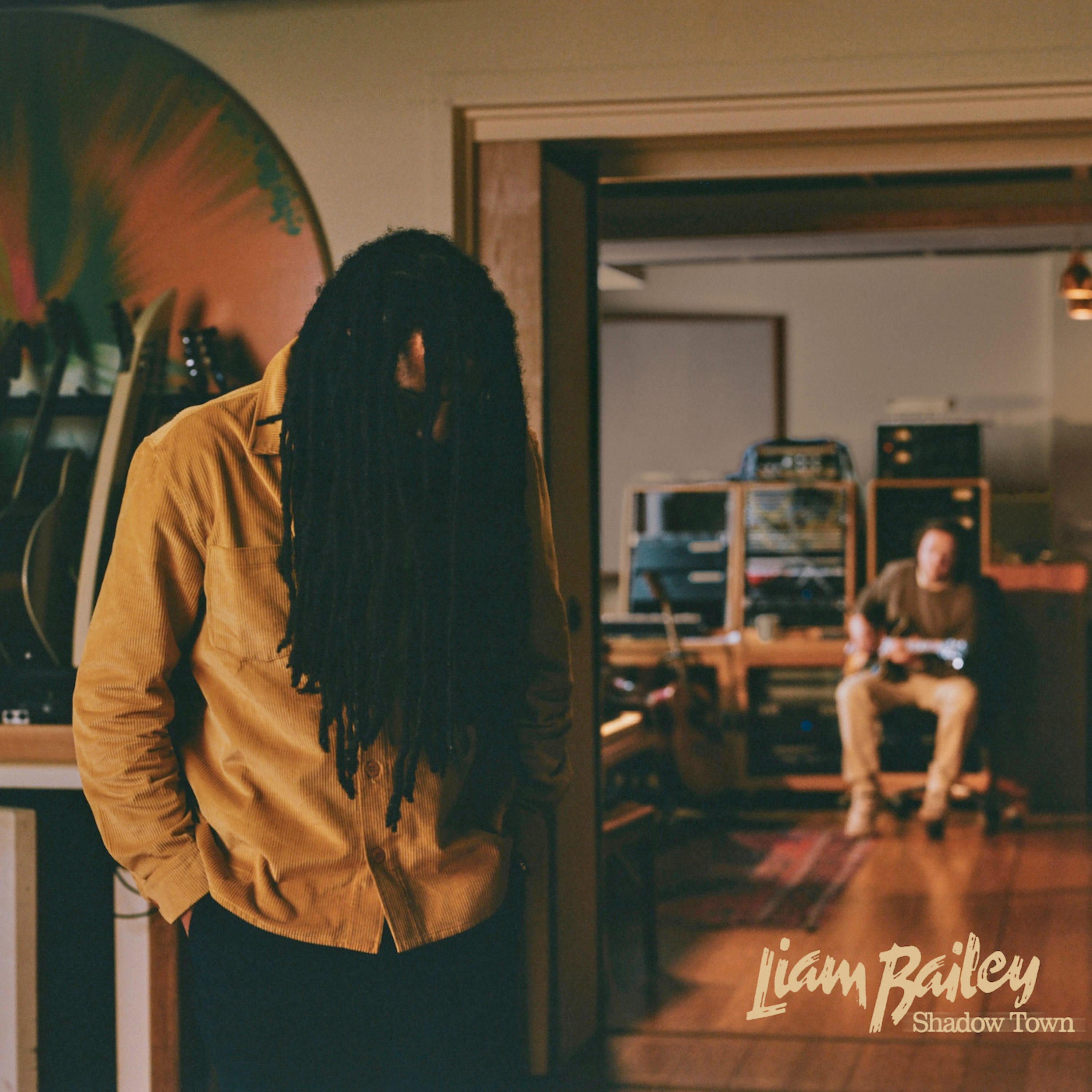
Liam Bailey learned three different ways to talk in a pit village outside Nottingham. Around extended family, he spoke Jamaican Patois; in his mother’s house, the Nottingham accent came out; among friends in London, where he started playing open mic nights around 2005, he picked up something else entirely. His parents’ record collection put Bob Marley next to The Beatles, Dillinger beside Stevie Wonder, and taught him that none of these languages canceled the others out. He modeled his singing after Michael Jackson, Tina Turner, John Lennon (four people who sound nothing alike) before he eventually sang in his own accent for the first time on “She Hates This Life.” Five studio albums later, that multiplicity runs so deep that the press cycle scrambles to sort it: pastoral soul, British folk, reggae, singer-songwriter. Shadow Town, his fifth, ignores every one of those labels.
There are no proper nouns anywhere in these lyrics, which is a genuinely strange thing to pull off across eleven songs. Nottingham, London, Jamaica, friends, enemies, streets: all absent. The settings could be anywhere. The only proper noun on the album is “the gods” in “Gold,” and even that seems like an accident. Against five albums’ worth of press narratives about where Bailey comes from and what tradition he belongs to, Shadow Town strips all of it away. A man keeps using the word “love” and “kill” and “crying” and “gone” without once telling you where he’s standing when he says them. It shouldn’t work as well as it does.
Jimmy Hogarth, who produced Bailey’s debut Definitely Now over a decade ago, recorded the whole thing in his Hampstead home studio. Bailey freestyled most of the songwriting; Hogarth played bass and keys and caught the performances as they happened. “Trauma” came from a psychology book Bailey picked off the studio library shelf, its clinical language about childhood psychological damage feeding straight into a stream-of-consciousness vocal over Chris Vatelaro’s drums and Martin Slattery’s percussion. The record sounds made in a living room, and that looseness gives it something Bailey’s Big Crown reggae albums, tight as they were, didn’t have: the sense that nobody was listening except the people playing.
Bailey croons “It’s okay, now honey, I won’t change/It’s okay, now honey, I won’t fake” on “Got to Love You,” and for a second you think that’s a reassurance. Then the chorus arrives: “Hold me, touch me/That I love you, babe/Break me, hurt me/That I love you, that I love you, babe.” Love declared through the language of being destroyed. On “Concrete and Stars,” he howls “We’re not worth saving” in the same chorus where he asks “Why can’t we change ourselves from this loaded gun/We point at ourselves,” the self-accusation folded into a track about standing together. “Love Don’t Fear Light” calls himself “A victim of myself again/I’m always fighting something” and then stays on the high, won’t let go. Bailey is damaged and knows it and won’t stop. Nobody gets asked to fix anything.
At least half of Shadow Town isn’t talking to a partner at all. “Trauma” opens with spoken-word descriptions of a child whose defenses never formed, then drops into a hook that sounds more group therapy than music: “Trying to kill it, kill it, kill it/Killing your life away.” On “Northern Lights,” Bailey asks, “Are they making it harder for us?” while describing people in cars with no cause, then calls himself a satellite, spinning endlessly, hoping he never breaks. “A Perfect Release” wakes up in taverns, sleeps on concrete with no money, and closes with a list of natural resources (regular seasons, dependable fresh water, endless fish, pollinators, minerals, soil) followed by “Make no mistake/There is no going back.” These are dispatches addressed to rooms full of strangers, and the strangers are not doing well.
Hogarth’s guitar stays close to Bailey on nearly every track, not backing him up so much as sitting beside him, humming along uninvited. Vatelaro’s drums on “Gold” have a loose, slightly behind-the-beat knock that lets the word “gone,” repeated eleven times in the hook, shift meaning each time it comes around. The bass on “Right Back Like That” is a low thud underneath Bailey’s vocal as it moves from tight anger in the verses to exhaustion in the bridge. Maverick Sabre and DRS (the drum & bass MC) appear somewhere on the album, and their contributions blend in so thoroughly that the guest spots vanish. They’re just other people who happened to be in the room.
Bailey isn’t interested in solving anything. “A Perfect Release” says love can save all of us; “Concrete and Stars” says we’re not worth saving. Bailey told The Voice he wants to sit on Graham Norton and “come with the patois and the Nottingham style. Just start introducing people to other interpretations of Black people.” That sentence names what the album itself won’t. The tracks don’t introduce anything. They sit between love as salvation and love as another thing that won’t save you, and they stay there for thirty-nine minutes.
Bailey croons “When I get the confidence to suffer/You shouldn’t call me” on “Right Back Like That.” Suffering as a skill you have to build, not a wound you endure, and the person who hurt you doesn’t get to watch you practice. The bridge, after two choruses of telling someone not to say where they are, drops to a single line: “All I’m trying to do is live again.”
Great (★★★★☆)
Favorite Track(s): “Got to Love You,” “Right Back Like That,” “Trauma”