

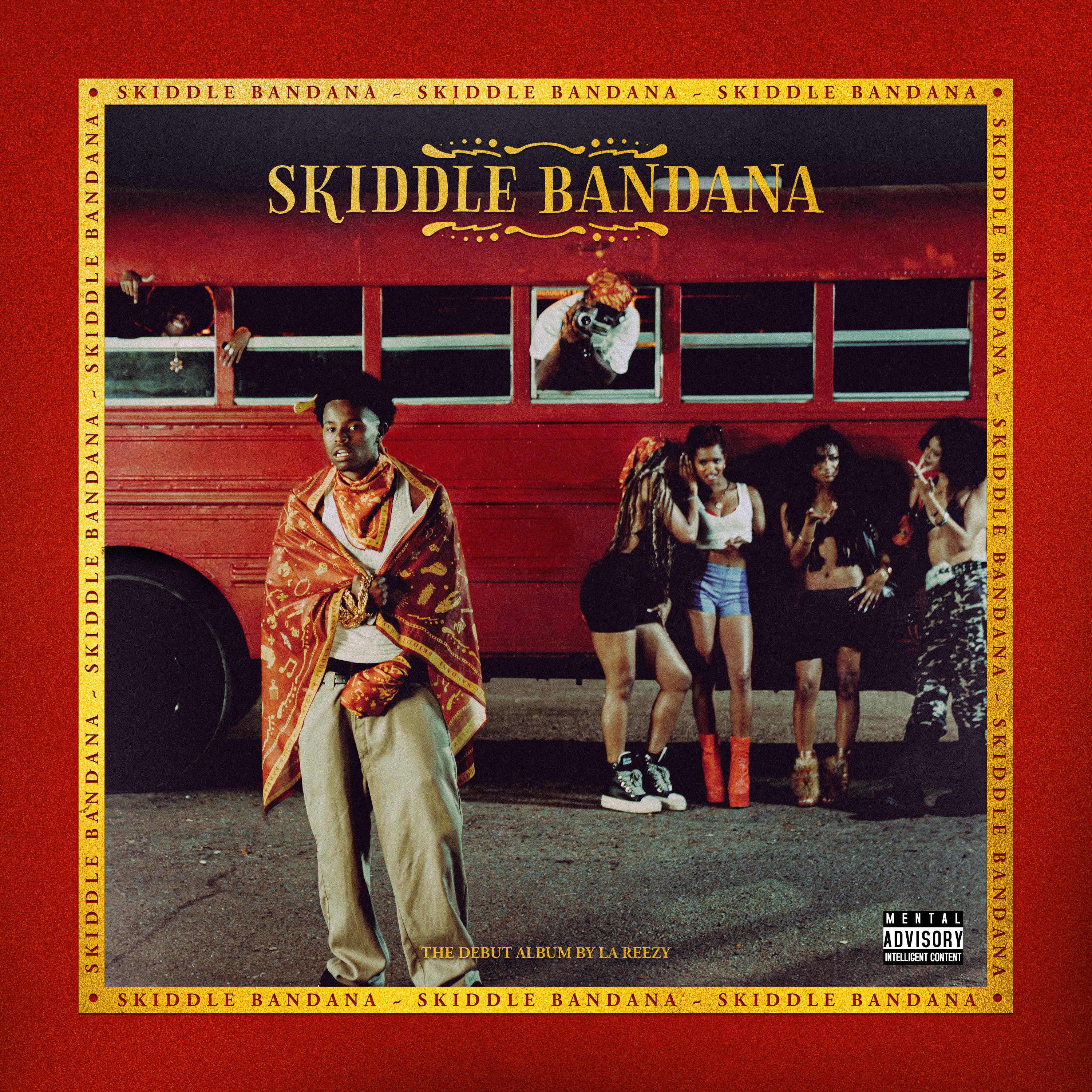
Born in the 12th Ward of New Orleans, La Reezy said that he was inspired to create the sequence of events in the song about a party bus based upon experiences he had riding such buses at age 13. Somewhere on the record, the vehicle is parked. There’s music being played, and someone is yelling for the curly-headed girls and boys to step onto the bus. The bus leaves again before they do, and continues to pick them up between songs. Riders are goofing off, and a driver is talking about unity before anyone will leave the bus. He said he staged the ride on Skiddle Bandana, which is his debut album, in the same manner. Whichever things pass in the window receive a verse.
His grandmother sewed him a Michael Jackson glove at the age of four. She did his locs anytime he wanted her to. His dad cuts his hair at home so that the money stays in the family. On “Family Bizzy,” during a hurricane, his parents and four brothers all were placed on one air mattress until “that FEMA started trippin’.” A 13-year-old cousin creates a viral video and receives over a million views. A 10-year-old brother gets straight A’s on his report cards. Reezy feels worse than both of those incidents because he hid his bad grade at the bottom of his book bag alongside a brand-new pair of shoes purchased by his mama. He turns the script around on “Normal Struggles,” creating dialogue between a parent and child pertaining to game-day shoes and bills that are due by the first, and later addresses single mothers with children on their way to school, returning home with dinner that’s “not healthy, but it’s hot.”
He enters alone on “Curly Head Boy” with vocals as the lead instrument and minimal instrumentation behind him until the drums kick in harder. Once the drumming begins, he and executive co-producer Clay Dough run one pattern with programmed drums and heavy bass underneath a repetitive loop, short, concise phrases allowing space for an audience to respond. On “Hot,” La Reezy uses a tighter grid with active hats and a steady clap. He describes a 100-degree Southern summer day versus a sage fire he always burns, stating that an experience cannot be microwaveable. La Reezy is most consistent on “Gold Chains,” using firm claps and direct lines to proclaim Black Royalty with green grapes for breakfast and “hot yakamein for the dinner.” This lyric allows him to sing to the widest crowd on “We Live,” with heavy bass, leaving the title to be carried by a whole street.
At a park bench outside of his job, a drunk barber complains to the narrator of “God Forgive Me” that he charges $20 per hour for cutting hair while his other barbers charge too much. The bartender listens to the man’s complaints and smells his breath. After hearing the man’s jokes privately, he catches himself judging a man that clearly needs a hug. He asks God for forgiveness once on the hook: “God forgive me/Forgive me, forgive me.” He gives the microphone to the barber. The barber states that his dad made him use clippers at 12. Two years prior to the recording date, he lost his wife to cancer. He claims that his psychiatrist does not know anything, and no one ever goes to pick him up when he is intoxicated. The final statement from the barber to God is: “I talk to God every day. And that’s why you done this to me.”
Seventeen years old and glamorously dressed, the girl in the opening verse of “Pretty Girl Bullshit” possesses a pure spirit that sends many hearts posting on Instagram. However, she cannot express her brother’s death on her face. The dope she originally used to deal with the pain returned laced with fentanyl. Near the conclusion of the song, a female voice breaks into the conversation explaining how she cleans her eyes after crying so people at school do not ask her what is wrong with her. La Reezy writes his verses into shorter begin/end pockets throughout this section. The speed of the ride slows as well.
La Reezy is most gentle on “How Did You Love Me,” where Maleah sings back at him the question in the title. He responds with his mother’s advice: “Treat your lady how you want somebody to treat me.” He casts a New Orleans romance as Tiana and Prince Naveen. Additionally, he recalls his mother spending one of her few days to herself relaxing, cleaning the house, cooking dinner and filling a bathtub with warm water.
If he could, he would freeze time on a Sunday afternoon. The suns are out, and guns are fired at a barbecue on “Melanate It,” while his wife expresses her desire to remove President Trump from office. Against Monday morning’s stupid ass newspapers. He declares: “Brown is the crown you could never take.” By 2055, he envisions himself living in a castle surrounded by people wearing white T-shirts with watermelons painted on them. He wants everyone to see him eating watermelon in full view while he eats it and reclaim this image forever. He also defends his pride on “Aight,” where he states limitation is given as an inheritance from above. He teaches you how to drive before you teach you how to fly. A skeptic fires back at him, questioning whether or not he has seen his dad go to work simply because of that fact. He accepts the challenge: “You took Malcolm and Martin, and now we taking our own kind and get rewarded with a million dollar sign.” He ends the argument with a question of his own: “Who’s to say I can’t turn this hood shit into good shit?”
The bus picks up passengers for a brief period during which time they hear a broadcast. The interlude (“Hold Yo Crown”) names New Orleans as the murder capital of America and faults the state for providing funds for punishment instead of solutions for long-term problems. Within minutes of stopping to listen to this news broadcast, a passenger requests that the driver allow him to dance atop the bus since it is his birthday. Before pulling away from this stop, a departing voice advises him not to allow anyone else to take his crown.
As a rap artist from New Orleans roughly a generation older than La Reezy, Mac Phipps introduces him on the title track. Mac describes him as “a young brother from New Orleans, Louisiana, with experience much, much like yours.” Reezy steps forward, tying his camel, praying through a prayer channel, filing a complaint in open court, “a 14-year-old charged as a man made me hot, your honor.” The second verse sits at a Save-A-Lot grocery store. As he recounts a 7-hour shift that boiled over after someone stole his parking spot, his energy collided with another person’s energy. The person remained mid-sentence while police were already present in the parking lot. He immediately redirects anger toward an empty chicken order, “Bitch, is you shittin’ me?” The comedic timing required to place dark humor next to death at 21 years old is evidence that he already has this raw talent.
Great (★★★★☆)
Favorite Track(s): “Family Bizzy,” “God Forgive Me,” “Gold Chains”