

Album Review: Solidified by Awon & The Other Guys
The Virginia emcee braids crime sagas, dead friends, and soul-food kitchens over The Other Guys’ heavy drums.
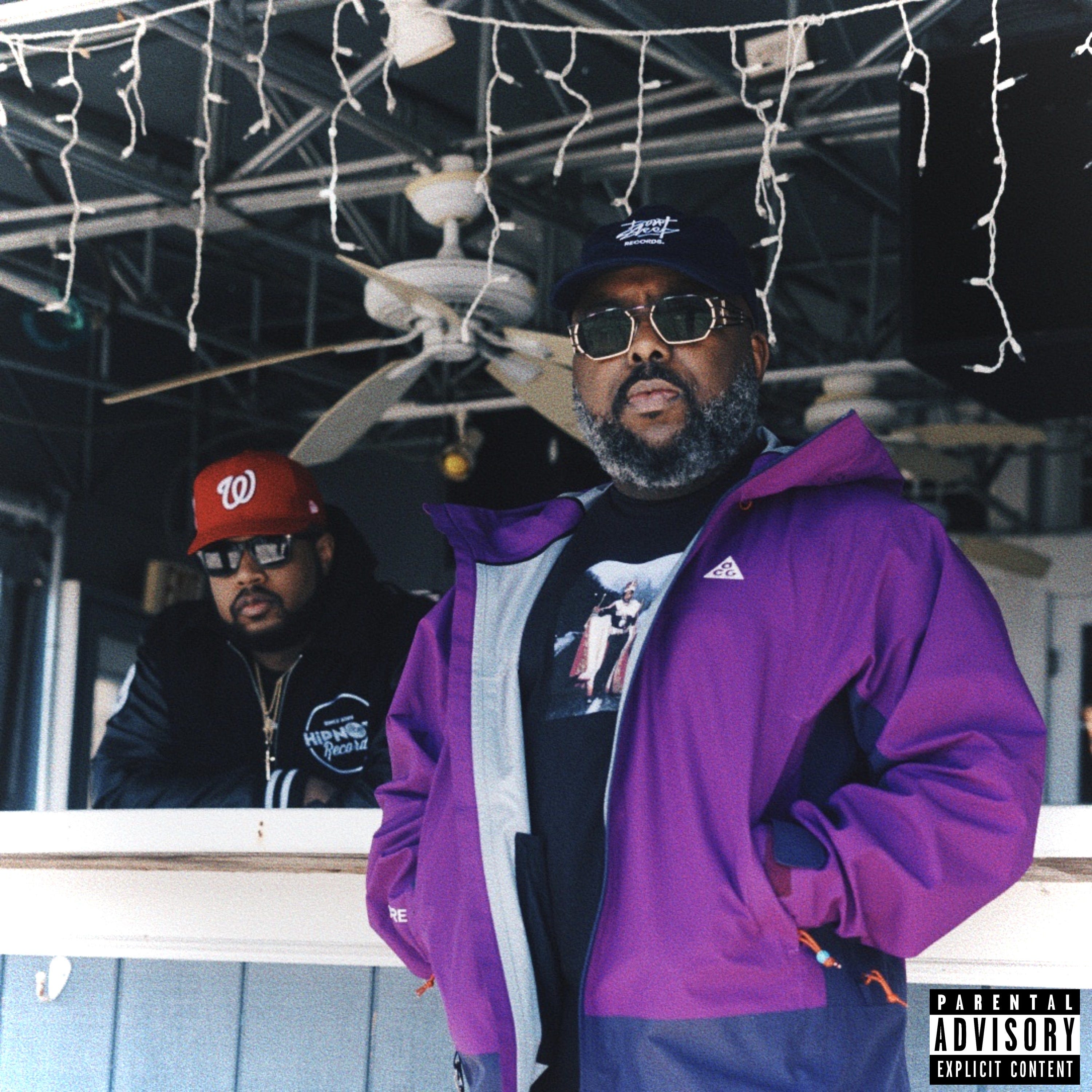
Awon doesn’t do hype. He tells of a drug bust’s disintegration, his friends laid to rest, platters of oxtail and peach cobbler with the same steady, understated delivery that defined his come-up from Brooklyn to Newport News, Virginia. His authority doesn’t come from decibels but from how he crafts a phrase, from its cadence. The Other Guys lay down one murky, bass-laden track and stay invisible behind him.
The street, to Awon, feels like an epilogue, the narrative pre-scripted. On “Lots of Pockets,” the man who seems to have everything loses it all. Madeline, his girl, pilots a black Caravan down I-95 into Maryland. His operation runs out of a number of abandoned buildings. He’s pulling in enough clean cash to sign an up-and-coming rapper out of Houston as executive producer without leaving his desk. Madeline is eventually found dead under an Uzi, the payoff at the docks is an ambush, AND the love of his life has turned on him. The man drops his gun. “So went the glory,” Awon says flatly. He turns the camera on himself in “The Embrace.” Twelve years old and reading obituaries; fourteen years old and selling; a teen Nino Brown playing hide-and-seek through buildings where users fell asleep forever. All set to a hook which completely subverts the usual boasting: “I didn’t embrace the streets, the streets embraced me/It’s not crime, it’s the way the streets raised me.”
Underneath the narrative lies a body count, and Awon makes it strikingly clear. In two verses, “Ice Rink” details the day he walked through it, dodging bullets, being harassed by cops demanding his name and if he has a piece, tucking jewels into his pants on his walk home from school in the land of power brooms, a native of the land with no power. He name-drops the Willie Lynch myth, then the knee on the neck, then the first-class flight where they check a Black man’s ticket twice and still expect him to be polite about it. The white tee on “New Notes” carries it all. It’s a gas station shirt, a work shirt—“A sign of dignity on the poverty line,” he calls it. It’s the same shirt on the dealer with the Rollie, the prisoner, the deceased. The hook is a running eulogy list in his phone; the latest was for a friend shot dead last week. He goes to work in the same shirt and goes to his burial in it.
The most tender lines Awon writes are composed on his feet, in his kitchen. The three verses to “All My Love” are cooking and all the people who cooked them, opening with a grandmother humming gospels over candy yams and peach cobbler in a project oven, moving to a Crown Heights stove where his mom stirs cornmeal into cou-cou base, mackerel in the stew, flying fish, rice and peas with oxtail, tamarind balls eaten like candy on Park Place. This food is never just food. All the food served pulls back the dead or departed to sit in their seats. Grandmother is dead, and the space remains open, mom’s kitchen remains bare, his homies are in jail or in the ground, and his lost ones rise as the allspice hits and the flavors sharpen enough to sting. The third verse lands on the simplest form of the statement, food as love infused, Jesus feeding a host on five loaves and two fish, a plate honored at a table for folks long departed.
Money, here, is going both ways, and Awon navigates this without any illusion that the paths will cancel. The bad is “Bonus Day”—a blue-collar bonus gets you a tip at the counter, and a drip for the kids, and the car breaks down, the gasket is the same price as the bonus, and AAA is called, and the dinner plans are canceled. Rob Cave takes the third verse, another rapper here, rapping as hardship itself in a stickup, demanding all the dough and the ice and the spirit while informing the man he’s robbing that “Every diamond is some carbon that survived the pressure test” and that the hand he’s robbing gave him his entire world to begin with. The bright side is “Mid Century Modern Aesthetic”—lobster tails and a wife and an organically eaten diet, a home he’s filled with a lifetime of found objects, so she understands both Coltrane and Funkadelic. The flex gives way to intention in the second verse as his six-year-old is a brand-aware genius heir to over a million in savings and a back catalog to carry.
When Awon stops rapping his narratives and speaks directly, his writing is at its most arresting. The most direct of these are “To the Sky”—written to his son who has special needs-and the three years Awon is sober, presented plainly and close to the ground as the story of parents who learn to read a grip and a hold in lieu of words, the hook on a sentence that no words were spoken and the work was done on a smile, a hold. “The reason they can’t fly is ‘cause God gave them little wings”—that line lingers, and he thanks his wife for schooling him on it. Raising the lighting on that, and on “Snickerdoodle,” the love poem Awon stumbled into while in a written rap and confessed is the only occasion he could admit to a wedding ring that no longer fit, two breaks in the dark, low ground the duo create under just about everything else. Held on this one, heavy floor for so long, a few of the tunes are of one color upon first listen, and it takes a second pass for the lyrics to pull them apart.
Great (★★★★☆)
Favorite Track(s): “All My Love,” “Bonus Day,” “New Notes”