

Album Review: StarrGirl by Ayra Starr
The Nigerian pop star packs her third album with money talk and dancefloor commands, then lets the English ballads go slack.
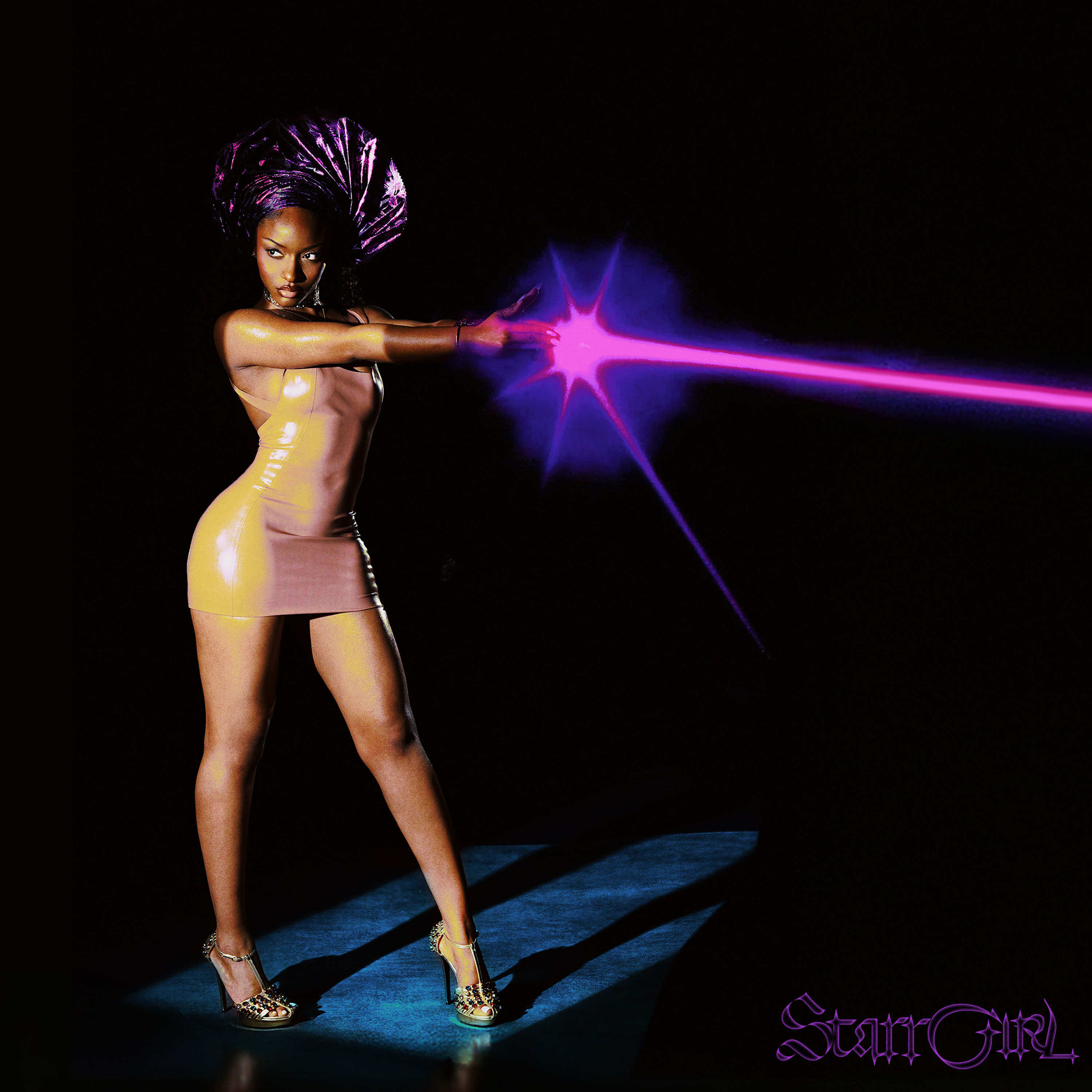
For over a decade, Mavin Records has ruled Lagos pop like a finishing school. Now, Ayra Starr is the most decorated student outgrowing the building, thanks to a duet with Wizkid that earned her a Grammy nomination, management by Roc Nation, but still recording at home on Mavin. She even performed on NPR’s Tiny Desk—but only so you can get a sneak preview of an unreleased single in the public radio show’s tiniest of stages.
She was Mavin’s marquee name even before the release of her new album, StarrGirl. Anticipation for her third album is so high; she hasn’t released the title, but she hints that it’s trilingual, moving effortlessly between English, Nigerian Pidgin, and Yoruba. In her most recent song, she breezily announces that she’s upping her Spanish, as well. She doesn’t need language to be understood, though; nearly every song of hers is either chasing after money or a body in motion.
Upon her first breath, “Dangerous” announces her name as Starrgirl and straightens her shoulders. “Mob stars na my family,” she says, brazen and drawling. “Bring the contract.” In her hands, the scroll isn’t paper. “I’m talking ten figures, in the day, I’m out,” she brags, without breaking a shrug. “What they do now, we already did that.” On “Ms. Paper,” Theodora sings, “Turn me on like gasolina” and introduces “Miss Kitoko ou Miss Paper.” The cosmos belongs to Ayra on “Dance,” where she prays, “Feels good to be who I am/I no pray for another life.” In her hands, money is “constant bi Maphorisa,” a currency custodian. “Presidential, I been dey chop like minister/my camera only caught jolly,” she says.
Combining smoke with perfume, things quickly turn crowded, yet funnier, both in bed and out, as the dirty songs become more joke than sex act. “Earthquake in my legs/By the bad boy, vibrate/Put a hole in the wall,” she advises in “Amazing,” then goes on to compliment, “Sweet like lemonade/You can stir it up for me, babe/But your spoon is small.” When kwn spills in for the second verse, talking of nothing but keeping an eye on the clock (“You got work in like 9:30/But let me bend you like it’s 9:30”), it only highlights the sullied discretion of his half of the deal, the secret she leaves all over his body.
The hook “Look what a hot body can do” sums things up a tad too neatly, and it’s the least interesting part of “Hot Body,” in fact. It’s the exhibits part (“Porsche Panamera inside,” “Fragrance smelling from a distance”) that gets things going, before you hit the meaty first few lines: “Controller, controller/Remote for my holder/Slow me down whenever I do.” The Spanish-language remix is equally engaging—over guitar licks and the familiar bass, Danny Ocean practically heralds the new year: “Tu cuerpo, mi cuerpo, somos un lenguaje.” If only the perfect note of both verses wasn’t punctured by a mediocre second helping of “Hot Body.”
In the unreleased song from that NPR set, she brags with numbers in “Tornado,” the meanest number available being “Inflation, I’m the price they wanna beat/If you’re starvin’, come and eat/I’m that girl they wanna be.” No fables here. She’s “straighter than a ruler,” “My figure no be fable.” The wildest boast has her dabbling in Nigerian infamy: “And if you belong to Caesar, steal am like Anini.” Shizzi and Skillies bullies the beat with ease of catchiness and groove.
Love is, in some ways, a priceless commodity and should be treated as such, but Ayra Starr starts her negotiations with a rate, and the price is laid in awoof, Nigerian Pidgin, for a freebie or a good thing that comes at no charge. “I want that peace of mind wey dey come with awoof,” is her pitch, as well as some additional terms and conditions for Wizkid, her apparent target, that there is no rush, that it’s a one-man race, and that there is no pressure. “Diallo, Diallo/If I give you my love, oh/Make you no disappoint, oh,” she intones on “Gimme Dat,” and gets a firm commitment in return: ‘Girl, na only you go make me stick to one girl/Keep it private, f’ọkàn bale.” So far so good, but the negotiation has not started yet: ‘So, baby, chill, make I survey your tools.’
Rema takes the longer road to his turn, with five years on the same Mavin roster before the two of them put out an official song together. In his verse of “Who’s Dat Girl,” he strolls in “all Balenci” and announces, “Black Powerpuff Girl, I’m a villain.” His escape plan, taken from prison television, involves: “Mi get plans to cop and runaway with you like Michael Scofield.” Flattery, meanwhile, comes with a copy-editor’s precision: “Not tryna gas you, everybody know this, you the baddie/I said ‘the,’ not ‘a,’ do you copy?” She gives it back, out cruising through “Santa Monica” and swearing “I dey motivate like Ken Saro-Wiwa,” the writer, the Nigerian state hanged in 1995.
Heartbreak often demands a passport switch, which is as good a reason as any to pair up with Ilya, the writer-producer behind a decade’s worth of American radio hits. Here he manages a modicum of airplay with “Where Do We Go,” written with a bench of co-writers including Amanda Marshall herself. Ilya sings of office hours: “You come and see me/Park the Mercedes.” The power shifts when Marshall flips the commute: “I come and see you/Park the Mercedes.” Forced to admit he was “led on, then followed…blind,” our hesitating hero can only ask, with her initials stenciled on the back seat, “Where do we go from here?/After I dry my tears.”
The third-person lyrics of “Misunderstood” tell us a little about the feisty girl’s character: “She was a black sheep in the middle of a white room/She was a lone wolf in a pack full of plus twos.” Plus twos is perhaps the best hit of the song. “They told her, ‘Never could, never would, never should, never make it on her own,’” she fights back. “In a two-door model, gas with no brakes.” In a song where she mixes her gas with no-brake metaphors, it’s nice to see that Ayra actually makes sure to stop in the codes. Her own name appears only once as a producer: “Midnight in New York,” wherein, alongside LONDON and Matt James, she tells us about drinking red wine with a stranger, not needing to know his name or bask in agreement.
“Are you alone time? I hope this isn’t the wrong time,” Ayra Starr asks a man with a pickup line that barely parses, “Your energy is flowing, it’s too cool,” and the light touch runs out. Heaven help anyone hoping to hear a compliment instead. “They say, ‘When you know, you know, you know’/Hello, hello, hello, you had me at hello,” she informs a suitor in “Heaven Baby.” ZAYN had said he’d jump as high as she said; Ayra Starr is betting that you will do better than inflation. Someone interested in out-pricing inflation will think twice about a woman who tore the grammar of “Letter to God.” I know you never would believe it/Would you, wouldn’t believe with you? That treasure has a little the same way. “It’s going, and I’m not free, compel/Victory, call me screaming, look well,” she sings in “Treasure,” where every syllable goes dim, waiting for the next to return it to life, as in “Dangerous.”
Above Average (★★★☆☆)
Favorite Track(s): “Gimme Dat,” “Tornado,” “Who’s Dat Girl”