

Album Review: STBC! III: "Shifa" by cunabear & Steel Tipped Dove
On a record titled after the Arabic word for healing, cunabear builds rooms for others to rest in.
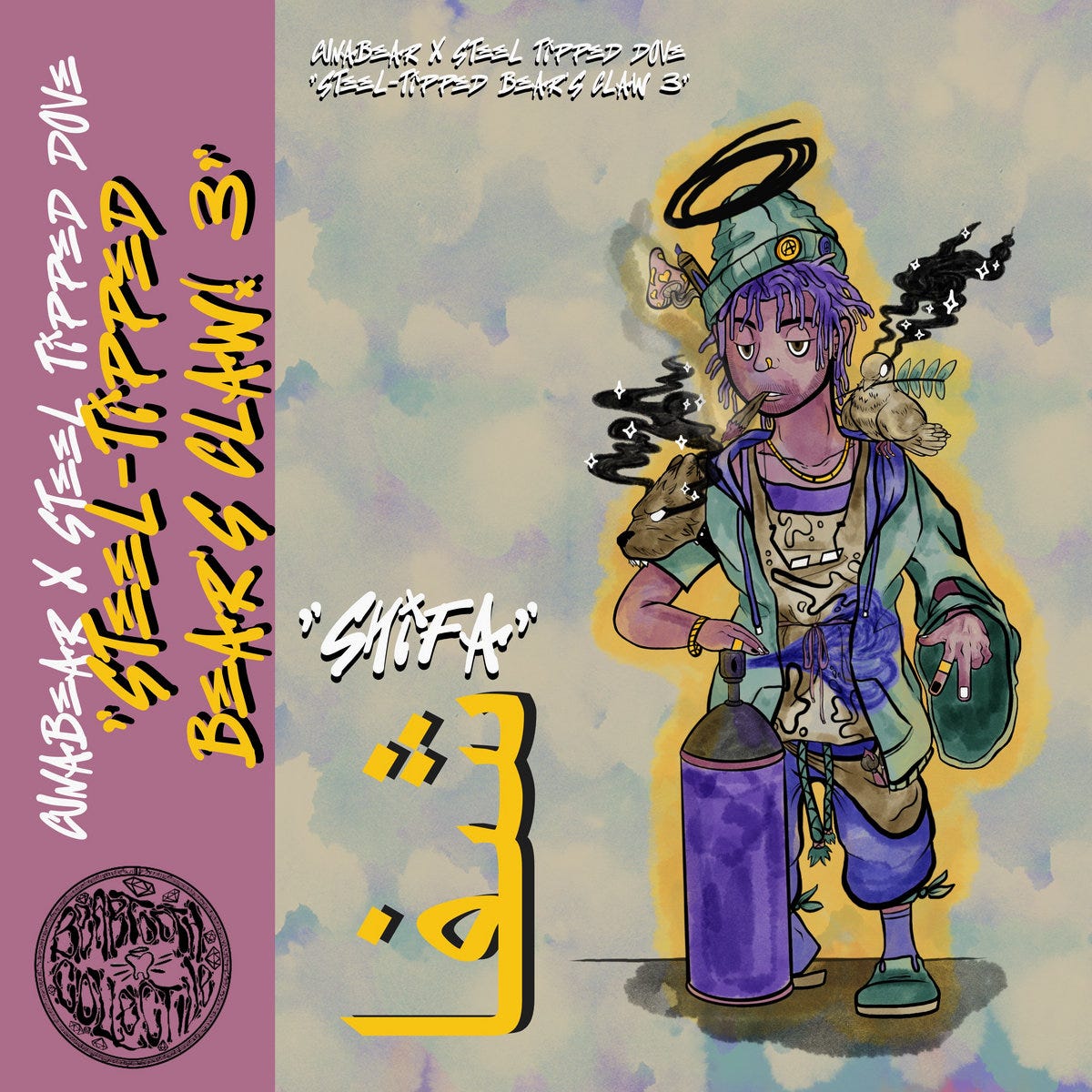
There is a rapper in Savannah, Georgia, originally from Richmond, Virginia, who runs a DIY record label and artwork collective called the BearTooth Collective. He draws bears and sells figurines. He screen-prints cassette tapes by hand and packages Magic: The Gathering cards with physical releases. He raps in a low, unhurried register, filling his bars with so many competing ideas that each one threatens to buckle under the weight of the next. His name is cunabear, and STBC! III: “Shifa” is his third collaborative record with Brooklyn producer Steel Tipped Dove. The title means healing in Arabic, and on Shifa healing looks like what it actually is when you’re broke and your family group chat used to be a war zone—pouring foundations, lifting walls, feeding people who aren’t your kids from the fridge because they showed up hungry.
Steel Tipped Dove, the Brooklyn producer Joseph Fusaro who has engineered or produced for billy woods, Armand Hammer, ShrapKnel, Fatboi Sharif, and most of the Backwoodz Studioz roster out of the same second-floor walk-up for over fifteen years, gives cunabear beds that breathe without rushing. The loops on “Grandma’s Hands Manifested a House for Me” hover at a midtempo sway, organ-flecked and slightly dusty, opening into a verse about crossbeams and concrete slabs and wingspans that open doors. The beat on “Nightosphere Bodega Blunts” drifts on what sounds like a detuned moog line humming beneath layers of soft percussion, and cunabear matches it by slowing his delivery until each syllable settles into the groove like a foot pressing into wet sand.
Dove’s contribution across the LP avoids the knotted, sample-dense maximalism of his billy woods collaborations. These instrumentals are warm and spacious, built from patient loops that repeat without growing stale, giving cunabear room to cram as many references and detours into a bar as he wants without the whole thing sounding cluttered. On “Jazz Is Freedom (You Think About That!),” a nimble, jazz-flecked instrumental bobs beneath cunabear’s most liberated performance, three full verses of freewheeling imagery, from growing mushrooms in knee-high Odd Future socks to the SS Take No Shit pulling out from Positivity Harbor.
cunabear’s lyrics populate a world where anime villains and Final Fantasy weapons share space with bodega runs and J-train commutes. On “Colossus (How to Build Community),” he finger-flicks One Punch Man out the storyboard, charges spirit bomb energy by touching thumbs, and asks a question that cuts through all the fantasy: “If punk never died, then where are all the radical lovers?” The nerd references aren’t decoration or personality signifiers. They function as the actual vocabulary of his thought. When he calls himself a “bear-shaped colossus” whose pions assemble “a moving prophet,” he’s using gaming language to describe community organizing, and it’s more precise than any plain-spoken version of that idea would be. On “Nightosphere Bodega Blunts,” he buys interstellar band-aids at the local mart, makes dinner for a kid who isn’t his, then sails off with the crew at the queen’s request, summoning a djinn and meeting yokai on a night ride back to Bushwick.
“Bear eat demon like pussy eats semen
So I fear not as I trudge along.”
The realm of darkness used to be his summer home but the dawn hasn’t left since he aligned with the light. On “Sardonyx-Coated Prayer Hands,” the mythology recedes and the communal impulse steps forward. cunabear smells like chai and sweaty subway piss, sings for no swans, opens a rift to love as an organic tendency, and asks, “Do you understand the violence it took to become this gentle?” He wants to tear borders down and build a communal throne.
“We ain’t fancy, but we got a free spirit. No living life is a paid experience.”
The line between the fantastical and the political keeps dissolving because cunabear treats both as the same errand.
Shifa opens and closes with New York City subway announcements—14th Street-Union Square and West Bergen on the way in, World Trade Center via C train on the way out. “The Last Train Home” turns that transit framing into Shifa‘s strangest and most affecting passage. cunabear boards a train with no stops, just a loop that rides until you arrive. The passengers tell him everyone only ever wants to stay. He says he needs to go. The song plays as a conversation between a man and a purgatory full of people who forgot what it felt like to belong somewhere. For a rapper who splits his life between Savannah and the Backwoodz orbit in Brooklyn, the idea of home as a destination you have to argue for, that other people don’t even recognize as a real place, feels specific enough to trust.
“BearTooth Collective Battle Cry No. 67” is cunabear at his most playful, rapping about breaking animals out of the Brooklyn Zoo, pricking demons with poison pins, and settling scores with pleasantries instead of fists.
“Too much love is a knockout punch.”
He means it literally—the BearTooth ethos flipped into fight-card language. “Mental Health Check” pairs its blunt hook with a verse about kickflipping the whole world to rearrange the tidepools and breaking knowledge off in tiny chunks like pomegranate guts, “the bonus to your health for tasting something that you love.”
But Shifa doesn’t ask for perfection, and cunabear would probably screen-print that sentiment onto a cassette label if he could. The album’s clearest triumph is “Jazz Is Freedom,” where he raps, “Some night terrors are forever and some wet dreams never last,” with the ease of someone who figured out that the dark and the light aren’t opponents.
“Pandora’s box disguised as a gift
Ain’t that some shit?”
He built the house, calmed the group chat, and showed up at the studio with enough to fill every minute. The music didn’t get bigger, but the man behind it did.
Great (★★★★☆)
Favorite Tracks: “Sardonyx-Coated Prayer Hands,” “Nightosphere Bodega Blunts,” “Jazz Is Freedom (You Think About That!)”
This review is a work of art in itself.
Thank you for the kind and positive review! I really appreciate the kind, well-written words and am glad the music resonated!
-cnbr